


Enhancing understanding amid difference, commonality
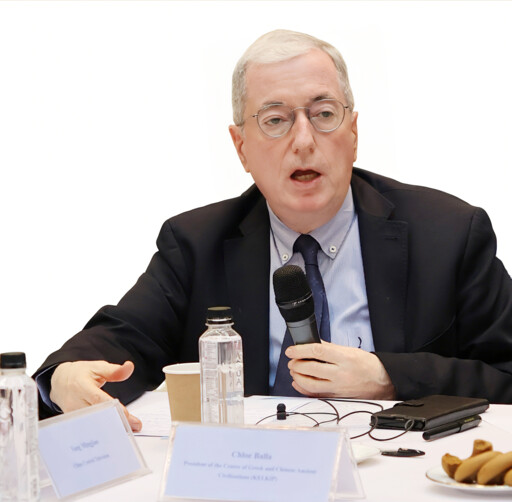
Stelios Virvidakis Photo: Lian Zhixian/CSST
As one of the foundational sources of Western civilization, Greece shares broad space for dialogue with China, a civilization shaped by a long and continuous historical tradition. As academic exchanges between the two countries deepen, scholars are finding new opportunities for comparative research and intellectual engagement. Focusing on the methodology and challenges of comparative philosophy, shifts in the global academic landscape, and the contemporary significance of mutual learning between Chinese and Greek civilizations, CSST interviewed Stelios Virvidakis, secretary general of the Center of Greek and Chinese Ancient Civilizations and a professor at the University of Athens.
Shared human experience makes cross-cultural understanding possible
CSST: In cross-cultural philosophical dialogue, differences in conceptual frameworks and modes of thinking often pose challenges. In this context, how can we better understand other cultures?
Virvidakis: I have long been interested in comparative philosophy. Can different cultures understand one another? Can they be compared? There are two extreme positions in the academic community. One emphasizes “incommensurability,” a somewhat pessimistic view holding that cultures cannot be translated at all, and will therefore never truly understand one another. The other stresses “commensurability,” suggesting that you can, in fact, do it very easily, without much to worry about. My own view lies somewhere between these two approaches.
When trying to understand another culture, to some extent, we inevitably begin from our own framework, and in that process, we often become aware of incommensurability. But you have to find ways to reinterpret or integrate ideas of the other culture into your own culture. To do comparative work well, one must go deeply into the other side’s conceptual frameworks and mental patterns.
There are clear differences between Chinese and Western philosophy. Western philosophy developed highly abstract concepts. Chinese philosophy is different in this respect. The terms Chinese thinkers were using and the questions they were asking were more closely connected to practical life and ethical relationships. Confucianism, for example, places emphasis on networks of roles and ritual structures. Such differences show that we should neither make easy analogies between traditions nor treat them as completely isolated from one another. Rather, we should search for paths of understanding within difference.
Language is crucial. Translation involves interpretation. For example, the Chinese Dao is often compared with the Greek logos, but we must remain highly cautious about such comparisons. We must ask whether we truly understand what these concepts mean.
This problem concerns not only parallels and differences synchronically, but also diachronically. So, it’s not only a question of whether the Greeks can understand the Chinese, but also whether modern Greeks can understand ancient Greeks, or modern Chinese can understand ancient Chinese.
When we translate Aristotle into a modern language, do we really understand what he meant? Do the words and concepts we choose accurately convey the original meaning? I suppose modern Chinese may find similar questions when reading ancient Chinese. Social structures have fundamentally changed, and our understanding of ancient concepts is challenged. This reminds us that, in order to comprehend these concepts, we must consider them within their historical context and reconstruct ancient social structures and ways of life as meticulously as possible.
At the same time, cross-cultural understanding is possible because human experience shares certain commonalities. We are born, we die, we suffer, we fall in love. We share experiences in life that we suspect are similar deep down, thereby gradually laying the foundations for mutual understanding.
More open, diverse global academic landscape
CSST: The global academic system has long been characterized by a center–periphery structure. In your view, is this changing?
Virvidakis: It was traditionally understood that there are some big centers in the academic world, shaped by language, publishing systems, and conditions of communication. Although Greece is foundational in the history of classical Western philosophy, it was for a time regarded as relatively peripheral in the Western philosophical world, and contemporary Greek philosophy and philosophers were not widely known. The Greek language itself is difficult, and was something of a barrier. What was written in Greece was not so influential or understood in Western countries.
But gradually, things have changed. Some Greek scholars based in Western countries such as France, Germany, the United Kingdom, and the United States became famous and influential abroad by writing in English, French, or German. In addition, thanks to new means of communication, Greek professors who live in Greece can also participate in global dialogue. Greek scholars now actively take part in international research projects, join global networks, and become more visible at international conferences, gradually moving from the periphery toward the center.
The cultures and intellectual traditions of countries such as China and India have strong indigenous characteristics. Nowadays, Western academia has become more sensitive and more aware of the need to open up and listen to ideas coming from the East. Resources from Confucianism, Daoism, Buddhism, and other traditions are offering new perspectives and inspiration for contemporary thought.
“Center” and “periphery” are not merely geographical concepts; they also relate to academic traditions and institutional structures. In the West, there is a lively debate in philosophy that questions this framework. Some believe that we are prisoners of this framework and we must break it. Some scholars hold that the Chinese thought has provided an opportunity to encounter alternative ways of thinking.
This change is also visible in specific academic practice. I’m very happy to see that courses on Eastern philosophy have increased in Western universities, and dialogue between Chinese and Western scholars has become more frequent.
Overall, the distinction between “center” and “periphery” is being relativized, becoming less clear and looser. What was once considered peripheral may come closer to the center, and what was center may also extend to the periphery and spread. The old academic landscape is being reshaped in a more open and plural direction, though this process still has further to go.
Expanding practical pathways for mutual learning among civilizations
CSST: It has been over a year since the establishment of the Chinese School of Classical Studies at Athens (CSCSA) by the Chinese Academy of Social Sciences. How would you view its achievements over the past year? What lessons does it offer for deepening Chinese-Greek civilizational dialogue and academic cooperation?
Virvidakis: I have been invited to some academic activities organized by the CSCSA. For example, I attended the launch of A New History of World War II, which gave me an opportunity to understand how contemporary Chinese historians approach this subject. I have read the book with care and believe that such a work deserves to be translated into Greek.
The other event was “The Dialogue on Exchanges and Mutual Learning Between Chinese and Greek Civilizations.” It involved comparisons of literature, literary traditions, myths, and poetry. That was very, very interesting.
As far as I know, the CSCSA is also promoting research and cooperation in archaeology. Given Greece’s rich archaeological resources, this is clearly a field with great potential.
From what I have seen, the CSCSA has already got impressive results in literature, philosophy, and history. More importantly, the fact that the CSCSA has achieved so much in just over a year since its establishment demonstrates the promising future of Chinese-Greek academic exchange and cooperation.
CSST: Looking ahead, where should Chinese–Greek dialogue focus? Beyond academic exchange, how can we deepen understanding and integration in areas such as popular culture, education, and everyday life?
Virvidakis: I have noticed that many Chinese universities have already introduced courses about ancient Greek, Greek history, and archaeology. I believe Chinese studies also have broad prospects in Greece. We aim to build Chinese studies programs in Greece. For Greek universities, beyond language teaching, it would be worthwhile to gradually establish a more systematic curriculum in Chinese studies, including Chinese history, literature, and philosophy. I am involved in a project for a philosophy textbook for high school and elementary school. I have selected some easy passages from Chinese philosophy so that Greek students may become familiar with this distant culture, which has some important similarities and affinities despite the differences from Greek culture.
I have noticed that some Chinese tourists are interested in Greek philosophy, which creates an opportunity for them to learn more about each other’s culture. Then we can build bonds of friendship at the personal level through travel and everyday contact, allowing dialogue to move from abstract ideas into concrete practice.
On this basis, we can continue to deepen mutual understanding, which will not only benefit the development of China-Greece relations but also set an example for the whole world by offering a valuable model of how civilizations may coexist—a path toward peaceful coexistence in a productive and creative way. In an age marked by uncertainty and conflict, that is especially precious.
From a longer-term perspective, China and Greece have some models that can be compared and even synthesized in a fruitful way. It is worth emphasizing that in both ancient Greece and ancient China, philosophy was not only abstract thinking, but also a practical wisdom concerned with how to live—guiding people in the pursuit of a good and fulfilling life.
Editor:Yu Hui
Copyright©2023 CSSN All Rights Reserved