


Common memories in ‘chaos’: Exploring Chinese and Greek creation myths
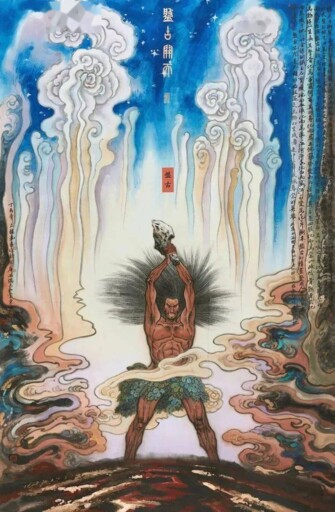
FILE PHOTO: A drawing depicting the Chinese myth of Pangu splitting heaven and earth, painted by modern artist Feng Yuan
Although Chinese and Greek creation myths emerged from vastly different cultural contexts, they share a surprisingly similar starting point: a world born out of chaos, an undivided state of heaven and earth, and the common motif of humans fashioned from clay or dust. While Chinese and Greek scholars have long studied their respective indigenous myths, direct comparative studies between the two traditions have been relatively rare. Yet these cross-cultural commonalities make it possible to compare the narrative structures and cosmologies of these myths. Such comparisons not only deepen our understanding of how ancient peoples imagined the origins of the world and life, but also offer a distinctive perspective for cross-cultural dialogue today.
Beginning of the world: chaos, order, and cosmic structure
Both Pangu separating heaven and earth in Chinese mythology and the Earth Goddess Gaia emerging from chaos in ancient Greek mythology reflect “chaos” as the starting point of the world, a motif found across global mythological traditions. Xu Jianxin, a research fellow at the Institute of World History of the Chinese Academy of Social Sciences, told CSST that this cross-regional similarity reflects how ancient peoples understood the origins of the world. In an era of extremely low productivity and limited historical memory, people found it difficult to trace back through remote time and space, and instead relied on their most immediate bodily experiences and perceptions to imagine the “beginning.” Faced with the unknown, the invisible, and the indistinguishable, people naturally envisioned an unformed and undifferentiated state of chaos. Here, “chaos” is not an abstract philosophical concept, but rather a fundamental conception of the origin of the universe, formed collectively under the constraints of early cognitive and narrative capacities.
Echoing this view, Ioannis M. Konstantakos, a professor of ancient Greek literature and culture at the Faculty of Philology at the National and Kapodistrian University of Athens, observed that most mythical cosmogonies begin with a state of chaos, out of which creation emerges through a conscious act of divine will. This pattern, he suggested, appears to be an archetype of human thought, rooted in a collective imagination that contrasts the ordered world we know with a preceding state of disorder and formlessness. The idea of primeval chaos arises from this bipolar way of thinking, though it takes different forms across ancient cultures. In Greek mythology, for instance, chaos is literally emptiness or void, later filled by material forms. Mesopotamian cosmology, by contrast, imagines a primary formless substance—such as water or an endless ocean—covering the universe before the creation of the earth and other beings. Thus, while formlessness and disorder are common elements, cultures differ on whether the primeval state is void and nothingness or a kind of formless raw material.
He also noted that some cosmogonies do not begin with chaos, but with a symmetrical and orderly primeval being—such as the cosmic egg found in Orphic and Hindu mythology—which more closely resembles the modern Big Bang concept of creation from a single point of immense concentration.
Birth of humans: body, flesh, and origins of civilization
From Pangu transforming into all things and Nyuwa molding humans from clay, to Prometheus shaping humanity from earth in Greek mythology, different civilizations have sought to answer the same fundamental question: Where did humans come from? In ancient times, when productivity was extremely low and scientific knowledge limited, people relied on their most immediate bodily experiences to understand the origins of life. Xu noted that early humans generally believed in animism—the body was seen as the vessel of life, yet also as possessing the potential to generate new life. Thus, the notion of Pangu transforming into all things emerged from humanity’s most primitive understanding of its own flesh.
As civilizations developed within their respective geographical environments and social practices, their conceptions of human origins became infused with increasing cultural elements. In Greek mythology, from the Earth Goddess Gaia giving birth to the sky, the sea, and the gods through parthenogenesis, to the complex genealogies of deities that structure the cosmic order, the process by which human societies projected their own social structures onto narratives of cosmic creation becomes evident. Xu argued that at least three mechanisms shape myths in their formative process: First, natural phenomena are personified into deities with defined functions through the abstraction and systematization of scattered nature worship. Second, important life experiences are sanctified, such as elevating the use of fire into myths of a fire god. Third, mythical figures are symbolized, enabling them to serve as symbolic sources of culture and social institutions. Examples include Nyuwa mending the heavens and Cangjie inventing Chinese characters—myths that grant cultural activities and cosmic order a foundation that transcends the secular realm.
Konstantakos observed that in most ancient cosmogonies, the human race is fashioned from pre-existing material substances, often humble ones. In Greek myth, humans are made from clay, as they are in Mesopotamian and Israelite traditions. In Egyptian mythology, humans are created from the tears of the god Nut. This use of modest substances, he argued, reflects a pessimistic worldview shaped by the difficult conditions of human existence in largely hostile environments—a perspective widely shared across the ancient Mediterranean and Near East. Such myths suggest that ancient cultures generally viewed human existence as contingent, fragile, and dependent on powers greater than themselves.
Significance of comparing creation myths
From a modern perspective, the value of myths does not depend on whether their narratives are “true” in a factual sense. As American sociologist Robert Bellah noted, the significance of myth lies not in telling historically verifiable stories, but in providing individuals and societies with spiritual and moral direction. In other words, modern societies continue to tell and reinvent myths because these narratives reinforce order, construct meaning, and sustain shared frameworks for understanding the world. Within this framework, the contemporary relevance of comparing creation myths becomes clear.
In Konstantakos’ view, although creation narratives sometimes appear to echo social structures, myths are generally not direct projections of social systems. He cited traditions from Mesopotamia, Greece, Israel, and Egypt to show that similar social forms can produce entirely different creation narratives, and that highly centralized or relatively open societies do not necessarily generate the same cosmic picture. These complexities suggest that creation myths more deeply reflect people’s interpretations of their natural environment, life experiences, and the cosmic order.
Accordingly, he argued that, like other aspects of comparative cultural studies, comparative mythology can help foster understanding among different peoples and cultures. Myth and cosmology form essential components of a society’s worldview, and studying them offers insight into how different cultures perceive and experience the world.
Xu likewise emphasized that, in the context of contemporary global civilizational dialogue, comparing creation myths holds both academic and practical value. Comparison itself, he noted, is a core method of historical research. Through comparison, scholars can identify differences among civilizations while also gaining insight into their deeper structural characteristics.
In large-scale civilizational comparison, each civilization can be viewed as an independent entity, he noted. The process of comparison, he added, essentially observes the position of these entities within the entire sequence of human civilizations. This approach, he said, helps address two key questions: how the overall structure of world civilizations operates, and how different civilizations influence one another.
Comparative research, Xu continued, reveals differences and structural patterns and can even offer a basis for assessing trends in civilizational development. Over thousands of years, Chinese and Western creation myths have developed distinct narrative logics and modes of thought. Comparing them, he argued, allows us to better understand the distinctive characteristics of the two civilizations and the worldviews that shape them.
Such research, Xu emphasized, not only deepens cross-cultural understanding but also opens new perspectives for complementarity, dialogue, and mutual learning among civilizations. It enables us, he concluded, to recognize differences while gaining a clearer understanding of how diverse cultures coexist within the same world system.
Editor:Yu Hui
Copyright©2023 CSSN All Rights Reserved