


Remembering Habermas: An unfinished conversation
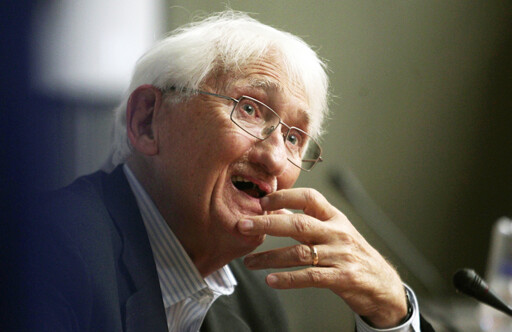
Renowned German philosopher Jürgen Habermas, a leading figure of the Frankfurt School’s second generation, passed away at the age of 96. Photo: IC PHOTO
On March 14, renowned German philosopher Jürgen Habermas passed away at the age of 96, marking the end of an intellectual epoch. As a leading figure of the Frankfurt School’s second generation, Habermas leaves behind a monumental theoretical corpus spanning philosophy, sociology, law, and political science. His core concepts—among them the “public sphere,” “communicative rationality,” and “the unfinished project of modernity”—have profoundly shaped the humanities and social sciences since the latter half of the 20th century.
To better understand Habermas’s critique of modernity and its contemporary relevance, CSST recently spoke with Tong Shijun, a professor of philosophy at East China Normal University and the chancellor of Shanghai New York University, who translated the 2003 Chinese edition of Between Facts and Norms: Contributions to a Discourse Theory of Law and Democracy and is one of the few Chinese scholars to have corresponded and spoken directly with Habermas. This firsthand retrospective highlights the essence of Habermas’s thought and the charge he quietly laid on Chinese scholars: to plumb the depths of their own cultural traditions and uncover intellectual resources for equal dialogue among civilizations.
Vindicating critique of modernity
CSST: Looking back across Habermas’s intellectual trajectory, how would you assess his theoretical path? How much explanatory power does his thought still hold for understanding our world today?
Tong: Habermas’s central endeavor is best characterized as a vindicating critique of modernity. It operates on two interrelated fronts.
On one front, Habermas carried forward the Marxist critique of capitalist modernity. In The Theory of Communicative Action, he identified a problematic tendency in modern development: money and power, which should function merely as means, gradually encroach upon the “lifeworld.” Economic and bureaucratic systems employ rules, money, and power to coercively organize daily life, thereby undermining the values of meaning, identity, and solidarity that can only be generated within the “lifeworld.”
Seen through this lens, Habermas reinterpreted the trajectory of Western society from the 17th to the 20th century. In his view, social progress consists largely in containing, through democratic participation and deliberation, the excessive expansion of the capitalist economy and bureaucratic administration. The damage these two systems inflict upon the values of the “lifeworld” constitutes the first strand of Habermas’s critique of modernity.
On the other front, Habermas remained equally alert to the wholesale rejection of modernity, which would entail abandoning democracy, the rule of law, industrialization, and the market. In The Philosophical Discourse of Modernity, he engaged with postmodernist thinkers such as Derrida and Foucault, whose work draws on Nietzsche and Heidegger, and critiqued their postmodernist (or post-structuralist) inclinations as equally in need of caution. This stance reflected the intellectual context in which Habermas worked. While he advanced numerous critiques of modernity, he also endeavored to engage in dialogue with anti-modernist currents as post-structuralism and postmodernism gained prominence. Accordingly, grasping this dialectical orientation is essential to understanding Habermas.
From these two fronts emerges the core concept of “communicative rationality,” which Habermas systematically elaborated in The Theory of Communicative Action. In his view, traditional conceptions of reason are one-sided: reason tends to be centered on the individual subject, measuring rationalization by the efficiency of the subject’s control over the object, thereby reducing reason to instrumental rationality. In response, Habermas argued that rationalism can be genuinely defended only by subjecting it to critique, just as modernity is critiqued in order to defend it. The key lies in “communicative rationality,” which seeks to overcome and supersede isolated “subjectivity” through “intersubjectivity.”
Habermas’s concept of “communicative rationality” is closely connected with that of the “public sphere.” In his seminal work The Structural Transformation of the Public Sphere, he examined in detail the historical evolution of this concept. The public sphere derives its significance from being a space where individuals gather to exchange information, discuss issues, and advance arguments. This has strong resonances with the Chinese notion of “handling issues through consultation” and with the consultative dimension of “whole-process people’s democracy.” If democracy is understood solely as an election-centered process, or if elections are taken as its defining feature, only one dimension of democracy is emphasized while others are overlooked. To address this, Habermas drew on German philosophy since Kant to stress the cognitive dimension of “autonomy” as central to democracy, rather than its volitional dimension alone. As Chinese philosopher Feng Qi put it, the Western cultural tradition places relatively greater emphasis on the “voluntary principle” of the will, while the Chinese cultural tradition stresses the “conscious principle” of reason. Only a conception of “responsible autonomy” that integrates these two principles is suited to serve as democracy’s core idea.
‘Haoxue’ as basis of dialogue
CSST: From your account, Habermas appears to have paid close attention to Chinese cultural traditions and scholarship. Could you elaborate on how he viewed Chinese scholars’ engagement with his work over the past decades, as well as Chinese philosophy’s efforts to participate in global dialogue?
Tong: I cannot say with certainty how deeply Habermas followed contemporary Chinese scholarship, but he was clearly attempting to integrate his understanding of modern Chinese realities with an appreciation of China’s millennia-old cultural traditions. This effort was still in its early stages when he passed away. What is evident from his work is his affirmation of the Confucian tradition, within which learning, knowledge, and education hold considerable importance.
In my view, Habermas was equally concerned with cross-civilizational comparison, particularly given the present need for dialogue among civilizations. Yet such dialogue must overcome many difficulties: How do secular and religious discourses communicate? How do different faiths converse? As Confucius observed, “People who differ in their principles do not work together.” Yet without mutual engagement and understanding, civilizations can hardly coexist in harmony.
Habermas’s proposal is that communication across civilizations depends, above all, on a willingness to learn—whether on the part of an individual, a culture, or a people. This accords with Confucius’s emphasis on “haoxue”—the eagerness to learn—in The Analects. Only when people’s eagerness to learn is combined with other virtues, such as benevolence, wisdom, trustworthiness, straightforwardness, courage, and firmness, can one avoid their potential deviations. The same holds true for a culture or a nation.
Habermas’s emphasis on haoxue thus forms a notable point of resonance with the Confucian cultural tradition.
Unfinished intellectual relay
CSST: How do you view the future reception and influence of Habermas’s theory, both globally and here in China?
Tong: Interest in Habermas is global. The Suhrkamp Verlag volume Habermas global: Wirkungsgeschichte eines Werks, with contributions from scholars in multiple countries is one indication of this. Yet the chapter on Habermas and China was commissioned from an Australian Sinologist, not a Chinese scholar. The views therein are open to debate, a fact that prompts reflection on whether Chinese academia’s engagement in international Habermas studies might be made more substantial and sustained.
Habermas himself considered how his ideas might engage the Chinese context and thereby advance theoretical development. He hoped Asian scholars would subject their own traditions to the same thorough, systematic examination he had attempted with the European one.
Some Asian scholars have criticized Habermas as Eurocentric, arguing he remains confined within that framework—a charge he found somewhat frustrating. He responded that he was, after all, a European most familiar with European culture; expecting equal familiarity with all world cultures was unrealistic. He preferred that Asian scholars undertake systematic, in-depth studies of their own traditions, excavating resources for dialogue and comparison with Europe. In this sense, Habermas returned to non-European scholars the task of developing their own traditions and strengthening their academic foundations as a means of moving beyond Eurocentrism. This also implies a collective, global endeavor requiring the participation of all.
CSST: Habermas’s philosophical thought is notably interdisciplinary. This raises further questions: How can philosophy and the social sciences truly achieve cross-disciplinary integration and establish an effective path?
Tong: For contemporary Chinese scholars, Habermas’s work offers two principal insights. First, one must have a strong problem awareness grounded in present practice. Second, in addressing a problem, every claim must be fully argued. Argumentation requires reasons, which may not be confined to familiar disciplines; one may not know at first where they lie. But if the problem is sufficiently important and the researcher’s awareness clear, paths toward a solution will naturally emerge. Precisely because every claim requires argumentative support, this internal requirement drives one to continually acquire knowledge and resources from various disciplines. In this way, an interdisciplinary path takes shape as a matter of course.
Editor:Yu Hui
Copyright©2026 CSSN All Rights Reserved