


Rural CEOs emerge as new force connecting urban, rural areas
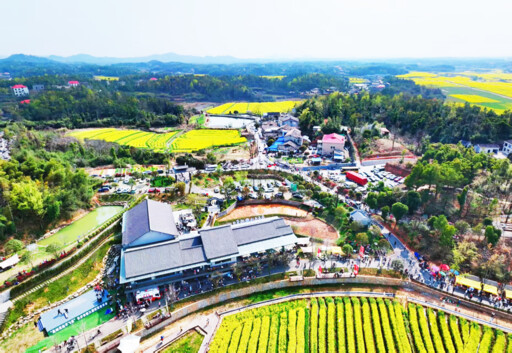
A view of the rapeseed flower field in Chating Town of Wangcheng District, Changsha City, Hunan Province Photo: PROVIDED TO CSST
Emerging in recent years through practical experimentation, rural CEOs—also known as rural professional managers—represent a new type of talent in rural business operations, chiefly responsible for managing and operating rural industries. In Changsha City, central China’s Hunan Province, 26 rural CEOs have been introduced in two batches through institutional innovation since 2024, with appointments made at the municipal and district levels. Guided by government initiatives, some townships and villages in the region have also actively recruited rural CEOs based on their own development needs.
This research found that most of these rural CEOs are under 45, have accumulated years of operational and managerial experience as well as extensive social networks from working in cities, and are adept at using digital media. By revitalizing dormant resources through new business models, forging fresh links among diverse stakeholders, and creating new value that reshapes rural identity, they are quietly transforming the way urban and rural areas connect.
Revitalizing dormant resources
In Lantangsi Village in Wangcheng District, Changsha, rural CEO Mr. Yang revitalized 30 idle rural houses by leasing them out and brought in a professional management company to help operate them. He also organized numerous events, including the “Lighthouse Garden Party.” On the night of the Mid-Autumn Festival in 2024, the village square was transformed into a marketplace and the ridges between fields became footpaths. Over 60,000 visitors poured into this small village, engaging in a deep dialogue with the countryside through moonrise ceremonies, intangible cultural heritage markets, and Hanfu garden tours. After just one year of operation, the village collective’s operating income had risen by 70%, more than 10 million yuan (approximately $1.47 million) of social capital had been leveraged, and villagers’ total income had increased by over 2 million yuan.
In Chenjiaqiao Village, Ningxiang, rural CEO Ms. Meng adopted a different approach to invigorating traditional agriculture. Faced with a glut of unsold yellow peaches, she introduced a creative “peach tree adoption” model, allowing consumers to adopt a tree for 188 yuan, with 500 trees taken up in the first year. The idea not only pushed the price of yellow peaches up from 6 yuan to 10–15 yuan per jin (500 grams), but also turned buyers into repeat customers. Events such as a rapeseed flower festival and study-tour camping projects followed, quietly extending the industrial chain of traditional farming through creative operations.
Chudong Village in Daweishan Town, Liuyang—also under the administration of Changsha and located on the border between Hunan and Jiangxi Province—is tucked away amid striking natural scenery. Here, rural CEO Mr. Liu keenly sensed a shift in consumption patterns: Urban dwellers were no longer satisfied with cursory sightseeing, but longed to immerse themselves in rural life. Seizing the opportunity, he capitalized on “Bed and Breakfasts” and rural tourism as anchors to drive a new model of localized consumption—encouraging visitors to stay longer while “sending” local agricultural products outward with them when they leave.
Fostering synergy for development
When rural CEOs take up posts in a village, their role involves far more than simply adapting as individuals. They operate at the intersection of market efficiency, community rationality, and administrative logic. They must both “engage upward with the government” and “communicate downward with villagers,” seeking the greatest common ground amid competing pressures.
In the Heimi Mountain area of Wangcheng District, rural CEO Mr. Deng found a way forward by bringing his urban networks into rural investment. More importantly, by delivering tangible visitor flows and real income gains, he turned villagers from bystanders into participants and village cadres from hesitant observers into partners.
If Mr. Deng’s approach centered on aligning people, then Mr. Tu, rural CEO of the Flower Sea Scenic Area at Chating Town in Wangcheng District, tackled the challenge of balancing interests and constraints. Rural operations must not only generate revenue for the collective economy, but also ensure safety and stability. In planning projects, Mr. Tu relied on professional expertise and careful design to address market concerns about expected returns while also easing township officials’ worries over event safety.
From individual exploration to vision of the era
From pioneering efforts in the east to successive innovations in central China, the practice of rural CEOs is spreading rapidly across the country. The 15th Five-Year Plan explicitly identifies “encouraging various talents to serve, start businesses, and find employment in rural areas” as a key task in promoting the two-way flow of urban and rural factors and invigorating agricultural and rural development. According to projections by a research team at the Rural Development Institute of the Chinese Academy of Social Sciences, nationwide demand for rural CEOs exceeds 300,000. Youth returning to the countryside is shifting from isolated experimentation to a widespread need.
Practice in Changsha shows that the value released by these “urban-rural connectors,” represented by rural CEOs, depends heavily on systematic institutional support. The research found that young people entering rural areas still face bottlenecks such as fragmented policies, ambiguous roles and responsibilities, and constraints related to land and finance. These issues urgently require institutional solutions and coordinated efforts in three dimensions.
First, the service system should be improved by shifting from scattered policy measures to integrated empowerment. Multiple departments should jointly develop a “youth rural-entry service package” and promote a “first-inquiry responsibility system,” so that policies move from paper into practice with precision.
Second, collaborative governance should be strengthened by replacing ambiguous boundaries with clear rules. A regular decision-making and coordination mechanism should be established, and a management model combining a negative list with a filing system should be explored, so that young people can operate with clarity in their roles.
Third, factor guarantees should be reinforced by transforming bottlenecks into sources of vitality. This will require deepening the standardized management and revitalization of idle rural homesteads, guiding financial institutions to develop credit products aligned to the cycles of rural entrepreneurship, and channeling the “living water” of finance more precisely into the fields.
Wang Yu is an associate research fellow from the Rural Development Institute at the Chinese Academy of Social Sciences.
Editor:Yu Hui
Copyright©2023 CSSN All Rights Reserved