


Rise of minimalist internet slang erodes expressive depth
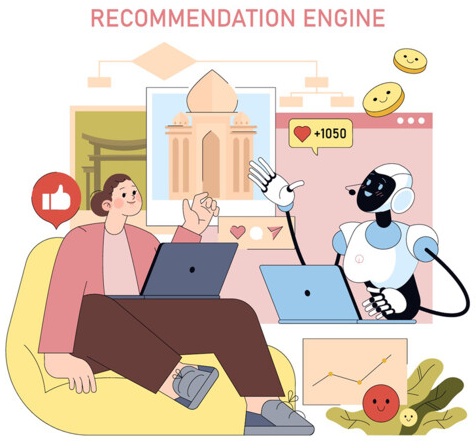
Algorithmic recommendation mechanisms bring homogenized content and exacerbate verbal aphasia. Photo: TUCHONG
“The scenery here is absolutely hang!” “This drama is totally la!” In contemporary Chinese internet slang, hang—literally “ram” or “tamp”—is used to describe something extraordinarily good, while la—literally “pull” or “drag”—marks something as utterly terrible. This minimalist vocabulary of online commentary is rapidly seeping into everyday expression.
From films, television dramas, and cuisine to natural landscapes and social events, almost everything can now be placed within the framework of hang and la. While this highly adaptable internet lexicon appears to make communication more efficient, it also quietly blurs distinctions among different objects of judgment and erodes the nuance and individuality of expression.
Several scholars recently interviewed by CSST said that when rich experiences are compressed into a single viral term—leaving detailed perception, emotional description, and logical expression consistently absent—the generalization of internet slang may produce a form of “verbal aphasia” and, in turn, a broader crisis in public expression.
Generalization of internet slang weakens expressive ability
To a certain extent, the popularity of internet terms such as hang and la, as well as expressions formed by abbreviating Pinyin initials, reflects a kind of verbal aphasia in the internet age. Liang Xinyuan, a young scholar at the new dictionary editorial office of the Institute of Linguistics at the Chinese Academy of Social Sciences, said this phenomenon is primarily manifested in lexical poverty, homogenized expression, fragmented sentence structures, and logical confusion when individuals attempt complex emotional expression, formal writing, or sustained logical argumentation.
Liang explained that this phenomenon stems from three major features of online communication. First, the fragmentation and rapid pace of online information continue to encourage linguistic simplification, with large numbers of unconventional expressions crowding out traditional normative expressions. Second, the logic of online traffic has produced a proliferation of exaggerated, vague, and emotionally charged expressions that are efficient and highly resonant, but weaken semantic precision and emotional nuance. Third, internet language increasingly occupies individuals’ linguistic reserves; lacking normative structure, cumulative depth, and cultural carrying capacity, it ultimately leaves people at a loss when rigorous, complex, and formal or written expressions are required.
Cao Jin, a professor from the College of Foreign Languages and Literature at Northwest Normal University, said verbal aphasia is, in essence, an inertia of expression fostered by fragmented communication. Combined with the degradation of language ability caused by prolonged shallow use, this inertia manifests as homogenized expression, insufficient logical depth, weakened cultural and linguistic sensitivity, and the formation of subcultural language barriers. Moreover, the phenomenon is rapidly spreading into more contexts and infiltrating younger demographics. Driven by short videos, instant messaging, and algorithmic content feeds, many are increasingly unwilling to expend the effort needed to organize language or refine expression. Over time, this develops into an expressive inertia marked by being “too lazy to speak, unable to speak, and poor at speaking.” Long-term, repetitive use of homogenized internet language gradually weakens the brain’s language-processing system, eventually producing a tangible decline in expressive ability.
Liang added that verbal aphasia is showing two new tendencies: the generalization of contexts and the lowering of the age of those affected. Internet slang has long since moved beyond social media platforms and has infiltrated classroom essays, public speeches, formal publications, and even academic articles, undermining the normative standards of written language. Meanwhile, adolescents in compulsory education are at a critical stage in the formation of language habits. Prolonged exposure to highly minimalist internet language can easily result in a limited vocabulary and weak writing ability, and may even erode the foundations of native-language literacy.
Double-edged sword of ‘meme culture’
The rise of internet language is, in essence, a natural evolution of language as it adapts to digital communication. Online expressions originate in community-based meme creation and circulation, meeting the needs of online social interaction for immediacy, lightness, and emotional resonance. By using minimalist symbols to convey emotional intensity that traditional language may struggle to communicate quickly, these expressions rapidly break out of their original circles and enter wider public use. Liang explained that the term “meme” derives from British evolutionary biologist Richard Dawkins’ The Selfish Gene, where it refers to units of cultural information capable of replication and transmission. In the internet context, it broadly refers to cultural elements—such as phrases, images, and videos—that can be continuously adapted and rapidly disseminated. The concept is similar to gen, or comedic trope, in xiangsheng, traditional Chinese crosstalk. Later, in online communication, it was colloquially written as geng, meaning joke, and became widely popular.
Zhu Xiuling, a professor from the School of Journalism and Communication at Guangdong University of Foreign Studies, argued that meme culture gives language powerful creativity and empathic force, making it an efficient tool for young people in the digital age to establish identity and forge emotional connections. To some extent, it enriches the rhetorical repertoire of language, but its hidden risks are equally significant. When memes become the default mode of expression, homogenized expressive styles diminish the depth of language, and people gradually lose the ability to use precise, nuanced native language to describe complex feelings. In the pursuit of virality, meaning is easily simplified, generalized, or even distorted, as expressive precision gives way to communicative efficiency.
Cao said meme culture exerts a dual effect on language development: It activates linguistic vitality while challenging linguistic order. In essence, this is a dynamic adjustment as language adapts to the context of online communication. On the positive side, internet memes enrich expression through devices such as homophones and abbreviations—simplifying communication while enhancing emotional intensity—meeting the demands of real-time online interaction. Their high transmissibility accelerates linguistic diffusion, accurately conveys social emotions, builds group identity, and expands the functional boundaries of language. On the negative side, some memes violate linguistic norms, leading to fragmented and superficial expression and creating barriers to communication. Community-based dissemination intensifies linguistic divergence, fostering group alienation. Vulgar memes pollute the linguistic ecosystem. Moreover, the rapid turnover of memes leaves little room for sedimentation, easily leading to homogenized expression, while long-term reliance on them weakens the ability to organize language.
Loss of linguistic precision widens social communication divide
Algorithmic recommendation mechanisms further exacerbate verbal aphasia, creating a closed loop of “homogenized content feeding—habitual reliance—degradation of linguistic ability.” Cao said algorithms tend to promote shallow, easily transmissible, and emotionally rewarding linguistic content, while deeper expressions rich in cultural substance and logical rigor are marginalized because of their lower communicative efficiency. Users who remain immersed for long periods in this homogenized linguistic environment may find their thinking flattened, making it difficult to engage in abstract reasoning, logical organization, and deep expression. Ultimately, they become trapped in a “linguistic cocoon.”
Linguistic precision forms the foundation for shared understanding in social communication, and bears directly on the warmth of expression and the quality of interpersonal connection. Some scholars suggested that verbal aphasia—triggered by the impact of internet language—results in the loss of linguistic precision and thereby intensifies problems in social communication. Cao believes that the erosion of linguistic precision widens the social communication gap according to the process of “vague expression—misunderstanding—breakdown of consensus,” and that this gap continues to expand along three axes: generation, social circle, and context, ultimately lowering both the efficiency and quality of social communication.
In Zhu’s view, when one segment of the population still possesses nuanced expressive ability while another can only summarize everything through viral internet catchphrases, the cognitive cost of mutual understanding rises sharply. “This fragmentation exists not only between generations but has also spread into public discourse: Serious issues are replaced by emotional labels, complex problems are simplified into antagonistic slogans, and social consensus becomes increasingly difficult to achieve.” Zhu warned that if this continues, society may face a predicament of “communication without genuine dialogue,” and “emotion without shared understanding.”
Rebuilding expressive ability in language
In an era marked by algorithm-driven homogenized content feeds, the delegation of expression to AI tools, and the comprehensive penetration of internet language into everyday life, how can people break free from verbal aphasia and rebuild their capacity for expression?
Cao suggested a reading approach that combines classical and contemporary works. For example, intensive reading of classic texts can help readers accumulate precise vocabulary and refined sentence structures, while fostering appreciation for the logic and aesthetic beauty of their native language. Quality cultural programs can also awaken sensitivity to expression and teach forms of communication that are normative yet vivid. At the same time, positive and popular memes can be adapted and integrated, encouraging a synthesis of internet language and standard expression that is both contemporary and correct.
Liang suggested that rebuilding expressive ability in daily life can proceed in three directions. First, communicative contexts must be distinguished. People should choose their words according to the setting, using complete sentences and precise logic in formal or written situations. Second, they should commit to high-quality reading. By reading classics and other excellent works, individuals can expand their vocabulary, sharpen their linguistic sensitivity, and develop habits of deep reading. Third, role modeling and guidance should be strengthened. Schools, media organizations, and digital platforms should lead by example—especially in basic education, where stronger reading, writing, and expressive practice can directly improve students’ ability to communicate precisely and think critically.
Editor:Yu Hui
Copyright©2023 CSSN All Rights Reserved