


Citizen social science challenges traditional knowledge production paradigm
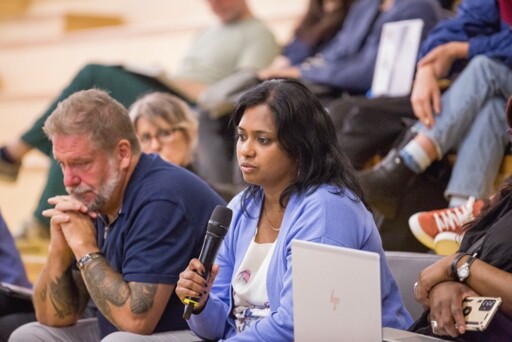
At the major “State of the Legacy” conference in 2022, citizen social scientists speak about the long-term impacts of the 2012 Olympic Games alongside established academics, policymakers, and local politicians. Photo: PROVIDED TO CSST
In East London, where the former Olympic Park still stands, the excitement of the 2012 London Olympics has faded, leaving behind a real-world question about the “future:” Who truly benefits from the prosperity promised by large-scale urban regeneration? While conventional evaluation systems focus on GDP growth, rising property value, and infrastructure investment, a spirit of exploration and inquiry has quietly taken root within the community. A team of local residents, acting as “citizen social scientists,” has worked for several years with the Citizen Science Academy at the University College London (UCL) in the United Kingdom to draw a markedly different “map of prosperity.” The “East London prosperity model” and corresponding “prosperity index” they have created shift the focus away from cold economic data, placing stable livelihoods, healthy neighborhood environments, and a strong sense of community belonging at the heart of how development is measured.
This project, titled “Prosperity in East London 2021–2031,” offers a vivid example of citizen social science methodology in practice. This decade-long, longitudinal study of 4,000 households is quietly reshaping the narrative around urban development, challenging not merely a set of indicators, but also the traditional paradigm of knowledge production. As Joseph Cook and Saffron Woodcraft—the two central figures in the citizen social science initiative at UCL—noted in a recent interview with CSST, citizen social science is “less of a methodology, and more of a framework for how qualitative research can be carried out. It represents a fundamental shift in the philosophy of knowledge production.”
From objects of study to research co-designers
In traditional social science research, communities and citizens are often treated as sources of data—observed, interviewed, and analyzed. Even participatory approaches such as “citizen science” have often followed a crowdsourcing model, benefiting from citizen involvement to gather data on a scale previously impossible, while leaving it less clear whether citizens benefit from the collaboration as much as professional researchers do. Citizen social science seeks to fundamentally reverse this dynamic.
Cook and Woodcraft told CSST that citizen social science moves beyond studying communities as passive subjects and instead actively engages them as collaborative partners in the research process. “By involving members of the public in not just data collection but the design of the project itself we can tackle the underlying issues society faces, including complex socio-economic challenges.”
This kind of “co-design” from the outset ensures that the production of knowledge is not only academically rigorous, but also deeply relevant to and closely connected with the public. It does so by addressing a fundamental contradiction: When professional researchers define what the “problem” is, they often presuppose a certain path toward a solution, potentially overlooking the real underlying issues. To planners, for example, “prosperity” might mean the number of new residential units and commercial spaces built; for residents, it may mean affordable rent, safe public spaces, and access to education for their children.
Such collaboration gives rise to distinctive research methods. In East London, residents who have personally experienced “post-Olympic” development and change not only completed standardized household surveys, but also received training in social science research methods, gradually becoming “local researchers.” They led “walking interviews,” engaging neighbors in conversation on familiar streets and alleyways to capture emotions and memories that written questionnaires cannot reach. They also used smartphones to document how public spaces are used and employed oral history methods to collect community stories that might otherwise be lost amid ongoing change.
These approaches ensure that “research captures the voices of those who may (perhaps with good reason) distrust professional researchers,” Cook and Woodcraft emphasized. Here, the roles of academic researchers and the public are redefined, with the goal aligning directly with the top rungs of the “Ladder of Citizen Participation” proposed by American scholar Sherry Arnstein—moving from “non-participation” and “tokenism” at the lower rungs toward genuine “citizen power” and “partnership” at the top.
Building bridge amid dispute on credibility
The knowledge produced by citizen social science often lies at the intersection of academic knowledge and local wisdom. As it seeks to influence policy, this positioning inevitably exposes it to questions of credibility and authority. Is the data sufficiently objective? Is the sample representative? Can residents’ emotions and demands serve as a legitimate basis for policymaking?
Cook and Woodcraft responded by reframing these questions. “Whilst an often-cited challenge of citizen science is that of the validity of the data it produces, and the credibility of its recommendations to ‘experts,’ we like to view this situation as a two-way challenge,” they said. “In the UK, and in many countries globally, there has been an observed decrease in levels to which the public trusts ‘experts’ and the data they create. From their Members of Parliament to family doctors, academics, or the police, the distance between professional ‘experts’ and the public has grown in recent decades. The credibility issue is therefore one acting in both directions.”
In Cook and Woodcraft’s view, citizen social science helps bridge the gap between those traditionally seen as experts and local people whose lived experience constitutes a form of expertise, but who often feel separated from—and increasingly different from—expert communities. “While academics bring theoretical knowledge and analytical skills, residents hold the intricate and tacit knowledge of their own environment. By bringing together varied forms of expertise we can create a different kind of knowledge—collaborative social science—and build credibility for all parties involved,” the duo said.
To establish credibility and authority, the UCL Citizen Science Academy uses a methodology that integrates the public’s lived experience with academic rigor, introducing a Citizen Science Certificate which validates that residents have been recruited and trained in robust research methodologies.
“This process ensures that the research is not merely anecdotal but is based on a rich tapestry of qualitative and quantitative data that is both academically rigorous and grounded in reality,” Cook and Woodcraft remarked.
When residents become proficient in tools such as semi-structured interviews, participatory observation, and basic data analysis, the information they gather evolves from scattered “opinions” into structured “evidence.”
More importantly, the knowledge generated through this methodology has a unique persuasive power in policy contexts. When East London residents engage with policymakers, presenting a “prosperity index” built on hundreds of in-depth interviews, mapping exercises, and focus group discussions, they are not offering abstract academic theories, but actionable proposals grounded in lived experience.
This evidence, drawn directly from the firsthand experiences of affected communities, carries undeniable weight. It uncovers inequalities hidden behind averages and points to the real pressure points where investment should be prioritized. “By involving citizens directly, we ensure that policy interventions are targeted at the most pressing issues identified by the community, which leads to more efficient and effective governance,” Cook and Woodcraft said.
Combining universal framework and local wisdom
While citizen social science is rooted in the contexts of specific communities and localities, its framework offers important insights for addressing global challenges. Climate change, social inequality, sustainable urban development—each of these grand issues ultimately manifests in the realities of specific communities and in everyday life. The methodology and core concerns of the East London study on “post-Olympic” community development—how to define and achieve inclusive prosperity—resonate powerfully with countless cities around the world undergoing rapid urban regeneration or large-scale event-driven development.
From Cook and Woodcraft’s perspective, the citizen social science paradigm offers a proven framework for generating innovative, people-centered solutions to global challenges that work in a local context. “Whilst a social issue may be global in nature, the solutions may not be universal, with what works in one country being very different to another. Even in a more local context what works in one part of the city, or with one community, may not work for another.”
The global value of this framework therefore lies in its philosophy of process: It emphasizes the need to empower local residents, enabling them to lead research into their own circumstances and identify solutions that are genuinely applicable. As Cook and Woodcraft explained: “Whilst a statistic may demonstrate the vastness of a problem or opportunity, it is only in understanding the local context that we can develop workable solutions with the support of local citizens.” This bottom-up, context-specific approach to knowledge production thus serves as both a vital complement and a necessary corrective to the many decontextualized, top-down policy solutions currently imposed on a global scale.
Ultimately, the methodology of citizen social science points toward a more democratic, inclusive, and robust future for knowledge production. It is not content with merely turning the public into “suppliers” of data. Instead, it strives to elevate them to the status of “co-creators” across the entire process—from defining problems and designing methods to producing knowledge and applying its outcomes.
Editor:Yu Hui
Copyright©2023 CSSN All Rights Reserved