


Modernizing Chinese painting: Traditionalism, reformism, eclecticism
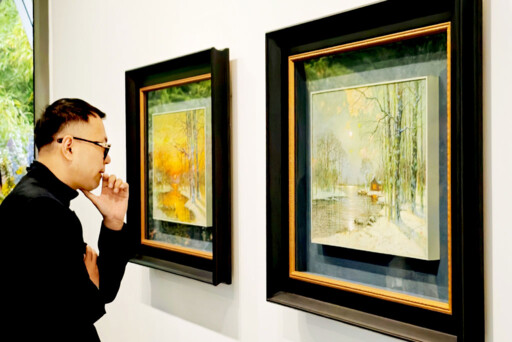
A visitor takes in works on display at an exhibition of 20th-century modern Chinese painting, featuring Reformist masters such as Xu Beihong and Liu Haisu, at the Cotton-D Contemporary Art Center in Nanjing, Jiangsu Province, on March 18, 2026. Photo: IC PHOTO
Over thousands of years of historical inheritance and cultural accumulation, traditional Chinese painting has developed into a distinctive artistic system and become an important vehicle of Chinese civilization. Since the 20th century, as Western thought and artistic practices gained influence in China, traditional Chinese painting has faced unprecedented challenges, prompting progressive intellectuals to reexamine it from a cultural perspective.
Amidst the collision between Eastern and Western art, and between tradition and modernity, Chinese painting circles gradually formed three major schools: the Traditionalist School, the Reformist School, and the Eclectic School, which advocated the integration of Chinese and Western art. These three schools did not exist in isolation, nor were they mutually exclusive. Rather, they developed dynamically through mutual penetration and accommodation. They reflected the different cultural positions and value orientations of various artists, demonstrated the multiple paths opened during the modern transformation of Chinese painting, and together constitute the pluralistic landscape of that transformation.
Traditionalist School: Persistence of guardians
Traditionalist painters are often associated with the guocui pai, or the school devoted to the quintessence of Chinese culture. Composed mainly of traditional literati-painters, they possessed a deep command of traditional Chinese calligraphy and painting techniques, held an optimistic view of the future of traditional Chinese painting, and acted as faithful stewards of traditional culture.
Under the impact and influence of new progressive ideas, Traditionalist painters advocated deeper exploration and reinterpretation of tradition. Following the principle of “revitalizing tradition by returning to antiquity,” they emphasized the equal importance of learning from the ancients and learning from nature, thereby safeguarding the autonomy and national character of Chinese painting while opposing the transformation of Chinese painting through realism.
Traditionalist painters sought to return to the original essence of Chinese painting. They responded to the transformations of the age by creatively reinterpreting the literati painting tradition, advocating the absorption of foreign artistic elements while preserving the essential characteristics of Chinese painting. They emphasized the core value of brush and ink, believing that the essence of Chinese painting lay in its unique, expressive use of line and the aesthetic vitality of ink and brushwork. In terms of subject matter, they continued to work within traditional categories such as landscapes, flowers and birds, and within the “Four Gentlemen” of the literati tradition: plums, orchids, bamboo, and chrysanthemums.
The Traditionalist School was often criticized as conservative. Yet because traditional calligraphy and painting enjoyed a broad audience and were cherished by cultural elites across different fields, they still occupied a dominant position in the art world as forms of high art. Most painters within the Traditionalist School maintained an open attitude toward Western art and advocated moderate reforms to Chinese painting. Wu Changshuo, for example, revered the traditional “epigraphic flavor” and skillfully integrated the brushwork of epigraphic calligraphy into his paintings, enhancing the calligraphic quality of Chinese painting. At the same time, he was also among the first painters to use Western red—a foreign red pigment—in Chinese painting, thereby introducing certain material reforms into the tradition.
The cultural significance of the Traditionalist School’s self-preservation lies in its emphasis on the internal logic of artistic development rather than on external influence alone. To a certain extent, the Traditionalist School helped preserve the independent aesthetic character of Chinese painting. In the midst of globalization, maintaining cultural self-awareness and holding fast to tradition represent a form of cultural confidence.
Reformist School: Innovation by pioneers
The earliest calls to reform traditional Chinese painting came from intellectuals who saw artistic revolution as part of a broader program of social reform, and as an extension of the literary revolution’s core arguments. Kang Youwei proposed a theory of Chinese painting reform that sought to weaken the xieyi tradition—freehand brushwork in traditional Chinese painting, characterized by vivid expression and bold outlines—of literati painting and to break the stagnant, self-enclosed impasse of traditional Chinese painting. Chen Duxiu and Lyu Cheng, in their discourse on art revolution, directly targeted the orthodox painting school led by the “Four Wangs”—Wang Shimin, Wang Jian, Wang Hui, and Wang Yuanqi—of the Qing Dynasty (1644–1911). Artists who returned from study abroad, such as Xu Beihong, Liu Haisu, and Yan Wenliang, actively promoted reforms in art education. They combined the Western teaching method of sketching from nature with traditional Chinese linmo, or copying from model paintings, establishing a teaching model grounded in Western painting and thereby broadening the space for the development of Chinese painting.
The Reformist School advocated comprehensive study of Western painting techniques, stressing that the innovation of Chinese painting should be based on scientific observation and realistic representation, while also emphasizing the connection between art and social reality. Seeking to break through traditional frameworks and adapt Chinese painting to modern aesthetic needs, Reformist painters introduced figures from real life and historical events into their choice of subject matter.
In terms of creative method, they adopted thematic composition, employed techniques such as linear perspective and chiaroscuro (the treatment of light and shade), integrated oil painting techniques, and in some cases turned directly to oil painting. Within the educational context of the time, Reformist painters helped address the shortage of art teachers, assumed important responsibilities in introducing and teaching Western art in China, and transformed traditional models of art education. They also actively introduced and explained Western painting genres and techniques, presented Western painters and their theories to the Chinese public, provided theoretical foundations for the reform of Chinese painting, and further enhanced the social value and practical function of art. Their artistic practices created channels for the application of Western painting techniques within traditional Chinese painting and provided support for improving its techniques.
The practices of Reformist painters were mainly reflected in three areas. First, they systematically introduced realistic techniques, transforming the formal concepts of traditional painting. Second, they reformed the art education system and established a teaching model based on Western painting. Third, they redefined the function of art, emphasizing its role in driving social change. The Reformist School thus shifted Chinese painting away from traditional literati elegance toward a focus on, and representation of, real life.
The Reformist School made its historical contribution by breaking open the closed system of traditional painting and injecting new expressive power and intellectual dimensions into Chinese art. As the Chinese public became increasingly familiar with the aesthetic approaches of Western art, Chinese painters gradually adjusted their own aesthetic tastes and educational methods, strengthened the formal and representational capacities of painting, and advanced the modern transformation of Chinese art.
Eclectic School: Grafting by mediators
The Eclectic School emerged from painters who sought to mediate between Chinese and Western artistic traditions, positioning themselves between the Traditionalist and Reformist schools. They argued that the modern transformation of Chinese painting could preserve cultural subjectivity while absorbing the essence of foreign art—neither embracing complete Westernization nor rigidly adhering to tradition. This approach avoided a stark either/or opposition and reflected a more open cultural mentality. Some painters combined Western composition with Chinese brush and ink in form; others integrated Eastern and Western aesthetic concepts in spiritual content; still others conducted experiments across materials and techniques.
The Eclectic School preserved much of the essence and charm of Chinese painting while moderately integrating Western painting techniques and carrying forward the brush-and-ink characteristics of traditional Chinese painting. Some returned overseas art students, to varying degrees, combined the strengths of Chinese and Western art to innovate Chinese painting, with particular emphasis on enhancing the formal and representational capacities of Chinese painting. In doing so, they also promoted, to some extent, the diversification of materials used in Chinese painting. Lin Fengmian, for example, focused on the complementary relationship between Chinese and Western painting. Taking the harmonization of Chinese and Western art as his guiding artistic principle, he sought common ground and balance between the two in order to reform Chinese painting.
Eclectic painters brought traditional and modern subject matter into dialogue. Departing from the poetic imagery pursued by traditional literati painting, they began incorporating new objects that reflected the face of the age—such as tanks, airplanes, and telephone poles—into their works. These painters boldly applied Western painting techniques, using fewer lines and more ink washes. Their paintings were vivid and lifelike, with a strong sense of perspective and three-dimensionality, thereby achieving a refinement of traditional Chinese painting.
These three approaches to the modern transformation of Chinese painting took shape amid the sweeping sociocultural changes of modern China. The national crisis following the Opium Wars prompted Chinese intellectuals to reflect on the value of traditional culture. The New Culture Movement’s advocacy of science and democracy provided an intellectual foundation for the dissemination of Western art. At the same time, a growing sense of national consciousness led artists to ask how Chinese painting could preserve its artistic subjectivity amid the encounter between Chinese and Western cultures. In this historical context, the coexistence and interaction of tradition, reform, and fusion reflected the dilemmas of cultural choice faced by Chinese society in the process of modernization.
Whether by deliberate choice or in response to the pressures of the age, Chinese painters introduced varying degrees of innovation and refinement into traditional Chinese painting, propelling its evolution from tradition to modernity. The interactive tension among these three schools continues to influence contemporary ink painting practices. Each approach had its historical inevitability, and each made a unique contribution to the modern transformation of Chinese painting.
Tao Xiaojun is a tenured professor at the USC-SJTU Institute of Cultural and Creative Industry under Shanghai Jiao Tong University. Wang Hanwei is a distinguished professor from the School of Humanities at Tongji University.
Editor:Yu Hui
Copyright©2023 CSSN All Rights Reserved