


Interdisciplinary research should be oriented toward reality, not disciplines
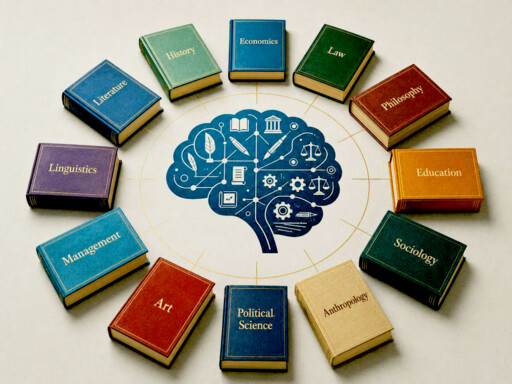
The current advocacy of interdisciplinary research in the humanities and social sciences is an inevitable requirement of socioeconomic development. Image generated by AI
As the development of the “New Liberal Arts” continues to advance in China, a broad consensus has emerged that the humanities and social sciences should embrace interdisciplinary research. In recent years, a large number of interdisciplinary studies have attracted widespread scholarly attention and sparked in-depth discussion. Yet despite the growing momentum behind interdisciplinary research in the humanities and social sciences, the development of emerging and cross-disciplinary fields has fallen short of expectations, and representative achievements that genuinely transcend disciplinary boundaries remain rare.
Several factors have contributed to this phenomenon, including researchers’ cognitive frameworks, prevailing modes of knowledge production, and academic evaluation systems. Due to intellectual inertia and path dependence, researchers tend to treat disciplinary boundaries as the natural divisions of knowledge, taking the concepts and norms of their own disciplines as authoritative standards.
At the same time, contemporary knowledge production is largely carried out by small specialized communities within individual disciplines, operating through the institutional structures of university departments or research institutes. These communities also hold the power to evaluate scholarly work and allocate academic resources, inevitably subjecting research questions, collaborative partnerships, and forms of output to established disciplinary paradigms. Since the institutional system “rewards skilled repetition,” researchers are naturally more inclined to examine questions recognized by peers within their own disciplines, without necessarily considering whether their studies correspond to real-world concerns.
It must be acknowledged that, to some extent, conducting knowledge production within small specialized communities has its rationale. Specialized communities constitute the core components of the modern disciplinary system and essentially represent the social division of intellectual labor. This division of labor has established more definite growth models, error-correction mechanisms, and evaluation systems. It is precisely such specialized disciplinary systems that have accompanied humanity through the steam revolution, the electrical revolution, the information revolution, and the intelligent revolution in less than three centuries.
The problem, however, is that the rationale for disciplinary division does not mean that such division is unconditionally valid. The current advocacy of interdisciplinary research in the humanities and social sciences is an inevitable requirement of socioeconomic development. Research objects originate in the real world, not within disciplines.
With the rapid advancement of science and technology, socioeconomic development is becoming increasingly complex. Compared with the past, knowledge production is now driven more by practical contexts in everyday life than by conceptual exposition and theoretical deduction within the framework of a single discipline. Today, many research issues—such as algorithmic governance, data ethics, public health, population aging, and the international order—do not belong exclusively to any individual discipline. Rather, they are composite issues shaped by the interweaving of multiple dimensions, including science and technology, cultural psychology, legal institutions, history and geography, economics, and military affairs. Approaching these issues from the standpoint of a single discipline, as in the past, can offer only a partial and limited understanding.
Meanwhile, under the impact of generative artificial intelligence, traditional research paradigms in the humanities and social sciences are facing major challenges. The strengths of traditional disciplines of liberal arts—including literature, history, philosophy, economics, law, education, management, and the arts—have primarily resided in the reading, memorization, organization, paraphrasing, translation, and interpretation of disciplinary texts. Yet generative AI excels precisely at this kind of high-density textual labor: It can process larger volumes of textual data and extract information with greater precision. Traditional training for the humanities and social sciences, along with the scholarly competencies on which it relies, is visibly “depreciating” into procedural capabilities that can be outsourced.
Encouragingly, advances in AI technologies have also created unprecedented opportunities for interdisciplinary research in the humanities and social sciences. Through new technologies such as natural language processing, texts that were previously scattered across disciplines and difficult to connect can now be effectively linked, and even synthesized into new research objects. Methods such as semantic modeling, automated coding, and cross-modal analysis have considerably reduced the informational and organizational costs of interdisciplinary and cross-domain collaboration. This does not mean that the application of new technologies is itself synonymous with interdisciplinarity. Likewise, technological empowerment is not equivalent to interdisciplinary research. Nevertheless, these technologies undeniably make multidisciplinary collaboration significantly more convenient.
Against this backdrop, the humanities and social sciences should engage in serious self-reflection. Certain disciplines in the natural sciences may exhibit highly specialized and relatively closed characteristics, but the humanities and social sciences are inherently closer to the complex human world. Mathematics has highly specialized questions, and physics has relatively well-defined ones, yet almost no significant question in the humanities and social sciences is confined to a single discipline. The issue of self-identity, for example, may appear at first glance to be a philosophical question. Upon deeper inquiry, however, it also proves to be a psychological, sociological, legal, and neuroscientific question. For the most part, research objects in the humanities and social sciences are continually generated and transformed throughout historical development. These fields are therefore interdisciplinary by nature.
Interdisciplinarity is a fundamental attitude. Only by breaking through disciplinary barriers can academic inquiry move closer to the real world. The world is first and foremost an indivisible whole; only later is it divided into different objects through human cognition. These objects are then classified into different categories, giving rise to distinct disciplines. Any concept or term merely expresses distinctions within the world as a whole, rather than the world’s true form. Therefore, treating a particular theory or disciplinary boundary as a fixed truth will lead to what Francis Bacon described as “Idols of the Theatre.” Interdisciplinary research should be oriented toward the real world, not merely toward disciplines.
Su Dechao is a professor from the School of Philosophy at Wuhan University.
Editor:Yu Hui
Copyright©2023 CSSN All Rights Reserved