


Media dialogue builds bridges between Chinese and Greek civilizations
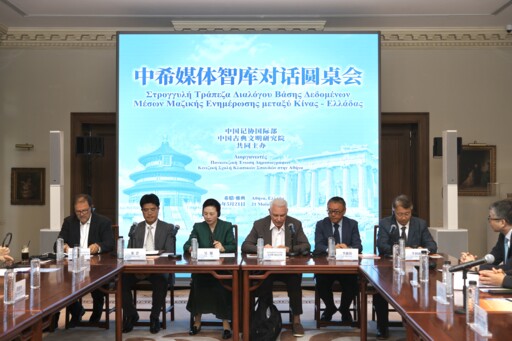
The China-Greece Media and Think Tank Roundtable was held at the Chinese School of Classical Studies at Athens on May 21. Photo: Lian Zhixian/CSST
On May 21, the China-Greece Media and Think Tank Roundtable was held at the Chinese School of Classical Studies at Athens (CSCSA), bringing together representatives from the Chinese Embassy in Greece, the All-China Journalists Association (ACJA), CSCSA, Piraeus Port Authority S.A. (PPA S.A.), Chinese institutions and media outlets, as well as Greek news organizations and Chinese-language media in Greece, including the Journalists’ Union of Athens Daily Newspapers (JUADN), the Periodical and Electronic Press Union (PEPU), the Athens-Macedonian News Agency (AMNA), ERT News, and the China-Greece Times.
Jointly organized by the International Department of the ACJA and CSCSA, the event centered on the theme of drawing on the civilizational depth of China and Greece, shouldering media responsibility in the digital age, and promoting mutual learning and shared prosperity among Chinese and Western civilizations.
Advancing civilizational dialogue
Zhang Gang, minister-counselor of the Chinese Embassy in Greece, said China and Greece are both world-renowned ancient civilizations whose achievements in philosophy, literature, art, and social governance have made outstanding contributions to human progress. In recent years, he noted, the China-Greece comprehensive strategic partnership has continued to deepen, with political mutual trust further strengthened and practical cooperation yielding fruitful results. Belt and Road Initiative cooperation, represented by the Piraeus Port project, has brought tangible benefits to the Greek people and become a model of China-Europe practical cooperation.
Amid profound changes in the international landscape and the rapid development of AI and digital media, Zhang observed, channels of communication have become more open, but new problems have also emerged, including fragmented information, divided perceptions, and the spread of false news. Media organizations and think tanks, he said, have a special mission: to uphold professional ethics, remain committed to civilizational exchange, convey constructive voices, bridge differences, and promote equality, mutual learning, and understanding among civilizations.
Georgios Gavalas, senior vice-president of JUADN, said the union has a history of more than a century and has long been committed to advancing journalism, culture, and education. Greece and China, he said, are ancient civilizations with deep historical traditions, and their intellectual legacies share many similarities in their approaches to justice, the rule of law, social ethics, and the value of the human being. Philosophy, he added, is an important language of cultural diplomacy, while the media has a responsibility to convey truth, foster civilizational dialogue, and deepen friendship between Greece and China.
Li Xinwei, director of CSCSA, told the media that the school, first announced at the inaugural World Conference of Classics in Beijing in November 2024, is intended to serve as a new platform for exchanges and mutual learning between China, Greece, and other civilizations. Archaeological fieldwork and research are among its major areas of work, and its first archaeological project has now been launched at the Angelokastro site in Greece. The school will also promote research in classical studies, visiting scholar programs, and exchanges among young scholars. Although CSCSA is an academic institution, it attaches great importance to communicating research results to the wider public and hopes to maintain close contact with Chinese and Greek media, encouraging more Greek outlets to learn about Chinese archaeology, Chinese civilization, and China's practices in cultural heritage protection, Li said.
Wu Xu, member of the Party Leadership Group and secretary of the Secretariat of the ACJA, noted that this year marks the 20th anniversary of the China-Greece comprehensive strategic partnership, while next year will mark the 55th anniversary of the establishment of diplomatic relations between the two countries. In Wu’s view, journalists should play a greater role in promoting civilizational mutual learning and cultural exchange, serving as chroniclers of their era and bridges between cultures.
Wu called for using civilizational dialogue as a bond to explore the deep heritage of Chinese and Greek civilizations. Media organizations and think tanks have a responsibility, she argued, to turn ancient civilizations into stories that contemporary audiences can understand. She also emphasized truth as the bottom line of a healthy information ecosystem, urging journalists to be guardians of facts—never allowing algorithms to determine bias, or speed to outweigh accuracy. Cooperation, she added, is the path toward telling vivid stories of China-Greece friendship, while exchanges, training programs, and joint reporting can help cultivate the next generation of journalists and sustain civilizational dialogue.
Upholding media responsibility
Many participants at the roundtable noted that as AI rapidly reshapes the production and spread of news, the responsibilities of the media have become even more significant.
Evangelo Sipsas, a reporter with CGTN, said Greece and China are building the future together. Today, he said, societies are being shaped by algorithms, digital platforms, and information that flows across continents and countries within seconds. This creates great opportunities, but also great risks, as AI can generate images and videos, imitate voices, and even reproduce the way people move. “In today’s world, journalists are not only simple reporters of events; we are defenders of credibility and translators of cultures.”
Alexia Kosina, a journalist from Bankingnews.gr, explained that the true strength of a nation lies in the quality of its thought, education, and consciousness, and cannot be measured only by economic indicators or technological achievements. At a time when information is produced and consumed at extraordinary speed, journalism should place greater emphasis on credibility, knowledge, responsibility, and the centrality of the human being.
In such an environment, Kosina said, civilizational heritage grounded in thousands of years of culture is not decoration, but a method and an antidote to the post-truth era. If algorithms decide what people see, journalism has the responsibility to remind the world that there are deeper things to be seen, she added.
Turning to ways of strengthening China-Greece media cooperation, Stavros Monemvasiotis, a financial journalist with Alpha TV, suggested establishing exchange programs that would allow Chinese and Greek journalists to enter each other’s media environment for reporting and collaboration. He also proposed a joint fact-checking mechanism—based on shared professional standards and transparent methods—to respond to disinformation, an annual China-Greece journalism award to encourage accurate reporting that presents the other civilization and promotes mutual understanding, and stronger links between media organizations in the two countries, so they can tell the historical and contemporary stories connecting China with Greece and Europe.
Seeing real China
Several Greek media representatives at the roundtable agreed that direct exchanges and first-hand observation are essential to breaking down stereotypes and deepening mutual understanding.
Notis Ananiadis, a journalist with Portnet.gr, recalled joining a delegation visit focused on Greek-Chinese journalistic cooperation, during which he traveled to several Chinese cities. He later wrote about the experience in his book Letters from China. The discipline of recording what he saw and felt each day during the visit, Ananiadis said, helped him better understand that journalists should serve as bridges between peoples and civilizations.
Aikaterini Tsimblaki, a journalist with AMNA, said her visits to Nantong, Jingdezhen, Guangzhou, and other Chinese cities gave her a vivid sense of China’s diversity in economic vitality, natural landscapes, and cultural heritage. She also saw how China has combined development experience, cultural traditions, and modern technology, showcasing achievements in infrastructure, industry, and the modernization of technological systems. Such experiences, she said, encourage people from other countries to learn more about China’s practice of high-quality development.
Markos Kantzios, a journalist with maritimes.gr, said he began formal cooperation with Chinese colleagues as early as 2011. During a visit to Qingdao in 2014, he came to appreciate the important role played by Greece, and Piraeus in particular, in cooperation related to the Maritime Silk Road. In October 2025, he traveled to China again for a conference. Walking along the streets of Guizhou, he was impressed by the warmth and hospitality of local people. What struck him most, he said, was that even in a mountainous inland region far from the sea, ordinary people knew Greece and felt a natural closeness to it, leaving him with a feeling akin to “meeting an old friend again.”
Writing new chapter of cooperation
Themistoklis Beredimas, president of PEPU, said the media should resist deepening confrontation and hostility between peoples and cultures, and instead use its influence to draw communities closer together. Journalism, he said, should show differences while also highlighting the common ground that connects people.
Beredimas called for networks of knowledge, culture, and experience, as well as journalistic practices that build mutual trust and respect among cultures. True understanding, he said, is built not only on political and economic agreements, but also on human contact, with journalists serving as important messengers in that process. He urged colleagues to use the power of journalism to foster trust and cooperation, making responsible media an important foundation for peace, cultural cooperation, friendship between the two peoples, and a better future for the world.
Piraeus Port and maritime cooperation were also prominent topics at the roundtable. Yao Yaping, director of the editorial department of China COSCO Shipping News, said the Piraeus Port project goes beyond commercial cooperation, serving also as a vivid carrier of exchange between two great civilizations and two cultures. Through key cooperation projects such as Piraeus Port, Greece has continued to deepen its economic and trade links with China while injecting momentum directly into connectivity and trade flows across Eurasia. Chinese and Greek media, she said, can continue to tell human-centered stories of how the port has grown with the city, and how local communities and industries have benefited from that shared development.
Ananiadis added that throughout history, shipping has been an important way for Greece to spread knowledge and engage with the outside world. Maritime trade remains essential to Greece today, he said, adding that China’s strengths in shipbuilding can be combined with Greece’s long-standing advantages in shipping and
Editor:Yu Hui
Copyright©2026 CSSN All Rights Reserved