


Poetic wisdom in Chinese classics holds contemporary relevance
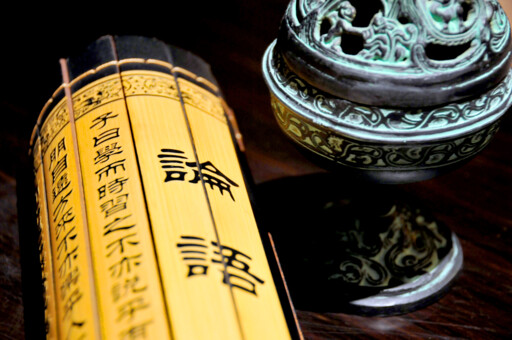
The Analects epitomizes the poetic wisdom of Chinese classical learning. Photo: TUCHONG
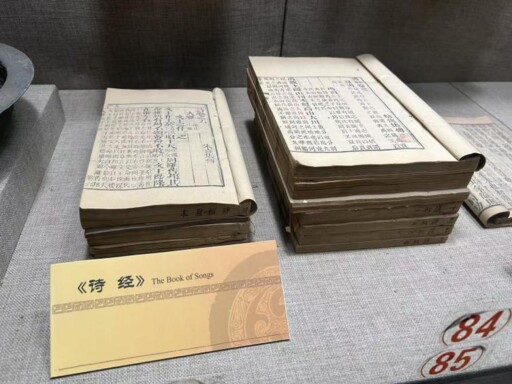
The Book of Songs, displayed at the Imperial College in Beijing Photo: Yang Lanlan/CSST
Unlike Western classical studies, which centers primarily on ancient Greek and Roman civilizations, Chinese classical studies is distinguished by the poetic wisdom of Chinese civilization—a tradition rooted in life contemplation, imagistic expression, embodied perception, and the preservation of cultural lineage. This intellectual heritage fully embodies the Chinese nation’s enduring pursuit of a poetic spirit.
As renowned modern Chinese poet Wen Yiduo observed, “Poetry seems never to have played so great a social role in any other country as it has here. From its very birth, poetry has served religion, politics, education, and social interaction; it is life itself in its totality.” This poetic mode of thought, spiritual aspiration, and value orientation has shaped the intellectual principles and developmental trajectory of Chinese classical studies.
In today’s world, amid multifaceted uncertainties and latent crises, Chinese classical studies—integrating practical reason with affective experience—offers profound insight and spiritual nourishment. Engaging with these classical texts holds significant potential for addressing global challenges and advancing human progress.
Xiang: Intellectual core
The intellectual core of poetic wisdom lies in symbolism, analogy, and intuition. It emphasizes a holistic understanding in which Heaven and humanity are one, and the self exists in communion with all things. Rather than confining itself to logical deduction, this mode of thinking gives priority to the perceptual resonance between the mind and the surrounding world. From this resonance arises the creation of Xiang, literally meaning “image.”
The Book of Changes, also known as I Ching, encapsulates this poetic mode of thought as “observing phenomena to grasp images,” describing it thus: “Anciently, when Baoxi [Fuxi] had come to the rule of all under Heaven, looking up, he contemplated the brilliant forms exhibited in the sky, and looking down he surveyed the patterns shown on the earth. He contemplated the ornamental appearances of birds and beasts and the (different) suitabilities of the soil. Near at hand, in his own person, he found things for consideration, and the same at a distance, in things in general. On this he devised the eight trigrams, to show fully the attributes of the spirit-like and intelligent (operations working secretly), and to classify the qualities of the myriads of things.”
Rooted in this dialectic of observation, Chinese classical studies contemplates nature through the lens of life itself, distilling from the virtues of the divine and the dispositions of all things the principles of Heaven, Earth, and humanity, and thereby assuming the mandate of the Dao. Ancient Chinese thinkers adopted the discursive mode of “establishing images to fully express meaning,” maintaining an enduring intimacy with, and reverence for, nature.
In The Analects, Confucius asked, “Does Heaven speak? The four seasons pursue their courses, and all things are continually being produced, but does Heaven say anything?” In Mengzi, Mencius declared that the sage’s virtue “flows abroad, above and beneath, like that of Heaven and Earth.” In the Luxuriant Dew of the Spring and Autumn Annals, Dong Zhongshu asserted, “By analogy, Heaven and humanity are one,” while Wang Yangming stated in the Great Learning, “Benevolent people regard Heaven, Earth, and the myriad things as one Substance.”
The ceaseless transformation of Heaven and Earth and the flow of human life remain in constant unity. This makes it possible to observe virtue through images and to classify emotions through imagery, forming the distinctive epistemological path of Chinese classical studies.
In The Book of Songs, the line “The peach tree is young and elegant; brilliant are its flowers” celebrates the beauty of marriage; “When we set out, the willows were fresh and green” gives voice to the sorrow of parting; the “luxuriance of the fir and the cypress” signifies eternal life; and “through the wind and rain all looks dark” maps the contours of existential adversity.
These “images”—embodying symbols, emotions, and meanings—serve not only as vessels for the poet’s affective response to the world, but also as media through which philosophers intuit Heavenly principles. Integrating Heaven and humanity, beauty and goodness, ethics and art, the image functions not merely as a distinctive literary device, but as a spiritual realm that unifies both the cosmos and existence itself. Each image is akin to a dewdrop crystallized from the collision between the mind and the external world, reflecting Chinese sensibilities toward the rhythms of life, the pulses of nature, and the moral order. From the hexagrams of The Book of Changes to the evocative imagery of The Book of Songs, from Zhuangzi’s allegorical images to the paradoxical imagery of Chan Buddhism, the image bridges language and meaning, opening a gateway from the finite to the infinite.
Wu: Spiritual pursuit
The spiritual pursuit of poetic wisdom breaks through the constraints of logic and conceptualization, opening a direct path to the true self. This pursuit does not depend on rigorous deduction; instead, it emphasizes resonance between the mind and the external world, seeking to apprehend the holistic meaning of the cosmos and human existence through contemplation and meditation.
Wu, literally meaning “awakening” or “enlightenment,” represents the ultimate objective of this poetic quest. Such awakening is an internal perception of the self—a synthesis of cognition, emotion, and practice, a lucidity regarding the essence of things, a reconciliation with obsessive attachments, and a wisdom capable of guiding action.
In The Analects, Confucius’s declaration, “At fifty, I knew the decrees of Heaven,” exemplifies the Confucian insight into life’s journey. In the Tao Te Ching, Laozi’s tenet, “Having arrived at this point of non-action, there is nothing which he does not do,” reflects the Daoist comprehension of praxis. Wang Wei’s assertion that “true awakening needs no excessive words” in A Secret Guide to Landscape Painting points to the aesthetic intuition rooted in artistic sensibility. Chan Buddhism goes further still, directly pointing to the human mind to facilitate sudden awakening, the realization of one’s Buddha-nature, and the elevation of mental illumination above all else.
Wu represents the supreme embodiment of the spiritual pursuit embedded in poetic wisdom. It is not merely the accumulation of knowledge, but an elevation of one’s very state of being—a flash of the mind that illuminates eternity in a single instant. Rooted in daily life yet transcending formal rules, this capacity has enabled Chinese civilization to preserve, alongside its rational construction, a profound emotional dimension and a sense of spiritual transcendence.
He: Highest ideal
The value orientation of poetic wisdom consistently upholds harmonious coexistence as its highest ideal. As stated in The Analects, “In practicing the rules of propriety [Li], harmony [He] is to be prized. In the ways prescribed by the ancient kings, this is the excellent quality.” In this conception, He is not merely an ethical norm; it constitutes the most beautiful order governing the cosmos. This understanding is further elaborated in The Doctrine of the Mean, which declares, “Let the states of equilibrium and harmony exist in perfection, and a happy order will prevail throughout Heaven and Earth, and all things will be nourished and flourish.”
As the deepest rhythm underlying the universe, He permeates the mundane affairs of human relations and converges with the cycles of nature. It serves both as the standard of social concord and as the ultimate refuge of the individual soul. From the harmonious unison of stringed instruments to the shared vitality of Heaven and Earth, and from the coordinated governance of family and state to the inner equilibrium of the mind, He integrates individual life with the universal flux. It is the crystallization of a wisdom that seeks unity amid difference and achieves symbiosis amid opposition, reflecting Chinese culture’s enduring pursuit of mutual flourishing and its vision of a realm in which “all beauties are shared together.”
Implications for today
The object of inquiry in Chinese classical studies is fine traditional Chinese culture, at the core of which lie the “Six Classics”—The Book of Songs, The Book of Documents, The Book of Rites, The Book of Music, The Book of Changes, and Spring and Autumn Annals. Together with the “Six Catalogues” recorded in The Book of Han—namely the Six Arts Catalogue, the Various Philosophers’ Catalogue, the Poetry and Fu Catalogue, the Military Writings Catalogue, the Numerology and Divination Catalogue, and the Medical and Technical Arts Catalogue—these texts form the foundational corpus comprising documents from the Shang (c. 16th century–1046 BCE) and Zhou (1046–771 BCE) dynasties, the philosophy of the pre-Qin (prior to 221 BCE) masters, and canonical texts of the Qin (221–206 BCE) and Han (206 BCE–220 CE) dynasties. Bearing the conceptual frameworks and value systems of Chinese classical studies during its formative period, they serve as the living source of the spiritual icons of Chinese civilization.
These classics not only record how the ancients reflected on Heavenly principles, human affairs, order, and meaning; through continuous exegesis across generations, they have also generated new intellectual forms, establishing a cultural tradition of immense vitality. Poetic wisdom stands as a defining feature of this tradition. With Xiang as its vehicle, Wu as its pivotal mechanism, and He as its ultimate purpose, this wisdom permeates social education and governance based on rites and music as well as individual self-cultivation. It constitutes the shared foundation for both the individual’s spiritual anchoring and the construction of world order.
Today, humanity confronts the intertwined challenges of modernity and postmodernity, a confluence that has produced a highly complex spiritual predicament. Modernity, anchored in instrumental rationality and the dogma of linear progress, traps individuals in the anxiety of efficiency worship. Postmodernity, by deconstructing grand narratives and championing diverse individual experiences, often lapses into the relativism of fractured realities. Caught in this tension, humanity is highly susceptible to value nihilism and a sense of spiritual displacement.
Exacerbating this crisis is the rapid development of artificial intelligence, which hastens humanity’s loss of certainty. As vast oceans of information inundate the human mind through countless channels, what emerges is not the long-awaited “objective truth,” but an acute anxiety over the “nihility of meaning” and a fear of “decision paralysis.” Increasingly, it feels as if every act of “free choice” is coerced by invisible forces—a deliberate arrangement imposed by others.
Within this new historical horizon, the primordial spirit of Chinese classical studies should be revitalized through the creative transformation and innovative development of poetic wisdom’s mode of thought, spiritual pursuit, and value orientation. Doing so will enable this revitalized tradition to offer vital intellectual resources and spiritual guidance for navigating the dual challenges of modernity and postmodernity.
By drawing on the image-based and analogical thinking embodied in Xiang, binary oppositional modes of cognition can be transcended, enabling the apprehension of the holistic interconnectedness of all things through embodied experience. Through the intuitive process of Wu, individuals can reconstruct a unified sense of meaning amid the overload of fragmented information. Guided by the value of He, it becomes possible to seek dynamic equilibrium within the coexistence of differences. This process not only responds to the spiritual crisis of the technological age, but also allows the ancient wisdom of Chinese civilization to evolve into a practicable survival wisdom for the information age—wisdom that continues to contribute to the construction of shared human values.
Zhao Yumin is a professor from the School of Chinese Language and Literature at the University of Chinese Academy of Social Sciences.
Editor:Yu Hui
Copyright©2023 CSSN All Rights Reserved