


Growing popularity of ‘China chic’ demonstrates cultural confidence
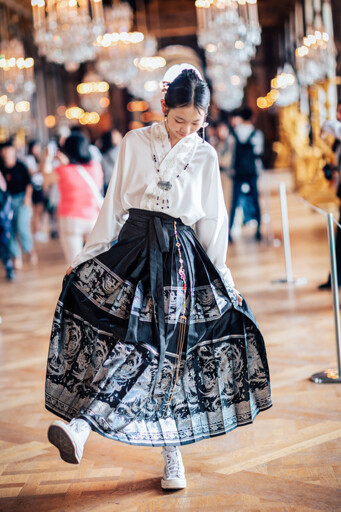
Horse-face skirt (a type of Hanfu) is becoming increasingly popular among young people. Photo: TUCHONG
In recent years, “Guochao,” or “China chic,” has rapidly evolved from a niche subcultural trend into a prominent force in both the consumer market and mainstream culture. Traditional elements such as Hanfu, or traditional attire of the Han ethnic group, Guofeng, or Chinese-style music, and intangible cultural heritage crafts have repeatedly entered the public spotlight. Iconic motifs including dragons, phoenixes, and landscapes have become visual signatures on apparel, cosmetics, trendy toys, and digital collectibles. Once dismissed as “staid” or “outdated,” traditional elements are now being worn, used, and reimagined in daily life by young people, serving as cultural symbols of self-expression and identity. According to industry estimates, the market size of China’s Guochao-related industries surpassed 2.5 trillion yuan in 2025 and is expected to exceed 3 trillion yuan by 2028.
What explains the rise of Guochao, and does it represent a lasting shift rather than a passing craze? Scholars interviewed by CSST suggest that the comprehensive mainstream breakthrough of Guofeng consumption reflects the convergence of several forces, including China’s economic rise, growing cultural confidence, changing aesthetic preferences, and advances in domestic creative industries.
Transformation in consumption logic
Gu Yaqi, vice dean of the School of Arts at Renmin University of China, said that the development of Guochao marks an important shift in consumption logic—from “functional consumption” and “status-distinction consumption” toward “cultural-identity consumption.” In Gu’s view, the sustained mainstream appeal of Guofeng consumption indicates that Chinese society has entered a new stage in which consumption is increasingly driven by cultural identity. Young people today are no longer paying only for the utilitarian value of products. By purchasing Guofeng apparel, neo-Chinese home furnishings, cultural-and-museum-themed creative products, and similar goods, they are affirming their cultural identity, forging emotional connections, and expressing their values. What they choose and buy is, in essence, a broader way of life shaped by Chinese aesthetic values.
The foundation of this transformation lies in Guochao’s shift beyond the superficial use of traditional motifs toward deeper cultural integration. Jing Junmei, deputy director of the Institute of Cultural Studies at the Beijing Academy of Social Sciences, noted that early Guochao products often simply grafted traditional patterns and colors onto modern commodities, while lacking a deeper spiritual core. Today, however, a growing number of products and brands are drawing on the philosophical and conceptual resources embedded in traditional culture. Essentially, they are attempting to translate classical aesthetic ideas such as “harmony between humanity and nature,” “the Dao follows nature,” and “negative space and freehand brushwork” into modern terms, allowing them to permeate contemporary clothing, food, housing, transportation, spatial design, and even film and television aesthetics. In other words, Guochao is shifting from borrowing “form” to absorbing “spirit,” completing a transition from simple symbolic patchwork to the internalization of cultural meaning.
The resurgence of Song-Dynasty (960-1279) aesthetics serves as a quintessential example of this shift. The revival of incense arts and tea-whisking ceremonies among younger generations, as well as the pursuit of restraint, understatement, and natural elegance in neo-Chinese home furnishings, are not merely stylistic revivals—they reflect a deeper alignment between the spiritual aspirations embodied in Song-Dynasty aesthetics and the contemporary yearning for a more composed and unhurried way of life. “This is not a simple replica of antiquity, but rather a refinement of modern values from within one’s own civilizational heritage—a profound manifestation of cultural confidence at a deeper level,” Gu explained.
This capacity for cultural understanding and re-creation relies on the overall enhancement of cultural production capabilities, as well as long-term immersion in visual culture. Gu noted that the proliferation of digital media and visual culture has transformed traditional culture from static museum exhibits into a living aesthetic that can be perceived, experienced, and actively participated in. “From The Poetic Dance: The Journey of a Legendary Landscape Painting” bringing “A Thousand Li of Rivers and Mountains” to life through dance poetry, to Hanfu vloggers’ lifestyle performances on short-video platforms and ancient scenes reconstructed in virtual reality, the younger generation has grown up immersed in a Chinese aesthetic environment that has been recoded and reinterpreted. This long-term aesthetic accumulation has subtly elevated public sensibilities, gradually transforming neo-Chinese apparel, Eastern incense arts, and intangible-cultural-heritage jewelry from niche refined tastes into mainstream consumer choices.
Chinese expression of aesthetic discourse power
On the surface, the growing popularity of Guofeng consumption marks a shift in Chinese aesthetics from the margins to the mainstream. At a deeper level, it reflects a strengthening sense of cultural subjectivity among the public, as well as the emergence of a more distinctly Chinese aesthetic voice in an increasingly globalized world.
In Gu’s view, the successful reinvention of Chinese aesthetics stems not only from a renewed appreciation of the intrinsic value of China’s aesthetic heritage, but more importantly from the reshaping of a modern aesthetic experience and cultural identity that belongs to the Chinese people. “When young people feel that wearing Hanfu or using Chinese-style furniture is natural, dignified, and fashionable, it essentially means that a standard of modernity rooted in one’s own civilizational heritage is taking shape.”
Jing interpreted this shift as evidence that the Chinese public has begun to view the world with a more equal and composed mindset. People are increasingly able to identify with and appreciate the fine traditions of their own culture in a more authentic and self-assured way.
Significant changes in communication have also provided strong support for this growing cultural subjectivity. Jiang Shen, a professor at the School of Journalism and Communication at Beijing Normal University, argued that the evolution of Guochao narratives represents, in essence, a redistribution of communication power, driving traditional culture to move from “passive dissemination” to “active expression.” An increasing number of creators now use personal experience, everyday scenarios, and genuine emotion as entry points for integrating traditional culture into contemporary narratives, transforming it from an “untouchable” cultural symbol into a living resource that young people can perceive, understand, and emotionally resonate with.
According to Jiang, this shift—from following the West, to viewing tradition on equal terms, and then to actively seeking resources within one’s own cultural traditions and emotional structures—does not represent a rejection of foreign cultures. Rather, it reflects a confident and composed approach to telling Chinese stories and expressing Chinese aesthetics on the basis of broad exchange and mutual learning. This calm yet steadfast cultural confidence, he suggested, is inherently compelling and attractive.
Reconstructing intangible cultural heritage value chain
Despite the tremendous waves that Guochao has stirred up domestically, it still faces the historic challenge of going global—the natural outward extension of growing cultural confidence. Yet the overseas expansion of Guochao has historically fallen into the awkward predicament of “products visible, culture invisible,” with a serious disconnect between commodity exports and cultural communication, and with the “cultural discount” problem remaining prominent.
Wei Xiaoyang, a professor at the School of Cultural Industries Management at Communication University of China, divides Guochao’s overseas expansion into two phases. The 1.0 era was dominated by OEM, or original equipment manufacturing: China had products, but no brands, let alone any cultural premium. The 2.0 era centered on brand e-commerce going global. Although cultural symbols began to be consciously incorporated, problems frequently emerged, including superficial piling-on of symbols, hollow narratives, and marginalization in distribution channels, with much of their cultural meaning lost in cross-border communication. In Wei’s view, the root causes lie in rigid one-way export thinking, insufficient cultural translation capabilities, the lagging development of intangible-cultural-heritage brand building, and a weak intellectual property protection system.
In recent years, Chinese-style accessories and intangible-cultural-heritage handicrafts that have gone viral on overseas social media platforms have offered a highly instructive new pathway for Guochao’s global expansion. Wei argued that these cases have achieved a meaningful leap in the cultural value chain—they have successfully transformed folk symbols associated with “warding off evil and attracting good fortune” into fashionable carriers that combine handmade authenticity, scarcity, and contemporary design sensibilities. By aligning with mainstream international aesthetic contexts, they have elevated themselves from locally distinctive handicrafts into culturally appealing products with global resonance. More importantly, they focus on universal emotional motifs such as “protection, kinship, and blessings,” reversing the typical cultural discount issue and turning it into cultural appreciation. This powerfully confirms that shared emotions are the most essential universal code in cross-cultural communication.
From the broader perspective of mutual learning among civilizations, the maturation of Guochao has provided a new paradigm for the modern expression of local culture and its external exchange. Jiang noted that what the world can learn from and replicate in Guochao is not the external symbols themselves—such as the cut of Hanfu or the color “Chinese red”—but rather the methodology of staying “rooted in local soil, sincere in empathy.” At a time when global technological development is driving cultural convergence, Guochao uses the warmth of craftsmanship and the bonds of kinship to resist the alienation of digital life, while drawing on universally shared human emotions to break through cultural barriers. This, precisely, is a Chinese approach imbued with Eastern wisdom, contributing to the diversity of world civilizations.
Editor:Yu Hui
Copyright©2023 CSSN All Rights Reserved