


Reconstructing aesthetic paradigm of Chinese manufacturing
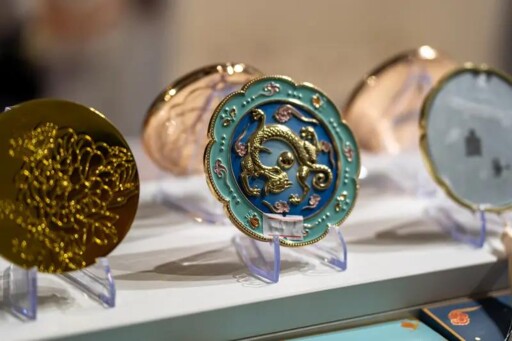
Copper mirrors embodying Chinese aesthetic elements Photo: IC PHOTO
Since the advent of industrialization, the organization of industrial manufacturing has centered on improving efficiency and controlling costs, with product value measured largely by the maximization of functional utility and cost-effectiveness. Under this logic, a manufacturing paradigm dominated by “functional production” gradually took shape.
With the rise of the consumer society, however, industrial production has shifted from a seller’s market to a buyer’s market, while personalized and diversified aesthetic demands have become increasingly prominent. The advent of intelligent production has further intensified the oversupply of material goods, making attention and lived experience scarce resources. Against this backdrop, manufacturing has begun to move toward a model centered on “aesthetic production,” and product functionality is increasingly defined not by producers but by consumers.
From functional to aesthetic production
The transition from functional production to aesthetic production marks a systemic turn in the logic, structure, and modes of industrial production. The first step in this transformation is a change in production logic—from conventional manufacturing logic to aesthetic-innovative logic. Rather than anchoring production in use value and cost accounting, aesthetic-innovative logic emphasizes the resonance between corporate self-awareness and user demand. The aesthetic value it creates emerges from a deep alignment between the personal sensibility of the enterprise or entrepreneur, the company’s mission, the meaning of the product, and the needs of users. Product function and user experience become closely intertwined, forming multilayered connections with consumers in terms of performance, emotion, and meaning.
The Industrial Revolution that began in mid-18th-century Britain ushered in Western modernization and inaugurated a capitalist model of industrial development oriented toward capital accumulation. Although it fundamentally improved human living conditions and quality of life, it also reduced human beings to instruments of capital expansion. The shift in industrial production logic from function to aesthetics signals the emergence of a new economic form that transcends the logic of capital and is, in essence, human-centered.
More profoundly, when industrial production returns to the human dimension, it marks the arrival of a new era in which—for the first time in history—the logic and coordinates of development are established around the comprehensive development of the individual.
Aesthetics is fundamentally a humanistic discipline. As a form of innate benevolence, aesthetic experience enables individuals, through embodied perception, to attain a state in which the Dao (the Way) and objects are inseparable, and to achieve self-awakening by realizing one’s true nature.
Return to aesthetic productivism of ‘making’
The reconfiguration of manufacturing from production-oriented logic to aesthetics-oriented logic constitutes a transformation at the industrial level. Yet to truly achieve a paradigm shift in Chinese manufacturing, it is necessary to return to its civilizational origins and answer the question “who are we?”—that is, what exactly is Chinese manufacturing?
Rooted in Chinese philosophy, aesthetics, and traditional ideas of craftsmanship, Chinese manufacturing has developed a distinctively Eastern conception of “making,” whose core lies in the aesthetic spirit of shengsheng—perpetual generation and renewal—and the idea of hemei, or harmonious beauty. Chinese manufacturing seeks to anchor life and reshape contemporary ways of living through beauty. In essence, it constitutes an aesthetic productivist practice that moves from “making things for use” to “making things for life.”
At the ontological core of Chinese manufacturing is an everyday aesthetics grounded in the inseparability of the Dao and objects. Chinese aesthetics embodies both the unity of Heaven and humanity and the harmonious coexistence of humans and nature. It is also an everyday aesthetics in which the Dao is inseparable from objects and is expressed through daily use. This has kept Chinese practices of making rooted in concrete life contexts. From clothing, food, housing, and transportation to the rhythms of everyday life, objects and lived human experience are interwoven, generating aesthetic meaning in the ordinary world and giving expression to continuous, generative vitality. For this reason, Chinese manufacturing should also be understood as the production of aesthetic life. It points to a way of life and to an aesthetic economic practice that integrates lived experience, philosophical ideas, attitudes toward life, propositions about living, and concrete aspects of daily life such as clothing, food, housing, transportation, and entertainment.
Furthermore, Chinese manufacturing needs to build a modern aesthetic industrial system in which the chain of fine traditional culture is inherently aligned with the chain of contemporary aesthetic life industries. Just as ancient craftsmanship enabled objects to circulate, evolve, and enter popular use—moving from cultural symbol to cultural meaning and finally to the daily lives of ordinary people—this integration calls for the context of aesthetic life to be incorporated into the context of aesthetic production in modern industrial manufacturing. In this way, product manufacturing becomes an organic continuation of culture and a distinctive aesthetic expression of China’s fine traditional culture.
Qiu Ye is a professor from the School of Fashion Management at Beijing Institute of Fashion Technology.
Editor:Yu Hui
Copyright©2023 CSSN All Rights Reserved