


Steppe Silk Road as bridge linking civilizations across Eurasia
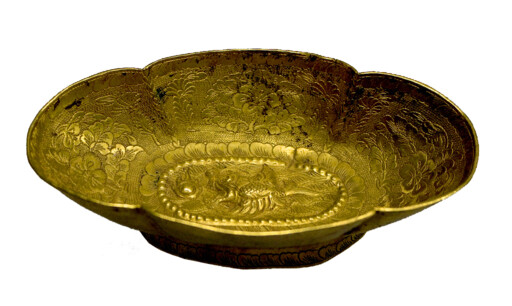
The Tang-Dynasty gold cup with makara motif unearthed from Taiyi Road in Xi’an, northwest China’s Shaanxi Province, which is now housed at Shaanxi History Museum Photo: IC PHOTO
The Steppe Silk Road was a historic trade route running through the northern steppe belt of the Eurasian continent. Extending northward from the Central Plains, it crossed the Mongolian Plateau and the Altai Mountains before following the Eurasian Steppe westward to Eastern Europe and the northern shores of the Mediterranean. Traversing geographical barriers and civilizational divides, it became a vital corridor of cultural exchange linking China with Central Asia, West Asia, and even Europe. Along this great artery of transcontinental communication, agrarian and nomadic civilizations met and mingled, while cultures from East and West encountered and influenced one another. The Steppe Silk Road thus occupied a prominent place in Eurasian history, serving as a bridge for mutual learning among civilizations in the material, intellectual, and technological spheres.
Corridor for material exchange
Material exchange gave rise to the Steppe Silk Road and sustained its vitality over the centuries. Between the 5th and 15th centuries, the migrations of nomadic peoples and the movement of merchant caravans facilitated a two-way flow of goods between the eastern and western reaches of Eurasia, allowing the material achievements of different civilizations to enrich one another.
Silk, tea, grain, and handicrafts from the Central Plains were among the principal commodities carried westward. Textiles produced during the Liao Dynasty (916–1125) were particularly renowned. Fabrics such as zhaoxia jin (morning-glow brocade), together with a wide range of damasks, twills, and satins, not only met domestic demand but were also purchased in large quantities by Song-Dynasty (960–1279) merchants and transported westward along the Steppe Silk Road. Chinese crafts and technologies—including porcelain, lacquerware, and papermaking—likewise spread westward along the route, reshaping production techniques and everyday life in many regions. Porcelain-making methods, for example, were adopted by artisans in Central and West Asia, who combined them with local traditions to produce distinctive styles of painted ceramics.
In the opposite direction, cattle, horses, sheep, hides, and furs from the northern steppes flowed southward into the Central Plains, supplying agrarian society with essential livestock products and raw materials. The route accordingly became known as both the “Fur Road” and the “Tea-Horse Road.” Gold and silver objects, jewelry, spices, and other luxury goods from Central and West Asia also traveled eastward across the steppe and into the Central Plains, where they were treasured as luxuries among the ancient upper classes.
This reciprocal flow of material goods not only met the practical needs of peoples across Eurasia but also fostered the shared development of the continent’s material cultures.
Bridge for mutual learning
As an open corridor, the Steppe Silk Road created a space in which different civilizations and ethnic groups could engage with one another. These cross-regional interactions fostered mutual respect, equality, openness, and inclusiveness, deepening mutual understanding among diverse peoples and providing enduring momentum for the development of human civilization.
The lands along the Steppe Silk Road formed one of the principal zones of convergence between agrarian and nomadic civilizations. By spanning the traditional divide between these two ways of life, the route helped establish a framework for peaceful coexistence and mutual development. Agricultural techniques from the Central Plains and pastoral practices from the steppe were exchanged and adapted. Grain, tea, salt, silk textiles, and metal products traveled northward and westward from agrarian regions, while livestock and other pastoral products moved in the opposite direction. This reciprocal exchange of goods and technologies fostered mutual dependence and complementarity between agrarian and nomadic societies. Beyond stimulating economic development along the route, these encounters also accelerated the movement and integration of different ethnic groups, giving rise to a diverse and pluralistic cultural landscape.
The exchange of goods and ideas was both an expression of the desire for greater connectivity and a vital force in civilizational development. Successive Chinese dynasties therefore worked to keep the Steppe Silk Road open and secure. The Liao Dynasty’s construction of Kedun Fortress and the establishment of an extensive relay-station (postal) system in the Yuan Dynasty (1271–1368) both ensure that this transportation network remained active over the long term. Effective governance provided the stable conditions necessary for commercial trade and cultural exchange to flourish along the route.
Convergence of thought, artistic traditions
The movement of peoples and goods naturally encouraged the circulation and integration of ideas and cultures. The migrations of nomadic communities, together with the transregional journeys of envoys, merchants, and religious adherents, enabled the exchange of ideas, religious beliefs, artistic traditions, and folk customs across different parts of Eurasia. Through these sustained encounters, diverse cultural traditions came into contact, influenced one another, and gradually converged, giving rise to a rich pattern of mutual exchange and learning.
Between the 5th and 15th centuries, Buddhism, Islam, Nestorian Christianity, and Manichaeism spread widely along the Steppe Silk Road, breaking down spiritual and cultural boundaries between civilizations. In the 13th century, Tibetan Buddhism reached the Mongolian Plateau by way of the route, contributing to the development of Buddhist art throughout the Eurasian steppe. Islam, carried eastward by Arab merchants and envoys, spread into Central Asia, the northern steppe regions, and even the Central Plains, where its architectural and religious practices left a profound imprint on local cultures. Nestorian Christianity and Manichaeism also spread extensively along the Steppe Silk Road, blending with local nomadic and agrarian traditions to produce distinctive forms of religious culture. The dissemination of these faiths likewise facilitated the cross-regional transmission of religious art and philosophical thought.
The music, dance, and visual arts of the steppe peoples drew upon traditions from Central and West Asia and vice versa, generating new and innovative forms of artistic expression. Liao Dynasty tomb murals depicting the fusion of Khitan and Han Chinese music and dance demonstrate how deeply cultural exchange along the Steppe Silk Road had entered everyday social life. Striking similarities between the pentatonic music of northern steppe peoples and Hungarian folk songs offer further evidence of cultural transmission along the route.
The gold cup with makara motif unearthed from Taiyi Road in Xi’an, northwest China’s Shaanxi Province, provides a vivid example of this artistic fusion. Combining the form of Sasanian Persian silverware, Indian Buddhist makara iconography, and Tang-Dynasty (618–907) decorative styles, it offers direct material evidence of Western craftsmanship traveling eastward and merging with Eastern traditions.
Central Asian glassmaking techniques and West Asian textile patterns were similarly adopted and adapted by artisans in the Central Plains and the steppe, enriching the repertoire of Eastern crafts. Poetry, painting, and calligraphy from the Central Plains spread northward to the steppe and farther west, influencing local artistic creation, while Central Asian musical instruments and West Asian dance forms traveled eastward, broadening the expressive range of Eastern arts. The fusion of steppe nomadic elements with Central Plains traditions also gave rise to Tang-Dynasty works such as Congjun Xing (Following the Army) and Longtou Ge (Song of Longtou).
Collaborative advancement of technology, knowledge
Mutual learning among civilizations has long been a driving force behind scientific and cultural progress. The Steppe Silk Road provided an important platform for the exchange of technology and knowledge across Eurasia, stimulating innovation and disseminating practical expertise throughout the regions it connected. This was not a simple process of one-way export or import, but one of reciprocal learning and mutual enrichment.
Chinese technologies traveled westward via the Steppe Silk Road to Central and West Asia and, from there, to Europe, contributing to advances in maritime navigation, military technology, and the circulation of knowledge. Textile technologies—including sericulture, silk reeling, dyeing, brocade weaving, and spinning—spread alongside metalworking techniques such as iron smelting, cast-iron production, gilding, gold-and-silver inlay, and bronze casting. Porcelain-making, lacquerware production, traditional Chinese medicine, and astronomical and calendrical knowledge also moved outward along the route, stimulating developments in textiles, metallurgy, ceramics, medicine, astronomy, and calendrical science throughout Eurasia.
Technologies and knowledge also traveled eastward. At the Yuan Dynasty capital Shangdu—known in the West as Xanadu and located in present-day Zhenglan Banner in the Inner Mongolia Autonomous Region—the Yuan Dynasty established an Islamic Astronomical Bureau. Under the direction of Persian astronomer Jamal al-Din, the bureau produced some of the world’s most advanced astronomical instruments of the period, collectively known as the Western Instruments.
Mathematical, medical, and architectural knowledge from Central and West Asia were also transmitted eastward. Arabic algebraic and medical texts were translated into Chinese, enriching the country’s mathematical and medical systems. The construction of cities such as Yuan Shangdu incorporated Central Asian architectural techniques, giving rise to styles that combined Eastern and Western characteristics. Meanwhile, livestock-rearing methods and cavalry tactics of the steppe nomads were adopted in both the Central Plains and regions farther west, advancing animal husbandry and military practice across Eurasia.
Through its distinctive geographical advantages and flexible network of passage, the Steppe Silk Road served as a cultural bridge connecting the Eurasian continent. It became a major conduit for the exchange of material goods, the integration of intellectual and cultural traditions, and the circulation of scientific and technological knowledge. By sustaining lasting ties among Eurasia’s diverse civilizations, it helped overcome geographical and civilization barriers and promoted their common development and mutual advancement.
Yu Xuebin is a professor from the School of History, Culture, and Tourism at Heilongjiang University.
Editor:Yu Hui
Copyright©2023 CSSN All Rights Reserved