


Why classics matter in technological age

Timothy W. Burns Photo: PROVIDED TO CSST
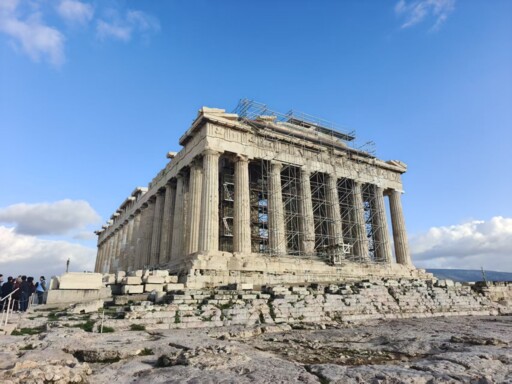
For over 2,400 years, the Parthenon has stood atop the Acropolis in Athens, a silent witness to the dawn of Western civilization. Photo: Fang Ke/CSST
For Timothy W. Burns, the classics are neither relics to be admired behind glass nor convenient vessels for modern grievances. They remain part of a living intellectual encounter between the ancient and the modern—one that continues to illuminate the permanent questions beneath contemporary life. A professor of political science and director of graduate studies at Baylor University, Burns specializes in classical political philosophy and critiques of Western modernity. In a recent interview with CSST, he discussed the continuing relevance of classical traditions, the modern implications of questions first posed by the ancients, and the seriousness and openness required of classical scholarship today.
Classical legacy and modern life
CSST: You once noted that Western intellectual tradition offers three interpretations of the relationship between the classical and the modern. Chinese philosophy has developed its own distinctive perspectives, which have profoundly shaped how Chinese people understand contemporary life. Drawing from your observations in China, do classical traditions still carry relevance today?
Burns: Permit me, if you will, a few examples. On my visits to China, I have seen many gardens. My favorites are the magnificent gardens surrounding West Lake in Hangzhou, where carefully situated pagodas, pergolas, and pavilions are surrounded by lush plantings of trees, perennial flowers, and flowering shrubs. They invite reflection, and they induce gratitude toward those who established them for us. I have also noticed that, even in ordinary apartments, the balconies are filled with flowering plants—overflowing, in what a Westerner would call the English style, as opposed to the French style of carefully cropped plants.
It might be understandable that many Chinese citizens, living in modern high-rises, have limited access to traditional gardens in daily life. I do not wish to diminish whatever complaints they may have on this score. But these historic gardens remain a cultural heritage in which all Chinese can take great pride. To my mind, this reflects a desire to preserve and understand the past in the course of modernization, rather than recklessly repudiate it in the name of “progress.”
During the first World Conference of Classics, all scholars were taken to various new museums in various cities in China. We saw in these museums—to be sure—mostly artifacts. But the most important part of the past is the thought, the thinking, of those then living; and this means the thought of those who thought most deeply. As it seems to me, as an outsider, this means that the deepest thought among the ancient Chinese—at least as it has come down to us—is of Confucius. I could not help but notice, on my visits, that Confucius’ written works—including statements found in the engraved writings on the stele in the Confucius temple in Beijing and in the banners over the throne of the emperor in the Forbidden City—make frequent references to “virtue,” and even to specific virtues. They thus demonstrate a common understanding between China and the pre-modern, ancient, or classical West—one that promises a fruitful engagement. China’s increased commitment to classical studies in recent years is most commendable, and I sincerely hope that this effort will not only benefit classical scholarship around the world but also bear rich fruit for China itself.
Revisiting permanent questions with classics
CSST: Today, we are surrounded by eroding values, fractured traditions, escalating conflicts, and technologies that challenge what it means to be human. How can classical studies help modern society engage these issues in meaningful dialogue? What wisdom from classical studies remains especially valuable today?
Burns: Classical studies, as a discipline, provides modern society with a common point of reference, allowing us, by reviewing the old, to come to understand the new. The questions addressed by the ancients are not simply “old”—or, in other words, peculiar to, limited by, their time and place—but are rather permanent questions that every civilization must confront. To address these questions thoughtfully is the starting point for understanding our own time and place. And if the questions are permanent, the answers proffered in the past may still hold value, offering insights that we, in our technologically transformed age, may easily overlook.
The very question of technology is one of those permanent questions. Technology—the use of science or philosophy to transform the given world—was taken up in earnest at the beginning of modernity and may be said to be one of its most authoritative characteristics. Undertaking it involved a certain disposition towards “nature”—that is, toward the permanent, intelligible necessities that philosophers had, in their search for causes, always claimed to exist.
The older philosophic disposition toward nature, though, was to understand it. While ancient philosophers did not equate the human good with obedience to ancestral traditions sustained by poetic accounts of the whole, neither did they think it possible to transform the given world with a view to a bright, shining future in which all those aspects of nature that thwart our happiness could be overcome. They consciously rejected, we may say, technology as something that would lead to the dehumanization of man. One sees this, for example, in Aristotle’s Politics, and in Xenophon’s Memorabilia and Cyropaedia.
The new, modern disposition—the disposition of the new science, clearly visible in the work of Francis Bacon, Newton, Descartes, and Hobbes—is toward nature as an enemy to be conquered: “for the relief of man’s estate,” in Bacon’s famous term, or, as he also says, “to the effecting of all things possible.” We are the heirs of this new project; we live in the technologically transformed, disenchanted world that they had hoped for. Has our wisdom increased with our power? If not, does the ancients’ disposition towards nature make more sense? If so, what is its ground? By what rational arguments—that is—did they arrive at it?
The choice between the classical and the modern is not as simple as preferring antiquity to the present, or vice versa; the crux lies in whether we are willing to carefully examine those permanent questions that have been obscured by technological progress. Technology and its goodness for our existence is, though, but one of those permanent questions with which we might approach the ancients and hope to learn from them.
Approaching classical texts with seriousness and openness
CSST: Could you speak to how the disciplinary orientation of classical studies has changed over time and what gave rise to this change? In light of this transformation, what pitfalls in approach and methodology should contemporary classical scholars guard against?
Burns: Classical studies, as we now call the study of ancient texts, was once understood as the study of permanent questions and enduring answers to those questions. Things have, however, dramatically changed. One reason is the Enlightenment—a movement conceived quite consciously and deliberately to disenchant the world. I quote Leo Strauss: “the whole scheme suggested by Hobbes requires for its operation the weakening or, rather, the elimination of the fear of invisible powers. It requires such a radical change of orientation as can be brought about only by the disenchantment of the world, by the diffusion of scientific knowledge, or by popular enlightenment,” in Natural Right and History.
In the wake of this attempt, scholars of classical studies—reading the works of the greatest thinkers of the past from various civilizations, in suitable modesty about our own abilities and with a readiness to learn from them—may perhaps find a path out of our present, highly novel, and in some ways quite dire situation.
In seizing new opportunities for development and promoting dialogue among civilizations, modern scholars of classical studies need to avoid two dangers. One is the reading of ancient texts in a way that makes the activity unserious and nothing more than an exercise in vanity: by “contextualizing” the texts, in the manner of Derrida and his followers, so that every text becomes, as it were, clay in the hands of a potter. The texts come to say nothing more than what we want them to say—often blamed, in fact, in accord with grievances we bring to the texts. This approach is misologistic.
If the texts are instead approached by everyone as a path to truth—with intellectual honesty and readiness to learn, and with full awareness of the strategies of writing practiced by the ancients—then striking and unfamiliar insights are bound to emerge. Agreements among scholars can serve to confirm one’s insights and understanding, while disagreements can provoke thought, more patient and close reading, double- and triple-examination of the actual arguments being made, and can thereby sustain the kind of serious friendship that emerges in the mutual pursuit of truth.
A second, related danger is the false open-mindedness of perspectivism, in which there is nothing more than agreement to disagree, or a false honoring of opinions that one thinks are wrong, rather than respectful dialogue. I refer to the famous “celebration of differences,” which means an intellectual relativism and tribalism—a means of keeping one’s opinions safe from serious scrutiny. For those who are mutually engaged in the search for truth, taking the time to disagree and to spell out one’s reasons for doing so is, in fact, a sign of respect; it is taking the other’s scholarship seriously. Every scholar of classical studies needs to be open to the truth, wherever it leads—seeking help from any quarter in exploring the classical spirit and confronting the modern condition, and being fully prepared to change one’s mind when compelled by reason to do so.
Editor:Yu Hui
Copyright©2023 CSSN All Rights Reserved