


Costume cultural exchange from Han to Tang through archaeological lens
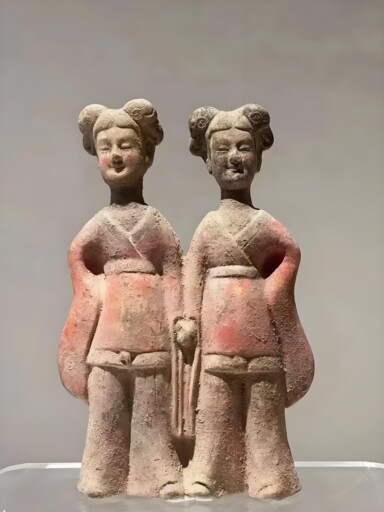
FILE PHOTO: Hand-holding female figurines unearthed from the Northern Wei Tomb of Yang Ji, wearing man-style kuzhe
Between the Han (206 BCE–220 CE) and Tang (618–907) dynasties, Chinese dress underwent a far-reaching transformation. As the Silk Road opened and flourished, garments, materials, techniques, and decorative motifs moved across regions and among ethnic groups, reshaping costume traditions in the process. Textiles and clothing recovered by archaeologists—together with pottery figurines, tomb murals, and other visual evidence—fill gaps in the written record and bring this history vividly into view. Taken together, these materials reconstruct the long historical process through which distinct cultural elements met, interacted, and gradually became part of a shared sartorial language.
From selective borrowing to comprehensive cultural integration
From the Han to the Tang, traditional Chinese costume evolved from relative stylistic uniformity toward increasing diversity and integration. The shift was neither immediate nor linear. It emerged through continuous interaction, convergence, and reconfiguration among diverse clothing traditions.
The Han court inherited the ritual system of the Zhou Dynasty (1046–256 BCE) and placed great emphasis on sartorial regulation. Its hierarchical costume system centered on the traditional shenyi (one-piece robe) and pao (long robe) of the Huaxia people, with dress clearly marking rank and social status. Stone and brick reliefs, pottery figurines, and tomb murals show a remarkable degree of consistency in clothing across the territories governed by the Han. Yet this stylistic uniformity never prevented foreign elements from entering and gradually reshaping the system.
Early Huaxia trousers consisted of two separate leg coverings, while the nomads of the steppe were the first to develop trousers with a sewn crotch. By the Western Han (206 BCE–24 CE), these had become standard attire for soldiers, farmers, and servants, as numerous pottery figurines and stone reliefs attest. Metal-plaque belts favored on the steppe also became popular among the elite; examples have been excavated from high-ranking tombs, including the Mausoleum of the King of Zhongshan at Mancheng in Hebei Province and the Mausoleum of the King of Chu at Shizishan in Xuzhou, Jiangsu Province.
Exchange also moved in the opposite direction. Chinese silk traveled west to the Western Regions, Central Asia, West Asia, and the Mediterranean world. Colorfully patterned Han-style brocades have been found at Loulan in Lop Nur and the Niya site in Minfeng, Xinjiang Uygur Autonomous Region, as well as in present-day Mongolia, Russia, and Syria.
Large-scale migration during the Wei and Jin periods (220–420) accelerated the adoption of the practical, close-fitting attire of northern ethnic groups—short jackets, trousers, and high boots. Pottery figurines of male attendants and warriors from Western Jin (265–316) tombs in Luoyang, Henan Province, depict these garments clearly. During the Southern and Northern Dynasties (420–589), the jacket-and-trouser ensemble known as kuzhe became extremely popular and even served as court dress in the early Northern Wei (386–534).
In its adapted form, kuzhe combined a close-fitting upper garment with wide sleeves and loose trouser legs. Rather than simply reproducing steppe clothing, it preserved its practicality and dynamism while taking on the dignity and flowing elegance associated with Huaxia dress, making the ensemble a defining fusion of non-Han and Han aesthetics. Murals and pottery figurines from Northern Dynasties (386–581) tombs at Wanzhang, Cixian County, Hebei Province, offer prominent examples.
By the late Northern Dynasties, narrow-sleeved, round-necked robes favored in the Western Regions had also come into fashion. Murals from the Northern Dynasties tomb at Jiuyuangang in Xinzhou, Shanxi Province, show warriors, ceremonial guards, attendants, and women wearing them, indicating acceptance across social groups.
Following reunification under the Sui (581–618) and Tang dynasties, the integration of non-Han and Han costume traditions reached its fullest expression. Kuzhe, round-necked robes, and high boots entered the court dress code. According to the Yufu Zhi (Treatise on Carriages and Costume) in the Old Book of Tang, Tang dress fell into four categories: everyday, official, court, and sacrificial attire. The round-necked robe increasingly dominated everyday dress and was commonly worn by aristocrats and officials conducting business or attending cultured social gatherings. Official, court, and sacrificial dress largely retained earlier ceremonial forms, but was reserved for progressively narrower occasions.
Decorative motifs followed the same trajectory. Persian pearl-roundel patterns and Buddhist baoxianghua (precious-flower) motifs blended with traditional Chinese auspicious designs and became markers of official rank and status. By the Tang, many foreign elements had been so thoroughly absorbed that they formed an intrinsic part of a distinctly Chinese aesthetic. The resulting costume system embodied an age of inclusiveness, confidence, and creative renewal, and laid the foundation for the subsequent evolution of Chinese dress while also exerting a profound influence on the costume traditions of Japan, Silla, and several states in the Western Regions.
Diverse agents of costume exchange
Human beings are the primary carriers of civilizational exchange and mutual learning, and costume traditions travel with them. From the Han through the Tang, rulers, officials, nobles, and ordinary people all participated in the transmission and transformation of dress, though their roles, resources, and choices differed markedly.
Rulers facilitated the trans-regional circulation of costume forms and institutions through tributary relations and the conferral of titles. Political entities of various ethnic groups presented the Central Plains dynasties with furs, leather goods, and rare treasures as tribute. The Book of the Later Han and the Book of Jin, for example, record the Wuhuan and Sushen peoples offering marten pelts. In the Central Plains, marten fur provided warmth and also entered ceremonial dress as the diaochan crown (sable-tail crown), a symbol of high office used from the Han through the Ming Dynasty (1368–1644). On the west wall of the entrance passageway to the Tomb of Lou Rui of the Northern Qi Dynasty (550–577) in Taiyuan, Shanxi, a gate guard wears a cage-shaped crown with a marten tail inserted on its right side—a vivid image of this form.
Central Plains dynasties also invested tributary rulers with official garments, seals, and ribbons, reinforcing imperial authority and ceremonial prestige. The Xiongnu Chanyu Huhanye, supreme ruler of the Xiongnu confederation, visited the Han court several times. Gifts bestowed by Emperor Xuan of Han included symbols of rank and identity—“crowns, belts, garments, seals, and ribbons”—as well as textiles for warmth including “clothing, silk fabrics, and padded materials.” Later dynasties largely inherited this system. By the Tang, the garments bestowed had developed into official everyday attire known as paodai, comprising a round-necked robe and waist belt.
Nobles and officials were the primary adopters of foreign treasures, ornaments, textiles, and decorative motifs. Monochrome drawn glass beads from the Indo-Pacific entered China in large quantities during the Han and continued to appear in Northern Dynasties tombs. Combined with imported natural gemstones such as amber and agate, they formed elaborate sets of zu yupei (pendants), becoming important ornaments through which nobles and officials enhanced their appearance.
A gemstone-inlaid gold ring from the Tomb of Xu Xianxiu of the Northern Qi Dynasty in Taiyuan offers a striking example of this cultural interaction. Its bezel holds a sapphire, while figures grasping staffs are engraved on its surface, displaying strong Central and West Asian influences. Similar rings have been found in the Northern Wei Tomb of Lyu Da in Luoyang and the Northern Zhou Tomb of Li Xian in Guyuan, Ningxia Hui Autonomous Region. Derived from Mesopotamian cylinder seals, such intaglio rings were more than ornaments: They stamped impressions onto sealed documents and served as symbols of authority among political leaders and merchants.
Ordinary people chose clothing chiefly for durability, practicality, and freedom of movement. Before cotton became widespread, Central Plains garments were mainly made from hemp and kudzu fibers and cut for labor and daily activity. Wool-textile techniques introduced from frontier regions broadened the available range of clothing materials, while the growing popularity of trousers brought significant changes to garment styles.
Han stone and brick reliefs depict farming, cooking, brewing, fishing, hunting, and other forms of labor. The figures depicted usually wear knee-length short jackets and straight-legged trousers. Some are dressed even more simply: Customers buying wine in a tavern scene on a brick relief from Yihe Township in Pengzhou, Sichuan Province, wear short-sleeved upper robes and knee-length shorts. Practical and convenient attire of this kind remained mainstream among ordinary people through the Sui and Tang, although details changed—for example, round collars increasingly replaced crossed collars.
Women were not the principal drivers of costume transformation, but their makeup, accessories, and clothing also registered cross-cultural contact. During the Western Han, Zhang Qian’s missions to the Western Regions introduced safflower-based yanzhi (rouge), bringing vivid color to the established ideal of a “powder-white complexion and darkened eyebrows.”
The ruqun (jacket and skirt ensemble) became women’s everyday attire from the Han onward. After the Northern Wei capital moved to Luoyang, it grew longer and more flowing, with the skirt waist raised to the chest. From the late Northern Dynasties into the early Tang, narrow-sleeved short jackets came into fashion. High-waisted skirts were often assembled from vertical strips of contrasting fabric to create striped patterns, as shown by female attendants in murals from the Northern Qi tombs of Xu Xianxiu and Lou Rui in Taiyuan, and from the Tomb of Lady Wei, consort of Emperor Taizong of Tang.
Narrow-sleeved jackets and high-waisted skirts were closely connected to the relatively elevated position of women among steppe peoples such as the Tuoba Xianbei, whose women rode horses, practiced archery, and joined social gatherings. Raising the skirt waist allowed greater freedom of movement, especially when riding. Within this cultural setting, women also began wearing men’s clothing. The story of Hua Mulan disguising herself to take her father’s place in military service became famous, but archaeological evidence also survives: Hand-holding female figurines from the Northern Wei Tomb of Yang Ji in Luoyang wear male-style kuzhe.
The practice became particularly widespread in the Tang, appearing at court and among ordinary women alike and projecting confidence and vitality. A female equestrian figurine from the Tomb of the Princess of Jinxiang shows its rider wearing a peacock crown, round-necked robe, leather belt, and black leather boots. Spirited and dynamic, such styles crossed traditional ritual boundaries and became a vivid expression of the openness, confidence, vitality, and cosmopolitan character associated with the flourishing Tang era.
Song Bingling is an associate professor from the School of History and Culture at Shandong Normal University.
Editor:Yu Hui
Copyright©2023 CSSN All Rights Reserved