


Viewing global reach of Chinese scholarship through overseas library holdings
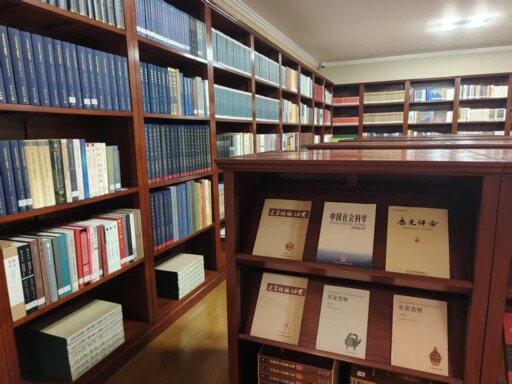
Chinese books and journals are on display at the Chinese School of Classical Studies at Athens. The institute houses a dedicated archaeology library and exhibition spaces that showcase Chinese publications and cultural materials. Photo: Fang Ke/CSST
Chinese scholarship grounded in the country’s own experience and intellectual traditions is increasingly finding a place on library shelves around the world, opening new channels for dialogue across civilizations. Because overseas library holdings can be quantified and tracked over time, bibliographic data offers a distinctive window onto how effectively Chinese scholarship is reaching international audiences—and where it is gaining recognition.
On June 17, China Publishing & Media Journal (CPMJ) and Beijing Foreign Studies University (BFSU) jointly released the 2026 edition of the Research Report on the Influence of Chinese Books in Overseas Libraries (hereinafter referred to as the Report). The Report examines the current landscape and emerging trends in the international circulation of Chinese academic works, offering valuable insights into how their global reach and influence might be strengthened. To explore these findings in greater depth, CSST reporters spoke with He Mingxing, a professor at the School of International Journalism and Communication at BFSU and principal investigator of the “Research on the Influence of Chinese Books in Overseas Libraries” project.
Library holdings data
CSST: How did you first become involved in researching the overseas library holdings of Chinese books? How has the project evolved and improved since its launch?
He Mingxing: I worked in the publishing industry for more than 20 years, and one question stayed with me throughout that time: After the books we published passed through various distribution channels, who ultimately read them? In 2011, I joined BFSU, where I moved from editorial work into academic research and began focusing on this question.
At the time, the BFSU Library already subscribed to a number of international bibliographic databases and library catalogs, including a database operated by OCLC, a global library organization. Using this as my primary data source, I began researching the influence of Chinese books in overseas libraries.
The Report was first released in 2012, and 2026 saw its 15th edition. Over the years, its data sources have expanded beyond the OCLC database to include the CiNii database maintained by Japan’s National Institute of Informatics (NII). The analytical framework has similarly grown from an initial focus on Chinese-language books published by Chinese institutions to encompass English-language publications, reader analysis, book reviews, and other areas. The project has now developed a preliminary three-dimensional framework for assessing the international dissemination of Chinese books: the scope of overseas circulation, measured through library holdings; exposure in mainstream media, reflected in book reviews; and audience reception, based on readers’ attitudes and evaluations.
CSST: What does being included in overseas library holdings signify for Chinese academic works?
He Mingxing: Popular books written for general readers may climb bestseller lists and perform well in the marketplace, but most academic works are unlikely by their very nature to become bestsellers. Whether an academic work is acquired by libraries at overseas universities and research institutions therefore becomes a key indicator of whether its value has been recognized.
The Report uses library holdings data for quantitative analysis, reflecting overseas audiences’ overall assessments of Chinese authors, publishers, and academic disciplines. In this sense, overseas library holdings reveal the knowledge production capacity of China’s academic publishing institutions and serve as a barometer of the country’s academic publishing sector.
CSST: According to your research, in which countries or regions are Chinese academic works most widely collected, and what types of institutions constitute their primary collectors?
He Mingxing: Databases such as OCLC and CiNii aggregate records from many different types of libraries, so the overall picture does not lend itself to a simple summary. The principal overseas collectors of Chinese academic works are university libraries with departments or research institutes specializing in Asian studies. Some public libraries serving Chinese communities also collect Chinese academic publications. University and national libraries in Japan and Southeast Asia are likewise major institutional purchasers and collectors of these works.
Libraries in a number of Latin American and African countries have also gradually begun collecting Chinese books. Although the number of titles remains limited, the scope of these collections is expanding. We have not yet conducted a detailed investigation into the reasons behind this trend, but it is likely connected to China’s growing influence among countries of the Global South.
Growing international influence
CSST: Which disciplines and themes feature most prominently in overseas library collections of Chinese academic works? Which Chinese publishers are most strongly represented?
He Mingxing: Fifteen years of bibliographic monitoring shows that academic works constitute a major category of Chinese books held by overseas libraries, particularly scholarly monographs in the humanities and social sciences. Contemporary Chinese literature and art, children’s books, and Chinese-language learning materials are also important categories in overseas collections.
Over the past decade and more, leading Chinese publishing institutions—including China Social Sciences Press (CSSP), Social Sciences Academic Press (SSAP), The Commercial Press, Zhonghua Book Company, Renmin University of China Press, and Guangxi Normal University Press—have consistently ranked among the top publishers in terms of overseas library holdings.
CSST: Are overseas holdings of Chinese academic works primarily composed of original Chinese-language editions or English translations? Are print publications significantly more widely collected than digital publications?
He Mingxing: Overseas holdings consist predominantly of Chinese-language editions, accompanied by a relatively small number of English translations. With physical storage space increasingly limited, overseas university libraries have expanded their budgets for purchasing digital Chinese-language books over the past decade or so. They have also called on major Chinese publishers to devote greater resources to developing Chinese-language academic e-books and specialized databases.
CSSP has developed the China Social Sciences Library; SSAP has established the Pishu Database; Zhonghua Book Company has created the Chinese Classic Ancient Books Database; and China National Publications Import and Export (Group) Co., Ltd. has launched the CNPeReading platform. These Chinese-language e-book platforms and academic resource databases have largely addressed the challenge of building digital Chinese academic resources from the ground up.
At present, however, overseas collections of Chinese academic works remain dominated by printed books. Only a small proportion of digital publications from the Chinese mainland has entered overseas library collections. The relatively low acquisition rate for Chinese e-books is mainly attributable to the limited number of large-scale platforms established by China’s publishing industry that can directly supply Chinese-language e-books to universities worldwide. This also reveals a gap between Chinese publishers and multinational publishing groups in their global digital publishing capabilities.
CSST: The Report draws primarily on OCLC’s WorldCat database and supplements it with data from Japan’s CiNii database to offset OCLC’s stronger focus on Europe and North America. What trends are emerging in the scale of overseas library holdings of Chinese academic works?
He Mingxing: The latest Report, covering January through December 2025, shows that overseas libraries held nearly 1,000 more Chinese book titles than in the previous statistical period. Most of these newly added titles came from the ten Chinese publishers with the largest overseas holdings. Among them, CSSP accounted for nearly 200 newly added titles, while Zhonghua Book Company and The Commercial Press each added more than 100. These figures indicate that the overseas influence of Chinese scholarship in the humanities and social sciences has grown significantly.
CSST: In the latest Report, books on history and culture stand out prominently among Chinese books held in overseas libraries in 2025. In your view, what accounts for this phenomenon?
He Mingxing: Historical classics have long dominated overseas collections of Chinese books, making them a defining feature of Chinese publishing in the international market. This pattern has been shaped by numerous factors, particularly historical ones. Some university libraries in Japan, for example, have a long-established practice of acquiring newly annotated and critically edited editions of major Chinese historical texts. This tradition grew out of the long history of book exchange between China and Japan.
In the libraries of American universities and Chinese studies institutions, meanwhile, the latest research achievements in contemporary Chinese humanities and social sciences have attracted considerable attention. This is closely associated with the academic tradition of Chinese studies in the US, which, since the Second World War, has placed particular emphasis on contemporary China in response to broader political, economic, and cultural concerns in the country.
From being collected to being noticed
CSST: How do you view the applicability of the three-dimensional framework for assessing the influence of Chinese books in overseas libraries, particularly in the case of academic works?
He Mingxing: Overall, the framework also works well for evaluating the overseas influence of Chinese academic publications. Different data platforms can be selected according to the discipline and field of a particular work.
One example is The Tianxia System by Zhao Tingyang, a research fellow at the Institute of Philosophy under the Chinese Academy of Social Sciences. Following the publication of its Chinese and English editions, the book not only performed strongly in terms of overseas library holdings but also received numerous reviews from mainstream Western scholars.
Some books from less widely studied academic fields can likewise appear in major Western academic databases such as JSTOR. Unlike contemporary Chinese literary works, however, which may begin generating relevant data in the year they are published, academically innovative works often require considerably more time before their influence becomes visible in the available data. This longer time horizon is one respect in which academic publications differ from certain other types of books.
CSST: What lessons can successful cases of Chinese academic works “going global” in recent years offer for enhancing the global influence of Chinese scholarship?
He Mingxing: The Tianxia System, which I mentioned earlier, is one successful example of a Chinese academic work “going global.” Rather than interpreting China’s historical development through a Western framework, the book articulates a Chinese worldview grounded in the distinctive logic of China’s own history. It has consequently performed well across all three dimensions: the scope of overseas dissemination, visibility in mainstream media, and audience reception.
This suggests that the Chinese humanities and social sciences must pursue intellectual innovation. Books that highlight “Chinese characteristics” often attract significant attention from the international academic community, and such recognition is quickly reflected in library holdings indicators.
CSST: What more can Chinese publishers do to help Chinese academic works move beyond merely being held in overseas libraries and truly “go global”?
He Mingxing: Publishing is a pillar and hub of knowledge production and cultural transmission. In my view, Chinese academic publishing must be strengthened on three fronts. First, we need to improve our capacity for cross-cultural and multilingual publishing. Second, we must expand our market presence across a broader range of regions and countries. Third, we need to bring together publishing professionals with international perspectives and diverse backgrounds.
Progress in these three areas is a key marker of the internationalization of Chinese publishing and a pressing responsibility for Chinese academic publishing institutions today.
Editor:Yu Hui
Copyright©2023 CSSN All Rights Reserved