


Governing by doing nothing? People-centered logic of pre-Qin political thought
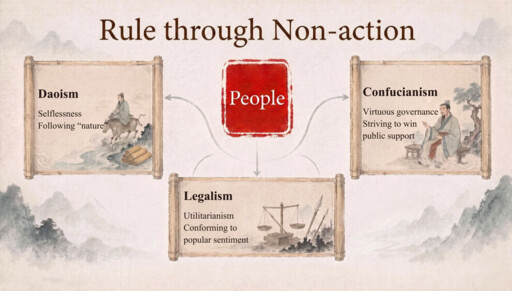
The governance philosophy of “rule through non-action” held that rulers should practice “non-action” out of respect for society’s underlying patterns, while recognizing the normative significance of human nature and the will of the people. Image generated by AI
In early Chinese political thought, wuwei er zhi—“rule through non-action”—was a widely shared governance ideal. During the pre-Qin period (prior to 221 BCE), Confucian, Daoist, and Legalist thinkers all explicitly articulated concepts of “non-action” or “rule through non-action.”
Regardless of the school advocating it, however, “rule through non-action” never meant doing nothing or remaining idle in the governance of society. Rather, it held that rulers should practice “non-action” out of respect for society’s underlying patterns, while recognizing the normative significance of human nature and the will of the people.
Conforming to human nature and attending to popular sentiment were thus understood as the basic approach to social administration, as well as the value orientation and ultimate purpose that should guide it.
Daoism: People’s mind as basis of governance
Laozi believed that only by truly achieving complete “selflessness” could one “achieve one’s own private ends.” For those who govern, the key to so-called “non-action” lies in overcoming personal desire. Only by fully overcoming such desires and following the laws and requirements of “nature” could a ruler ensure that “nothing is left undone”—in other words, achieve the governance goals of social order, the people’s well-being, and the longevity of rule.
Laozi said: “The sage has no invariable mind of his own; he makes the mind of the people his mind.” If the sage—seeking a stable, orderly, and enduring society—also has a “mind,” that mind can only be directed toward meeting the people’s needs in life, rather than imposing any selfish, subjective will of his own. In this sense, Laozi’s conception of “rule through non-action,” guided by the Dao, takes “the people’s mind” or “popular sentiment” as both the immediate practical basis and the value orientation of social governance.
Confucianism: Popular sentiment as standard of effective rule
Confucius admired Emperor Shun’s “rule through non-action.” As The Analects put it: “May not Shun be instanced as having governed efficiently without exertion? What did he do? He did nothing but gravely and reverently occupy his royal seat.” Confucius sought the governing effect described as: “He who exercises government by means of his virtue may be compared to the north polar star, which keeps its place and all the stars turn toward it.”
To achieve this effect, he invoked the principle of “making more beneficial to the people the things from which they naturally derive benefit” as a guide to government. In other words, those who governed should follow the people’s wishes and respond to them through practical, effective measures.
In Confucian thought, whether a policy accords with popular sentiment is the most direct value standard by which its reasonableness should be judged. The ability to “win the people’s hearts” is the foundation upon which political authority gains public recognition and support.
Mencius inherited Confucius’ views on virtuous governance and benevolent rule, holding that a ruler’s power and status are derived from the recognition of the common people. Rulers who retained power over long periods did so precisely because they won the people’s hearts; those who lost power did so because they forfeited popular support.
To ensure the long-term stability of a regime, rulers had to understand the direction of popular sentiment and bring tangible benefits to the people. Mencius therefore emphasized that rulers should listen fully to the people’s views when making decisions and use those views as the basis for judging whether a course of action was appropriate. Even in matters as grave as military expeditions, acceptance or rejection should depend on whether the proposed action conformed to popular sentiment.
Legalism: Thinking from the ruler’s standpoint
The Legalist school, proceeding from a utilitarian perspective, likewise held that rulers should achieve “rule through non-action” by conforming to popular sentiment. Unlike Confucian scholars such as Mencius, who maintained that “the people are more important than the ruler,” pre-Qin Legalists reasoned entirely from the ruler’s standpoint.
Legalists from the Three Jin states—Han, Zhao, and Wei—including Shang Yang and Han Fei, consequently displayed seemingly contradictory attitudes toward the people and their wishes. They acknowledged a conflict of interest between ruler and people and, in defending the ruler’s interests, belittled the people’s will and needs. Yet they also recognized that if the ruler’s interests were to be truly maximized in practice, the people’s will and needs could not simply be disregarded.
They often portrayed harsh punishments, strict laws, and incentives for agriculture and warfare as measures intended to benefit the people over the long term, despite their immediate severity. In their view, mechanisms such as rewards and punishments were necessary if the ruler was to conform to human nature. Applied fully and appropriately, these measures would allow the ruler to “not weary himself with affairs” and thereby achieve “rule through non-action.”
The Qi Legalist school expected rulers to pursue dominion over the realm by first fully understanding and respecting the people’s needs, and then governing in accordance with popular sentiment.
Broadly speaking, the Legalist conception of “rule through non-action” aimed to secure maximum governing effectiveness at minimum cost. Although Legalist thinkers placed great emphasis on the ruler’s interests, they still recognized that conforming to popular sentiment was fundamental to achieving the ruler’s objectives.
Essentially people-oriented politics
In short, “non-action” does not mean that rulers or social administrators need not concern themselves with the people’s livelihood. Rather, under the guiding principle that “Heaven created the people and established their ruler to benefit them,” it required those who wield power to clearly understand their position and define their responsibilities. They must not make their own subjective preferences, preconceptions, or personal desires the objectives of governance, but should instead strive for a state of selflessness by maintaining “no fixed mind of their own.”
In this way, popular sentiment, understood as embodying a universal value, becomes the most direct value orientation for social administrators in their governance practice. In this sense, “rule through non-action” is essentially a form of people-oriented politics. As Mencius put it: “When a ruler rejoices in the joy of his people, they also rejoice in his joy; when he grieves at the sorrow of his people, they also grieve at his sorrow.”
In modern terms, the basic goal of governance is to satisfy the people’s needs and aspirations, while the standard of political judgment is whether the people themselves are satisfied and pleased. Only on this basis can social order and long-term stability be secured.
A persistent tension nevertheless remained between theory and practice. Even at the conceptual level, ancient China witnessed continuing political debates over whether the ruler or the people should constitute the foundation of governance.
Moreover, although ancient Chinese scholars developed extensive arguments for ideas such as “non-action” and “people-oriented governance,” the reality of monarchical centralization never produced comprehensive institutional arrangements consistent with these ideals. Reliance solely on the moral cultivation and self-awareness of those in power made it impossible for rulers or social administrators to fully overcome the pursuit of special interests and the assertion of personal will, and thus to realize true “non-action.”
Consequently, the ideal state of “rule through non-action” and people-oriented governance was never actually achieved in traditional society. Nevertheless, this ideal—which took popular sentiment as its value pursuit and sought to maximally reconcile conflicts of rights or interests between rulers and the ruled—still carries positive historical significance.
In terms of contemporary relevance, the idea of “rule through non-action,” particularly as developed by the Confucian and Daoist schools, offers a way of understanding the relationship between administrators and the administered, and between those in power and ordinary people, that differs from Western traditions of political thought. It also provides cultural resources and historical reference for reexamining the relationship between power and the people today, and for implementing a people-centered development philosophy through stronger institutional arrangements.
Zhao Qingwen is a professor from the School of Philosophy and Public Administration at Henan University.
Editor:Yu Hui
Copyright©2023 CSSN All Rights Reserved