


How did ‘real-person vibes’ become buzzword on social media?
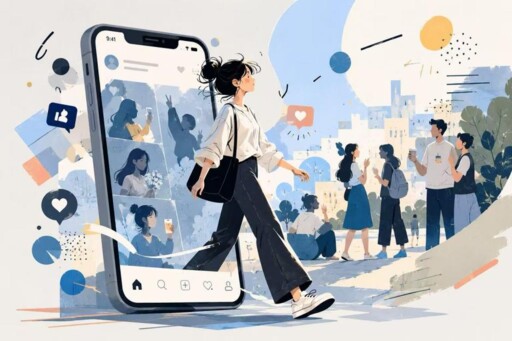
“Real-person vibes” reflect the autonomy and richness of an individual’s inner experience. Image generated by AI
From social media to everyday conversation, “huo ren gan,” or “real-person vibes,” has become a popular internet buzzword among young people. They use it to praise expressions that feel genuine and natural, while also conveying a longing for a more autonomous and vibrant way of life. But why have “real-person vibes” gone viral? What shifts in social attitudes and the communication environment does the phrase reflect? And when authenticity itself becomes something to pursue, does “performing authenticity” become a new form of identity discipline?
Perceived authenticity
A livestreamer’s slip of the tongue during a broadcast, an interviewee’s momentary pause, an ordinary person candidly sharing their failures—content once regarded as “flawed” is now often praised by netizens for its “real-person vibes.”
“The first time I noticed ‘real-person vibes,’ it was in the ‘secondary discourse’ found in the comment sections of short-video platforms and social media. Users employ it to distinguish between expressions that ‘sound like a real person talking’ and those that ‘feel like they were generated from a template,’” said Deng Jianguo, a professor from the School of Journalism at Fudan University.
According to Hou Yubo, an associate professor at the School of Psychological and Cognitive Sciences at Peking University, “real-person vibes” reflect the autonomy and richness of an individual’s inner experience—a positive, authentic, and self-directed state of being. People who retain a strong sense of their own presence and agency while actively constructing goals and meaning in life tend to exhibit stronger “real-person vibes.” Those who lack this sense, Hou explained, are more likely to slip into a passive, empty, and alienated state.
From the perspective of communication studies, “real-person vibes” are not synonymous with authenticity itself, but rather represent an audience’s judgment of the authenticity of media content. Deng noted that texts capable of evoking this feeling often possess qualities such as “incompleteness,” “contextual embeddedness,” and “exposure of the subject.” In other words, people are not necessarily seeking information that is absolutely true, but expressions through which they can sense the presence of a distinct individual.
Sun Jianmin, a professor from the School of Labor and Human Resources at Renmin University of China, first encountered the concept in an entertainment news story. A celebrity’s agent had rejected unreasonable work arrangements and responded humorously to an overwhelming workload, prompting netizens to praise the agent’s “real-person vibes.” In Sun’s view, when a quality that should be a matter of common sense must be repeatedly affirmed through an internet buzzword, that is precisely a sign of its growing scarcity in real life.
Scholars generally agree that the popularity of “real-person vibes” is closely connected to the psychological concepts of authenticity and genuineness. Hu Penghui, an associate professor from the School of Sociology at Huazhong University of Science and Technology, defined it as “the free expression and autonomous enactment of an individual’s genuine inner emotions, feelings, and intentions.” Criticism of a lack of “real-person vibes” ultimately points to the increasingly scripted and procedural nature of social life. Under the combined influence of external evaluation systems, social norms, and platform logic, more and more people are living performatively according to predetermined scripts, while vivid personal expression and authentic life experiences are steadily being squeezed out.
Authenticity anxiety in age of technology
The rapid rise of “real-person vibes” is by no means a linguistic accident. Rather, it is the product of social emotions, changes in the communication environment, and technological developments working in concert.
Cheng Boqing, a professor from the School of Sociology at Nanjing University, noted that the evolution of internet buzzwords in recent years is particularly revealing. Public attention has gradually shifted from joking about and defusing the pressures of the real world to reaffirming authentic existence, the texture of everyday life, and the value of individual subjectivity.
The scholars interviewed agreed that shifts in the communication environment have been an important force behind the popularity of “real-person vibes.” Platform algorithms have long favored highly polished, tightly structured, and easily replicable content, pushing online expression toward ever greater “templateization.” Meanwhile, AI has dramatically lowered the barriers to content creation, making linguistic styles even more homogeneous. Faced with an increasing volume of standardized, interchangeable information, people have begun turning their attention back to content that bears personal traces, emotional nuances, and expressive imperfections, regarding these qualities as “evidence of being human.”
“At its core, ‘real-person vibes’ are a form of compensatory discourse emerging from an imbalance in the communication ecology,” Deng argued. As algorithmic logic increasingly standardizes content production, audiences develop a greater affinity for expressions that may be imperfect but convey a stronger sense of individual subjectivity. Rather than treating “real-person vibes” as an entirely new phenomenon, Deng suggested, they are better understood as an affirmation of the self by people navigating a highly technology-mediated environment.
From a psychological perspective, the popularity of “real-person vibes” also reflects public unease over “dehumanization.” Xu Yan, a professor from the Faculty of Psychology at Beijing Normal University, noted that humans define themselves not only in contrast to animals, but also to machines. When people become increasingly indifferent, numb, and instrumentalized—operating like machines—they instinctively seek out the qualities that embody human emotion, creativity, and autonomy.
Cheng further explained that as digital technologies and virtual media become deeply embedded in everyday life, social relationships grow increasingly abstract and indirect. This, in turn, intensifies people’s desire for genuine interaction, authentic emotion, and a real sense of presence. In this respect, “real-person vibes” are also an expression of the anxiety particular to our era.
Beware of ‘performing authenticity’
The popularity of “real-person vibes” has weakened an evaluation system based solely on traffic metrics and polished production. In Sun’s view, if enough people recognize and internalize this signal, it could exert a corrective influence, helping individuals shed some of the burden of constant performance and reducing emotional exhaustion.
Hou likewise noted that, at the societal level, the rise of discourse surrounding “real-person vibes” is prompting a reexamination of the logic by which well-being indicators are constructed. The growing willingness of young people to express their own views should be recognized as a positive social trend: The reasonable articulation of opinions and communication of needs can contribute to institutional improvement and social progress.
However, scholars also cautioned that the risk of commodifying “real-person vibes” should not be overlooked. First, they can be strategically manufactured and transformed into a new source of online traffic. Deng described this as “carefully designed imperfection”: Once authenticity becomes a scarce resource, it too can be packaged and marketed.
Sun further proposed what he called the “meta-authenticity paradox”: If someone deliberately performs imperfection to appear authentic, that authenticity has itself already become a performance. Some online influencers now deliberately display their shortcomings, voice complaints, and cultivate a casual manner, yet the underlying objective remains the construction of another carefully managed persona.
Second, “real-person vibes” may be misinterpreted as a rejection of professionalism and respect for rules. Hu emphasized that the concept does not mean breaking free from social norms and responsibilities. Authentic expression should rest on a foundation of basic social consensus and public rules; otherwise, it risks becoming an excuse for irresponsible behavior. Xu noted that slacking off or simply giving up should not be equated with “real-person vibes,” which in their genuine form should reflect a positive and healthy state of personality.
Is emphasizing “real-person vibes,” then, ultimately a good or bad thing? Sun argued that no single answer applies in every situation. In low-risk, high-trust social settings—such as private friendships, family relationships, and creative departments—“real-person vibes” can help build deeper connections. In high-risk professional settings governed by strict rules—such as courtrooms, emergency operating rooms, and public service counters—their indiscriminate expression may instead generate conflict and risk. What matters is the degree of “role clarity” and the “severity of the consequences” in a given context.
Between individuality and responsibility, Hou drew clear boundaries around the expression of an individual’s “real-person vibes,” locating their reasonable limits in a dynamic balance between subjectivity and sociality. Individuals must coordinate self-expression and self-realization with social norms and interpersonal responsibilities, preserving their inner subjectivity while also fulfilling their social roles appropriately.
“A healthy society is not one where everyone is required to have ‘real-person vibes,’ but one that creates an environment that allows authentic expression and respects individual differences,” Sun said. Perhaps this is the most important insight behind the “real-person vibes” craze: What people ultimately seek is not another internet label, but a reaffirmation of human value and meaning in an era of accelerating technological change.
Editor:Yu Hui
Copyright©2023 CSSN All Rights Reserved