


‘Cult of technique’ in HSS: When methodology eclipses meaning
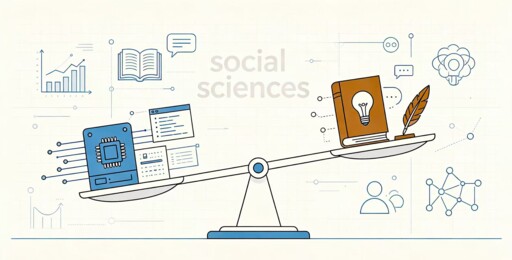
Only by restoring technology to its proper instrumental role and allowing thought to guide research can the humanities and social sciences preserve their intellectual foundations. Image generated by AI
A growing tendency in humanities and social sciences (HSS) research to emphasize innovation in research tools while downplaying problem orientation has drawn increasing attention. Several scholars recently told CSST that, under the incentives created by paper publication and project evaluation mechanisms, this inversion of means and ends is generating a large volume of academic-industrial output that is increasingly sophisticated in technique yet increasingly mediocre in its intellectual contribution.
Research held hostage by technology
“AI, especially the emergence of generative AI, has brought progress at the tool level to humanities and social sciences research,” said Shi Ying, a professor at the College of Humanities and Social Development at Northwest A&F University. In his view, while AI improves research efficiency, it also exacerbates a long-standing tendency toward technicism in social science research—namely, the elevation of technology over substance. The phenomena of “technology for technology’s sake” and “tools for tools’ sake” are becoming increasingly prominent. Some studies do not begin with real-world problems and then seek out appropriate technologies; instead, researchers set their agendas according to the data already available or the modeling techniques they have already mastered.
Zhang Weiguo, director of the Center for Language Economics at Shandong University, pointed to a harsh academic reality: “Academic review has a ‘readability’ threshold. A clean identification strategy and a beautiful regression table—reviewers can instantly recognize the technical effort behind them. But the judgment of ‘whether this question is worth pursuing’ is implicit. The evaluation system thus unconsciously rewards what is visible.”
Sheng Yinan, deputy director of the Institute of Population Economics at the School of Labor Economics, Capital University of Economics and Business, observed that a large number of research topics are “technology-driven”—“although they employ the most cutting-edge techniques, the conclusions they reach are merely common sense.” Quite a few research questions, she noted, “are less derived from a genuine concern with theoretical issues and more from the search for a clean natural experiment.” While good natural experiments are certainly valuable, “behind the increasing sophistication of technical methodologies, there may well be a failure to engage with some of the most important research questions.”
If technology-driven research is the disease, then sophisticated mediocrity is the symptom. Shi said that, in the processes of paper review and project approval, the use of particular models or tools can make it easier for research to pass review. Papers featuring elaborate models and formal rigor have thus given rise to a large body of sophisticated yet mediocre work—“lacking in ideas and arguments, merely proving or falsifying common knowledge—such papers are easy to publish.”
Why are such papers so readily accepted by reviewers? Zhang suggested that the answer lies partly in the relative safety of technical rigor: “A clean identification strategy makes the conclusions ‘hard to attack’; whereas a bold theoretical judgment is vulnerable to criticism at any time. Thus, ‘technically solid but mediocre’ becomes the safe choice.”
Sheng has also observed a “follow suit” mode of knowledge production—“some studies directly take the causal effects identified in Europe and the United States as benchmarks and replicate them using Chinese data. If the results are similar, the article has found its contribution; if not, it discusses China’s particularities. This model is highly efficient in terms of academic production, but it does not constitute an original analytical framework for indigenous Chinese research.”
Such “follow-suit” research is not uncommon in Chinese academic journals. From the standpoint of publication, it represents an efficient mode of production. From the standpoint of knowledge creation, however, it fails to generate genuinely original concepts, frameworks, and theories or to respond adequately to China’s distinctive experiences and problems. It also entails a more insidious danger: the influence it exerts on the intellectual development of young scholars.
Sheng noted that when training in technical methodology occupies an overwhelmingly dominant position, students may become increasingly adept at “running models,” yet progressively less able to scrutinize the models’ underlying assumptions. She mentioned that some doctoral students, from the very beginning of their graduate studies, concentrate on acquiring research techniques and learning how to publish papers as quickly as possible, while rarely taking the initiative to consider why they conduct research, which questions are worth pursuing over a lifetime, and what constitutes good humanities and social sciences research.
Zhang expressed deep concern about this tendency: “If a young scholar just entering the field learns that research is nothing more than an assembly line of find data—run models—write papers, he or she may very well go through an entire career without ever having the opportunity to propose an imaginative theory.”
Core of HSS undermined
How did this technological “involution” come about? Sheng explained that the evaluation system encourages researchers to produce results quickly, further reinforcing path dependence. “Compared with theoretical innovation, the marginal cost of technical innovation is lower. Theoretical innovation often requires reconceptualization, challenging established paradigms, and constructing new analytical frameworks, and its academic value usually takes longer to become apparent; whereas improvements in technical tools and the expansion of their applications can yield visible marginal contributions in the short term.” Under the pressure to “publish or perish,” choosing technically incremental research over theoretically groundbreaking research therefore becomes a rational strategy for academic survival.
Extending this critique, Shi argued that “this is a problem arising from the transplantation of technologies from the natural sciences to the social sciences. Technological iteration and tool innovation have intensified dependence on tools.” Research project approvals and the publication of academic results tend to favor quantitative studies, “which implicitly creates a direction that encourages researchers to place emphasis on the technical dimension.” This orientation is also reflected in talent evaluation, which commonly uses the number of papers published in authoritative or core journals as an indicator of performance. The selection of papers for publication, in turn, often depends on whether they employ models, whether their techniques are standardized, and whether their data are sufficient.
Beneath these institutional factors, Zhang has identified a subtler psychological motivation—“the anxiety of not being hard enough.” This anxiety is rooted in the gap in disciplinary status between the humanities and social sciences, on the one hand, and the natural sciences, on the other. Within the knowledge hierarchy of the modern university, the “hard sciences” enjoy greater prestige, more abundant resources, and higher levels of social trust. The social sciences have sought to follow this trajectory, and quantitative techniques have consequently become not merely research tools but also markers of disciplinary legitimacy.
Thought must take center stage
Faced with this technological “involution,” scholars have resisted pessimism. They agreed that only by restoring technology to its proper instrumental role and allowing thought to guide research can the humanities and social sciences preserve their intellectual foundations in the age of AI.
How, then, should the boundaries of big data, AI, and other technological tools in social science research be delineated? Zhang emphasized that while AI can indeed make research more robust, technical means cannot replace value judgments or theoretical construction. On this basis, he offered three recommendations. At the evaluation level, reviewers must have both the courage and the capacity to assess the substantive importance of a research question rather than focusing solely on technical sophistication. In academic training, young scholars should be taught to think about problems before learning techniques. And in research evaluation, space should be reserved for “slow” research as well as speculative and conceptual inquiry.
Alongside these corrective voices, some scholars have cautioned against swinging too far in the opposite direction. Miao Jianjun, dean of the School of Economics at Zhejiang University, argued that the increasing technicization of social science research reflects a broader trend and can serve as a marker of greater scientific rigor in the field. Research that “sees only techniques but not people” will gradually be phased out, while research that garners widespread citation will necessarily strike a balance between technical tools and humanistic concerns.
Shi likewise stressed that reflecting on the technicization of social science research does not mean denying the value of science, technology, or data in the field. On the contrary, quantitative research has played an irreplaceable role in moving the social sciences toward a more rigorous and testable scientific paradigm.
This debate surrounding technology and the humanities ultimately points to a more fundamental question: How can China’s humanities and social sciences produce truly original knowledge? Zhang argued that genuine originality must come from within rather than from technical novelty alone: “Genuine originality has never been achieved simply by introducing a newer set of technologies. Concepts, frameworks, and judgments about problems must grow from within ourselves.”
In recent years, building an independent Chinese knowledge system has become a prominent topic in academic circles. Yet a closer examination of current research practices reveals a paradox: While Chinese researchers are becoming increasingly aligned with international practice at the technical level—proficiently applying cutting-edge econometric techniques—progress in formulating original questions and developing indigenous theories has been less encouraging. To address this imbalance, Shi called for research to engage directly with social life and practice and draw enlightened intellectual reflection from that engagement.
Editor:Yu Hui
Copyright©2023 CSSN All Rights Reserved