


Making libraries hubs for knowledge sharing and collaboration
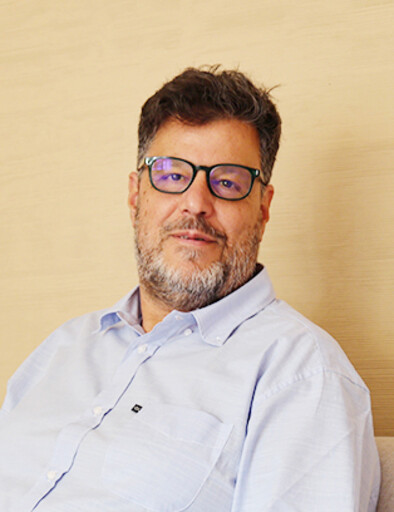
Thanos Giannakopoulos Photo: Lian Zhixian/CSST
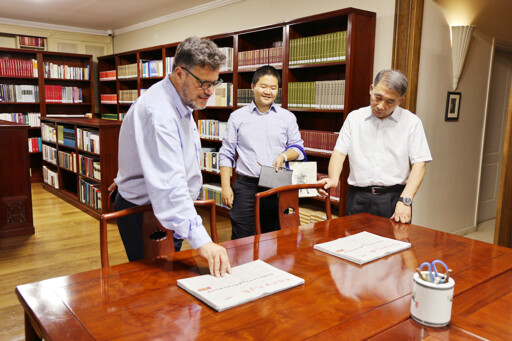
Thanos Giannakopoulos scans the headlines of Chinese Social Sciences Today Photo: Lian Zhixian/CSST
Digital technologies, open science and generative AI are reshaping how knowledge is produced and disseminated—and redefining the role of research libraries in the process. During a recent visit to the Chinese School of Classical Studies at Athens (CSCSA), Thanos Giannakopoulos, chief librarian of the Dag Hammarskjöld Library, the United Nations’ headquarters library, toured its permanent exhibition and spoke with CSST. In his view, research libraries today should move beyond the traditional functions of collecting and preserving documents. In the era of open science, they can draw on their professional expertise to connect researchers, build research communities, and foster collaboration across institutions.
From preserving documents to building research communities
CSST: As digital technologies continue to develop, in what areas should research libraries expand their functions?
Giannakopoulos: Collecting and preserving books and documents is still part of the picture. It’s not that you have to abandon that. It’s just that, in terms of functionality, it has become less central because a lot of content is now being produced online. I think research data management is a major area for research libraries today.
Then there’s community building—serving the community and actually acting as a convener within it. Libraries are also spaces, and it is important to bring people together, particularly researchers. You may have young researchers working away in isolation, doing amazing work but not having opportunities to communicate it.
Libraries have a role to play in helping communicate this work within the research community. A researcher may spend long hours working on a project, then present it at an event hosted by the library, where other researchers can engage with the work. So bringing people together and building a community are important roles for research libraries.
CSST: While continuing to preserve the historical record of the United Nations, the Dag Hammarskjöld Library is increasingly becoming an open platform for knowledge exchange. How has the library expanded its role in this regard?
Giannakopoulos: We continue curating the institution’s historical record and making sure that it is digitized and made available online.
There are still many historic United Nations documents in New York that have not yet been digitized. To conduct historical research on the UN, scholars still need to travel to New York to access those records. That should not be necessary. All of this material should be available online for researchers to access and work with.
At the same time, we increasingly see the library’s mission as extending beyond the preservation of the historical record to encompass the broader role of a research library. Our library in New York supports research undertaken by UN staff, and we also provide support to delegates.
Since 2018, we have been working on a suite of open science projects. We have been pursuing and promoting open data, open access and open infrastructure. This has also helped create a broader community around open science.
From ‘being able to read’ to wider dissemination
CSST: How do you view the relationship between open access and open science?
Giannakopoulos: I think open access requires the freedom to read and publish. It is important that researchers are able to publish their research freely, while also having access to research produced by others.
At the same time, you should have the ability to download the research data or datasets that accompany a publication, reuse that information, and replicate the results. That is fundamental to science, because science depends on replication. If you do not have access to the datasets, you cannot replicate the research.
When we talk about open science, we are talking about opening up the entire research lifecycle, not just the publication stage.
CSST: Can open science truly benefit researchers from different countries and linguistic backgrounds? What obstacles do language differences create?
Giannakopoulos: That would be the dream, but it’s not yet a reality. We know that, at the moment, English is the lingua franca of research, and the services designed to promote research have largely been built around English. I think that is a big issue.
The fact that a research paper has been written in Greek does not diminish the value of the research that was behind it. Knowledge is produced in many languages. But if you go into high-level and mainstream research databases, you realize that this is a considerable issue.
Then there is the issue of unequal infrastructure, right? We have countries that have mature research ecosystems and countries that do not. What does that mean for the research that has been produced in those countries? This is one of the problems that we need to focus on more closely.
Research funders also need to keep this in mind when they support research. Research does not necessarily need to be conducted entirely in English.
Building bridge for Chinese-Greek classical studies
CSST: Since its establishment, CSCSA has organized academic conferences and promoted archaeological cooperation, exchanges among young scholars, and cultural outreach. In your view, what new possibilities can these efforts create for the study of and exchanges between Chinese and Greek classical civilizations?
Giannakopoulos: The forums and conferences are really important. I’ve read about them in Greek newspapers, so it seems that you’re doing a good job of getting the message out there.
I think it is really important that you have an institution rooted in an ancient culture with a base in Athens. It is important for Athens to have a direct connection with Beijing and with another ancient culture that has a very long history and has left an important footprint on human history.
You’re still a young institution, which is really great because that gives you a lot of room for creativity and ingenuity. You can experiment with directions that perhaps other classical studies schools may not feel able to pursue because of their long history and traditions. You have the opportunity to rethink what a classical studies school should be today.
When we grow up, we learn that on the other side of the planet another great civilization was developing. I think it’s really important that this bridge has been created. I don’t know where it will lead, but bridges are about connection. And when we connect as humans, we do wonderful things.
CSST: The CSCSA library is still being developed. For a library serving classical studies, what areas do you think should be prioritized?
Giannakopoulos: I think it would be important to include some seminal works in archaeology for the researchers coming here, including important archaeological research from the different language traditions that carried much of the research in the 18th and 19th centuries.
The collection could also include important and valuable works on modern Greek culture, as well as research on ancient Greece that is still available, whether in print or as datasets.
But the collection itself is not enough if it is not also a vehicle for convening and community building. The collection is valuable—don’t get me wrong—but we shouldn’t stop at the collection. We need to build a community around it.
So, say we acquire a rare 19th-century print. What do we do with it? We don’t just lock it in a glass case and leave it there. That’s how libraries used to be some time ago. It should become part of community building and exchange.
I would also suggest that the library participate in international programs and research library associations, committees and professional networks. That would help bring the library onto the map of research libraries around the world.
There are also opportunities for collaboration on the digital frontier—for example, creating online exhibitions around research, rare books, or documents in the library’s collection. These are all important ways of connecting the library with the wider community of libraries in Europe and beyond.
CSST: Looking five to 10 years ahead, by what standards should we assess whether a young research institute and its library have been successful?
Giannakopoulos: I would look at the coalitions that have been built. What coalitions has the library developed? What projects has the library initiated? What projects has the institute initiated, and what have those projects produced?
Then I would look at the community around the institution. Is that community being convened? Has it been tested?
I think it would be a good idea to run a survey and ask young researchers and young scholars of archaeology what they would expect from a modern classical studies school. Just a simple survey. Then go through the responses and work from the data.
Editor:Yu Hui
Copyright©2023 CSSN All Rights Reserved