


Echoes across Eurasia: Artistic parallels in Chinese, Western civilization
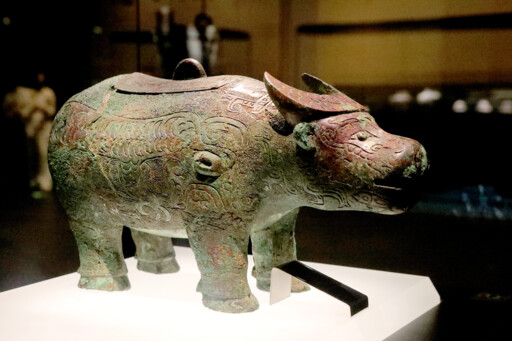
The Shang Dynasty “Yazhang” ox-shaped xizun (sacrificial wine vessel), now housed at the Yinxu Museum in Anyang, Henan Province Photo: CFP
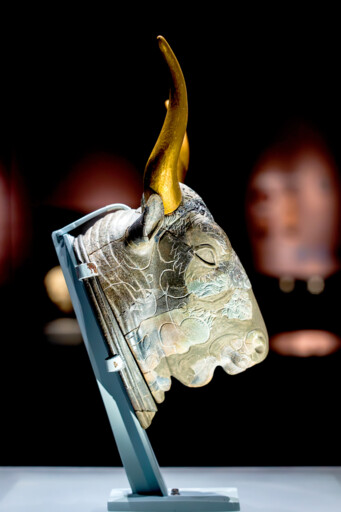
The stone bull-head rhyton in the collection of the Heraklion Archaeological Museum in Greece Photo: CFP
Historical records date official cultural exchanges between China and the West to the opening of the Silk Road during the Western Han Dynasty (206 BCE–24 CE). Yet the artistic affinities between the two civilizations reach much further back. Long before the Silk Road took shape, the early civilizations emerging at opposite ends of Eurasia—China during the Xia (c. 2100–1600 BCE) and Shang (c. 1600–1046 BCE) dynasties, and ancient Greece during the Minoan and Mycenaean periods—were already producing art and literature that displayed striking parallels in their trajectories of development and aesthetic spirit. Such convergences at the dawn of Chinese and Western civilizations amount to more than a remarkable coincidence across vast distances; they offer a glimpse of the universal wisdom and aesthetic imagination shared by humanity during the formative stages of early civilization.
Totemic symbolism of dragon and sea creatures
Geographically, Chinese and ancient Greek civilizations arose in markedly different environments. China’s vast alluvial plains and monsoon climate, with abundant rainfall accompanying the warm growing season, provided fertile conditions for agriculture and helped shape a civilization deeply rooted in agrarian life. Ancient Greek civilization, by contrast, emerged around the Aegean Sea, where rugged terrain, scarce arable land, and a profusion of islands and natural harbors favored seafaring and maritime trade, giving its culture a distinctly maritime character. These contrasting geographical settings, in turn, found expression in the distinctive artistic and literary totems of the two civilizations.
Agrarian communities drew inspiration from the vast expanse of Heaven and Earth, imagining totemic creatures that could soar through the skies. During the Xia and Shang dynasties, motifs such as the kui-dragon, coiled-dragon, and creeping-dragon patterns were used to evoke the dragon’s divine majesty. Embellishing bronze ritual vessels that embodied both authority and belief, these motifs helped establish the dragon as a shared symbol among the Huaxia people, absorbing and integrating the totems of different clans. The dragon expressed an agrarian civilization’s reverence for Heaven, Earth, and the natural world, while also embodying the early ancestors’ desire for communal cohesion. It therefore occupied a place of singular importance in Xia and Shang culture.
Maritime peoples, captivated by the sea’s shifting moods and mysteries, naturally turned to marine life for their totemic imagery. Minoan civilization, centered on the island of Crete in Greece, vividly exemplifies this maritime character in ancient Greek art. Between 1700 and 1450 BCE, dolphins, octopuses, and other sea creatures recurred as prominent motifs on pottery, stone artifacts, and frescoes. Among the best-known examples are the octopus-decorated pyramid-shaped weight and octopus pottery unearthed on Crete, as well as the dolphin frescoes at the Palace of Knossos. Together, they attest to a deep reverence for the mysterious power of the sea and to hopes for safe passage and prosperity.
Chinese totemic traditions embody a reverence for “conformity with the rhythms of Heaven,” while their ancient Greek counterparts express an aspiration toward “communion with the sea.” Though different in form, both reveal a profound respect for the natural world and point to a deeper affinity between the two cultures: Totemic symbols served not only to invoke protection and well-being, but also to affirm a people’s connection to the sacred. Together, they embody a common ethos—the exaltation of life and the veneration of nature.
Artistic visions of xizun and rhyton
The Xia and Shang dynasties marked the height of China’s Bronze Age culture, while Minoan civilization likewise flourished during its own Bronze Age heyday around 1700–1450 BCE. Chinese bronzes were predominantly ritual vessels, whereas their Minoan counterparts were used chiefly as weapons and everyday implements. Yet alongside these objects, the Minoans also produced small bronze cups, jars, and other vessels for ritual and daily use, comparable in form and function to the Chinese jue, gui, and gu. Despite their very different cultural settings, both traditions developed similar vessel forms and incorporated them extensively into communal celebrations and sacrificial rites.
The bull occupies a prominent place in the artistic traditions of both China and the ancient West. The Shang Dynasty “Yazhang” ox-shaped xizun (sacrificial wine vessel), unearthed at the Yinxu site in Anyang, central China’s Henan Province, was modeled after a wild water buffalo regarded as sacred and served primarily as a ritual vessel for holding wine. Minoan archaeological sites have likewise yielded bull-shaped vessels in a variety of forms, perhaps the most striking of which is the stone bull-head rhyton. A rhyton is a ritual vessel designed to hold and pour liquids, with openings at both top and bottom; during sacrificial rites, wine flowed through the lower opening. Minoan bronze flasks also bear engraved scenes of people grappling with bulls, reflecting the bull cult tradition of ancient Crete.
At the formative stages of both Chinese and Western civilization, art reveals a shared impulse to transform animals familiar from everyday life and labor into potent symbolic forms. In sacrificial rites, these images served to appease the gods and invoke favorable weather and abundant harvests; in communal festivities, they became emblems of courage and valor, offering solace to the human spirit. In both settings, animals functioned as tangible symbols through which bonds could be forged between humanity and the divine, within the community, and among individuals—pointing to a deeper, shared human concern with fate and destiny.
Pictographic and linear modes of visual thinking
As Minoan civilization entered into decline around 1450 BCE, Mycenaean civilization on the Peloponnese gradually emerged as the new center of the ancient Greek world. By that time, Chinese civilization had already developed its own system of written symbols. During the Minoan period, ancient Greece had also produced “hieroglyphic script” and Linear A, both believed to have been in use between 2000 and 1450 BCE. Examples of these scripts have been found primarily on clay tablets, yet neither has been fully deciphered. Only after Mycenaean civilization supplanted its Minoan predecessor did Linear B emerge, drawing on certain signs from Linear A while developing a distinct writing system of its own.
This system was later identified as the earliest known written form of Greek and deciphered in the 1950s. Interestingly, some Linear B signs bear a striking resemblance to Chinese pictographic characters. Such morphological parallels do not, of course, suggest a common origin; rather, they reflect comparable ways of observing and transforming natural forms into written symbols.
Unlike the Mycenaeans, who inscribed Linear B on clay tablets, the Chinese recorded pictographic symbols on oracle bones, pottery, and jade. Pictographic characters grew out of recognizable representations of objects, but were never simply copies of what they depicted; some also incorporated indicative or associative elements. Evidence of pictographic symbol-making in China may extend back some 4,800 years. The symbols for “sun,” “moon,” and “mountain” found on the large-mouthed pottery zun unearthed at the Yuchisi site in Mengcheng County, Bozhou, east China’s Anhui Province, for example, are thought to represent possible Neolithic precursors to Chinese characters.
Exploring the convergences between Chinese and Western art and literature at the formative stages of their respective civilizations offers a deeper appreciation of the principle that “all civilizations can appreciate each other’s beauty while valuing their own and achieve common development.” These early artistic parallels can also offer wisdom and inspiration for contemporary cultural exchange and mutual learning between China and the West, while shedding light on the historical relationships among the diverse cultures that have flourished across Eurasia over thousands of years.
Li Yishuai is an associate research fellow from the Institute of Literature at the Chinese Academy of Social Sciences.
Editor:yu-hui
Copyright©2023 CSSN All Rights Reserved