


When grey meets green: Integration of intergenerational care
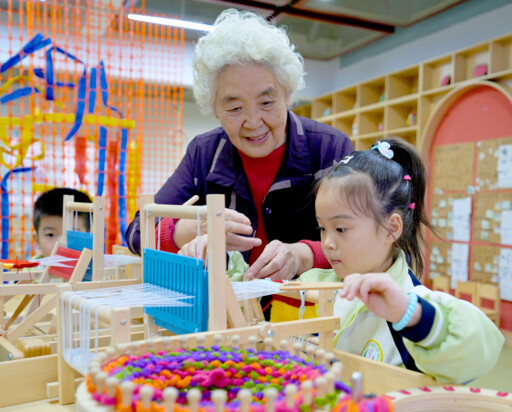
The intergenerational co-care model can make more efficient use of public-service resources while also forging mutually enriching bonds. Photo: CFP
The combined pressures of accelerating population ageing and steadily rising demand for childcare have made care for older adults and young children an increasingly important public-welfare issue, with direct implications for family well-being and social harmony and stability. As fertility declines and household sizes shrink, traditional family-based care arrangements are gradually weakening, while caregiving responsibilities are increasingly shifting from individual households to society at large. Integrated intergenerational co-care has emerged in response. By bringing eldercare and childcare together in spatial planning, resource allocation, and service provision, this model can make more efficient use of public-service resources while also forging mutually enriching bonds between older adults and children, strengthening emotional connections and enabling the two generations to contribute to one another’s well-being.
Social foundations
The symbiotic logic of intergenerational co-care rests on two foundations: the social ethic of mutual support across generations and the economic logic of resource integration. Its central aim is to overcome the fragmentation of eldercare and childcare services and generate synergies greater than the sum of their parts.
From a social-ethical perspective, intergenerational mutual assistance lies at the heart of traditional Chinese family culture. For generations, family-based childcare relied heavily on an intergenerational caregiving model in which grandparents played an important role in raising children. Intergenerational co-care extends this tradition of mutual assistance within families into shared community spaces and, through institutional design, reshapes interactions between generations. Older adults are no longer treated merely as passive recipients of care: Their accumulated life experience and practical wisdom can become valuable resources in caring for young children, while accompanying children as they grow can bring a sense of personal value and emotional fulfillment. Children, in turn, experience the care and affection of older adults through everyday interaction, developing respect for elders and an appreciation of cultural traditions.
From the standpoint of resource allocation, eldercare and childcare have much in common in terms of basic care facilities, logistical support, and professional services, providing a solid practical basis for integration. In terms of physical infrastructure, kitchens, laundries, activity areas, and other essential facilities can be shared across service settings, while the coordinated deployment of fire-safety, security, and medical-support facilities and equipment can significantly reduce the costs of duplicative construction. In workforce deployment, general functions such as cleaning, security, and logistics management can be centrally coordinated, while social workers, healthcare professionals, and other specialists can provide services across both domains, allowing human resources to be used more efficiently and improving service delivery. At the operational level, coordination through community public-service platforms can bring together volunteers, cultural resources, and other social assets, thereby diversifying co-care services. This integration of resources can help ease imbalances between supply and demand in public services, reduce operating costs, and offer a practical path toward the sustainable development of affordable and broadly accessible eldercare and childcare.
Practical obstacles
In response to the family-care challenges created by the combined effects of population ageing and declining fertility, a number of localities have introduced intergenerational co-care pilots, integrating eldercare and childcare resources and steadily improving care services for both older adults and young children. In developing service facilities, these initiatives have put underused community premises, older neighborhood service stations, subdistrict integrated-service centers, and other existing public assets back into use. Standardized age-friendly and child-friendly renovations, together with functional upgrades, have transformed such sites into one-stop community hubs combining daytime eldercare, health and wellness services, meal assistance, inclusive childcare, and after-school care. This approach helps address dispersed facilities, low utilization rates, and duplicative construction at the community level. In service delivery, providers closely match services to older adults’ needs for assistance with daily living, health maintenance, rehabilitation, and emotional support, as well as to infants’ and young children’s needs for nurturing care, early learning, and safe supervision. By offering core services to both groups on a routine basis, communities can extend care coverage across age groups. Intergenerational engagement is fostered through activities such as shared reading, folk-culture experiences, collaborative crafts, and programs centered on family traditions, creating regular opportunities for meaningful interaction. Resource coordination further allows security, healthcare, logistics, sanitation, and disinfection personnel to be jointly deployed, while venues and equipment for rehabilitation, infection prevention, and recreation are shared, substantially reducing the costs of building and operating public services. Overall, the model alleviates the care burden borne by working-age families, addresses older adults’ emotional needs while supporting children’s holistic development, strengthens community life through intergenerational warmth, and provides an embedded, public-interest-oriented model of inclusive service provision suited to a range of urban and rural settings.
As an innovative model of public-service provision, intergenerational co-care has already demonstrated considerable benefits for public welfare and broader social development in local pilot programs. Yet these experiments have also exposed policy barriers, gaps in standards, and insufficient professional support, all of which limit the model’s ability to fully realize its potential.
Fostering mutualistic symbiosis
To further develop intergenerational co-care and foster a mutually beneficial relationship between older adults and children, a multidimensional support system is needed, encompassing policy coordination, resource integration, professional support, and social participation. Together, these measures can help address the multiple obstacles that have emerged in practice.
First, stronger high-level policy design is needed to dismantle policy barriers and establish cross-departmental mechanisms for collaborative governance. The respective responsibilities of civil affairs, health, housing and urban-rural development, and other relevant authorities should be clearly delineated, and a regular mechanism for coordination and consultation should be established. Administrative procedures for establishing and approving intergenerational co-care institutions should be streamlined through the introduction of a one-stop filing system. Unified standards should also be developed for spatial design, safety oversight, public health, and infection prevention, with clear requirements for age-friendly and infant- and child-friendly facilities. In terms of policy support, dedicated subsidy resources for eldercare and childcare should be integrated, a special support fund for intergenerational co-care should be established, and policy tools such as tax incentives and rent reductions should be used to encourage private-sector participation, creating a diversified funding support mechanism.
Second, the professional support system must be strengthened to enhance service quality and develop services tailored to the distinct needs of both groups. This requires, first, training more interdisciplinary professionals by encouraging universities and vocational institutions to establish programs integrating eldercare and childcare, while strengthening in-service training to improve the ability of existing staff to work across both fields. Service design should also be refined by bringing in professional social workers, early-childhood education specialists, geriatric care workers, and other qualified practitioners. In light of the groups’ different ages and needs, providers can develop customized initiatives such as grandparent-and-child learning programs, traditional-craft workshops, and intergenerational games, allowing older adults and children to contribute to and benefit from one another. Supporting facilities must also be improved. Spatial layouts should balance opportunities for interaction with the need for privacy, provide both shared activity areas and separate rest spaces, and include specialized equipment for infection prevention, emergency response, and first aid to safeguard the health and safety of older adults and children alike.
Finally, broader social engagement is needed to build public consensus and cultivate an age-inclusive social environment. Community outreach, public education through the media, and other communication channels should be used to promote understanding of the principles and practical benefits of intergenerational co-care, address misconceptions about its safety and professionalism, and encourage greater family participation. Community residents and nonprofit organizations should be encouraged to take part in the oversight and operation of co-care services, creating a pluralistic governance framework led by government, with broad social participation and coordination with families. At the same time, locally adapted innovation should be encouraged. In view of differences in demographic structure, levels of economic development, and cultural traditions, localities should explore diverse models—including community-embedded services, institutional partnerships, and public-interest-led provision—rather than pursuing a uniform, one-size-fits-all model.
Intergenerational co-care is not simply a combination of eldercare and childcare services; it is an important vehicle for building an age-inclusive society. At its core, the model uses institutional innovation to optimize the allocation of resources across generations and foster reciprocal emotional enrichment.
Hou Wanfeng is a research fellow from the Institute of Public Policy at Gansu Academy of Social Sciences.
Editor:Yu Hui
Copyright©2023 CSSN All Rights Reserved