


New archaeological evidence reveals a fuller picture of Eurasian exchanges
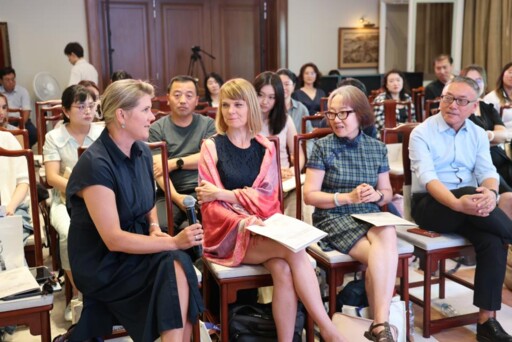
Symposium participants discuss new archaeological findings on Eurasian exchanges. Photo: Lian Zhixian/CSST
Broomcorn millet, a crop native to northern China, was already spreading westward across Eurasia thousands of years ago. Domesticated silkworm cocoons unearthed at Bronze Age sites in Central Asia suggest that Chinese sericulture and silk-weaving technology may have reached the region as early as 4,000 years ago. As new archaeological evidence continues to emerge, a richer and more concrete picture is taking shape of how Chinese civilization reached beyond its borders and participated in exchanges across Eurasia.
On Aug. 29, the Chinese School of Classical Studies at Athens hosted a symposium titled “Beyond the Silk Road: Archaeological Perspectives on East-West Connections.” Scholars from universities and research institutions in China, the United Kingdom, the United States, Kazakhstan, Lithuania, Hungary, and other countries approached the subject from different perspectives, drawing on a range of evidence and methods to examine Eurasian exchanges spanning several millennia.
Tracing China’s Eurasian exchanges further back
As archaeological discoveries continue to accumulate across Eurasia, growing evidence suggests that China’s exchanges with Central Asia, West Asia and Europe can be traced further back than previously understood. Giedrė Motuzaitė Matuzevičiūtė , a professor of archaeology from Vilnius University in Lithuania, has long studied the spread of broomcorn millet across the continent. According to Motuzaitė Matuzevičiūtė, the crop was domesticated in northern China before gradually spreading westward across Eurasia. It reached Europe around 1600 BCE and spread rapidly through Central Europe and the northern Mediterranean.
New findings relating to sericulture offer important clues to the early westward spread of Chinese technology. Shen Hui, an associate research fellow at the Institute of Vertebrate Paleontology and Paleoanthropology of the Chinese Academy of Sciences, reported that archaeological fieldwork and flotation sampling at several Bronze Age sites in southern Uzbekistan between 2017 and 2019 yielded three ancient silkworm cocoons. Direct dating of one cocoon placed it in the early second millennium BCE. The cocoons, mulberry remains, and materials related to textile production together indicate that activities associated with sericulture were taking place in southern Central Asia around 4,000 years ago.
Liu Xinyi, a professor of archaeology from Washington University in St. Louis, placed the discovery within the longer history of prehistoric Eurasian exchanges. Over the past 15 to 20 years, research has gradually revealed what he described as a process of “globalization” across Eurasia from the late Neolithic to the Bronze Age. Barley, wheat, goats, sheep and cattle domesticated in West Asia spread eastward into China, while crops domesticated in China, including broomcorn millet, traveled westward to the northern shores of the Black Sea, Eastern Europe and beyond, substantially influencing prehistoric diets and cultural traditions in those regions. “This was a two-way process,” he said.
For Liu, the new sericulture discoveries add another dimension to this picture. Earlier research largely examined prehistoric Eurasian exchanges through the spread of domesticated plants and animals. The new evidence suggests that sericulture—including silkworm rearing, mulberry cultivation, and techniques centered on the Chinese domesticated silkworm—may already have formed part of these early exchange networks.
Liu also pointed out that ancient Eurasia encompassed different traditions of silk production. Central and South Asia had long used silk from different wild silkworm species, suggesting that silk production along the early Silk Road may have involved multiple technological traditions. Current evidence indicates that Chinese sericulture technology had already spread westward at an early date, although further archaeological work is needed to clarify the specific routes of transmission.
For later periods, more abundant written records and material evidence make it possible to trace the westward movement of Chinese silk textiles with greater clarity.
Li Jinxiu, a research fellow from the Institute of Ancient History of the Chinese Academy of Social Sciences, has used documents from Dunhuang and Turfan to trace the movement of silk from Jiannan Circuit during the Tang dynasty. Her research shows that silk textiles from Yizhou, Zizhou and other parts of Jiannan entered the official transport system and were sent to the Hexi and Longyou regions. Once they reached the Western Regions, official transport and private trade converged: The textiles were used for military supplies, government expenditure and salaries, while also entering market circulation. Traveling merchants, especially Sogdian merchants moving between Hexi and the Western Regions, carried these textiles onward to the Eurasian steppe.
At the other end of Eurasia, Chinese silk also left material traces. Krisztina Hoppál, head of the Roman World and the Far East Research Group at Eötvös Loránd University in Hungary, told CSST that silk textiles displaying clear characteristics of Chinese weaving had been found at Palmyra in Syria. These finds suggest that not only raw materials such as Chinese silk thread, but also weaving traditions and artistic elements, may have traveled westward through trade networks into the eastern Roman Empire.
Xinjiang as a hub of exchanges between East and West
Interdisciplinary archaeological research in Xinjiang has continued to expand in recent years. From the prehistoric spread of species and technologies to exchanges involving cities, religions, art, and everyday life in historical periods, this region at the heart of Eurasia served both as a link between China’s Central Plains and Central Asia, West Asia, and more distant regions, and as a space where cultural elements from different civilizations were continually absorbed and integrated.
For Ren Guan, an associate professor from the School of History at Renmin University of China and director of archaeological excavations at Tangchaodun, Xinjiang’s role as a hub of Eurasian exchange begins with its geography. Long-distance travel depended on reliable supplies, and oases north and south of the Tianshan Mountains provided travelers, caravans, and official missions with water, food, and other provisions. These oasis cities thus became crucial nodes linking different regions, helping to make Xinjiang a core zone of connectivity across Eurasia.
“It was the crossroads of Eurasia,” Ren said. “Because of this distinctive location, Xinjiang was a hub of exchanges between Eastern and Western civilizations in both prehistoric and historical times.”
Ren identified “harmony amid diversity and harmonious coexistence” as a defining feature of cultural exchange along the ancient Silk Road.
Tangchaodun, on the northern slopes of the Tianshan Mountains, remained in use from the seventh to the 14th century. According to Ren, excavations across the city site, covering less than 160,000 square meters, have uncovered a Buddhist temple, a Nestorian Christian monastery, and remains associated with Zoroastrianism. People of different origins and faiths lived side by side in the city over an extended period, reflecting the multicultural coexistence that characterized societies along the Silk Road.
Murals in Tangchaodun’s Nestorian Christian monastery display artistic elements from Greek, Sasanian Persian, Central Asian Sogdian, and indigenous Chinese traditions. Ren explained that, as cultures came together, they influenced one another and incorporated new elements, giving rise to localized forms adapted to the surrounding society. These forms could then spread outward in different directions to other regions.
Tangchaodun’s public bathhouse preserves evidence of a technological journey across Eurasia. Its underfloor heating technology can be traced to the ancient Greek and Roman world. As it traveled eastward through West and Central Asia, it underwent successive changes. After reaching Xinjiang, this imported construction technique was further adapted to local environmental conditions and everyday needs.
“People influenced one another and drew on each other’s strengths, leading to new creations and further development,” Ren said. For him, this “harmonious coexistence” reflected a defining feature of cultural interaction along the Silk Road and gave the small city of Tangchaodun the distinctive vitality that sustained it for more than 700 years.
Several scholars emphasized that the Silk Road was not a single route, but a vast, evolving network made up of multiple routes and nodes. Discussions of East-West exchanges have often focused on major centers such as Chang’an and Samarkand. Yet how these distant centers were connected, and what roles the many small and medium-sized cities between them played, remained poorly understood for a long time.
As more of these smaller cities north and south of the Tianshan Mountains are excavated, the intermediate nodes connecting the two ends of long-distance exchange are gradually coming into view. The discoveries are bringing into clearer focus how Chinese civilization gradually reached wider Eurasia through specific communities, routes, and cities.
Hoppál’s research into relations between China and the Roman world also highlights Xinjiang’s importance. She explained that Eurasian exchange did not follow a single fixed route over time, and that the relative importance of maritime and overland connections also varied from period to period. Xinjiang long held an important position within the extensive overland networks. During certain periods, different cultural elements converged there and, through sustained contact, were integrated and transformed, giving rise to new local cultural forms.
Xinjiang was therefore more than a geographical “corridor”—it was also a place where exchange took place, cultural elements were recombined, and new cultural forms continually emerged. The culture of China’s Central Plains continued westward through the region, while incoming cultural influences were accepted and integrated into local life. Xinjiang thus offers a historical window onto how Chinese civilization engaged with the wider world while remaining open and inclusive through exchange.
Editor:Yu Hui
Copyright©2026 CSSN All Rights Reserved