


Museums as ambassadors of cultural exchange
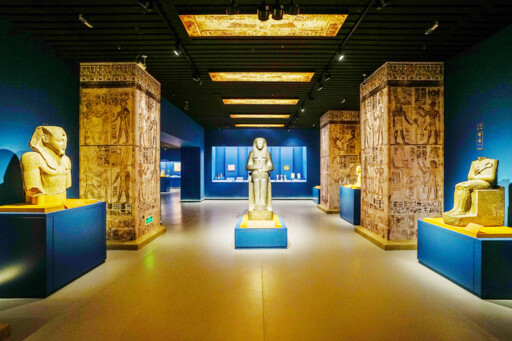
FILE PHOTO: The exhibition “On Top of the Pyramid: The Civilization of Ancient Egypt,” on display at the Shanghai Museum on People’s Square from July 19, 2024 to Aug. 17, 2025.
Beyond collecting, preserving, exhibiting, and interpreting cultural heritage, museums are increasingly serving as spaces for cross-cultural dialogue. In recent years, museums in China and abroad have used exhibitions to forge closer ties while expanding the range of interactive exchanges. As curatorial priorities shift and new forms of collaboration emerge, dialogue among civilizations has become a more pronounced feature of these exchanges.
Localizing exhibition themes
Historically, imported exhibitions often emphasized spectacle. Exhibitions of ancient Egyptian civilization, for example, frequently centered on visually striking elements such as mummies and pyramids, satisfying audiences’ curiosity about the “Other” while offering relatively little cultural depth. The “On Top of the Pyramid: The Civilization of Ancient Egypt” exhibition, launched at the Shanghai Museum in July 2024, broke with the conventional practice of passively accepting prepackaged lists of foreign objects. Instead, the Chinese curatorial team developed the exhibition around three thematic units—“The Land of the Pharaohs,” “The Secrets of Saqqara,” and “The Age of Tutankhamun”—and selected objects in collaboration with Chinese Egyptologists. For “The Land of the Pharaohs,” Chinese curators made five or six trips to Egypt, each lasting about a month, systematically examining museum collections to identify key royal sculptures. “The Secrets of Saqqara,” meanwhile, showcased the latest results of joint Chinese–Egyptian archaeological work at the Saqqara necropolis, including more than 400 excavated objects displayed for the first time.
Beyond integrating Chinese perspectives into thematic narratives, museums are increasingly emphasizing the juxtaposition of Chinese and foreign objects as a means of fostering dialogue between civilizations. “A Gift of the Nile: Ancient Egyptian Artifacts and Digital Art Experience Exhibition,” the special exhibition at the Nanyue King Museum in Guangzhou (February–October 2026), for instance, brought ancient Egyptian civilization, nurtured by the Nile, into dialogue with China’s Lingnan culture, shaped by the Pearl River. The Egyptian Sphinx and the Nanyue gold-inlaid bronze tiger tally, as well as mummies and the jade burial suit threaded with gold wire, speak to a shared ancient longing for eternal life. In 2024, the Anhui Museum’s “Gazing toward Olympus: The Ideal Life of the Ancient Greeks” paired three Chinese objects from its own collection with ancient Greek artifacts. A painted pottery wine vessel was displayed alongside a Chinese bronze wine vessel, while a statue of the Greek poet Pindar was paired with a memorial archway from She County, Anhui Province. Separated by vast distances, these objects nevertheless reveal a shared pursuit of the ideal life across civilizations. Also in 2024, the Sichuan Museum’s “Art and Life: Valery Lednev’s Oil Painting Exhibition” featured more than 20 Sichuan-themed works created during Lednev’s visits to China. A projection of Mount Qingcheng accompanied “Fog in the Back Mountains of Qingcheng,” while an immersive setting surrounded “A Wedding in Aba, Sichuan,” creating a layered visual environment where Russian realist painting and China’s Bashu culture converged.
Thus, cross-cultural exhibitions are shifting from passive reception and the wholesale import of prepackaged exhibitions toward active object selection and localized presentation. The incorporation of Chinese elements and perspectives reflects a growing cultural self-awareness among Chinese museums, while fostering a process of cultural “decoding,” “re-encoding,” and, ultimately, the creation of resonance through equal exchange.
Building interactive models through multidimensional collaboration
Digitalization is reshaping how museums conduct cross-cultural exchange, enabling new models that are lower-cost, immersive, and sustainable. Since 2023, the China National Silk Museum has launched global touring exhibitions combining physical objects with digital technologies to bring Chinese silk culture to international audiences. At the “Wonderful Silk Road” Chinese Silk Art Exhibition in Budapest, Hungary, it pioneered the concept of “taking a USB drive on tour”: 60 objects or sets were exhibited in just 500 square meters at a total cost of RMB 700,000. It subsequently launched the “Global Showcase” project, using multimedia lighting, 3D animation, virtual reality, and other technologies to bring digital representations of cultural artifacts vividly to life.
The “A Gift of the Nile” exhibition at the Nanyue King Museum in Guangzhou employed technologies including large-scale VR, glasses-free 3D, and AI reconstruction, enabling visitors to virtually explore the interior of a pyramid and take part in an immersive search for a “digital black cat.” Digital technologies can overcome geographical and spatial constraints, ease environmental requirements for certain fragile objects, and reduce both exhibition installation times and associated costs. Their low cost, ease of maintenance and installation, mobility, and potential for standardized reuse offer museums an efficient new model for cross-cultural dissemination. The China Archaeological Museum’s “From the ‘Nine-Story Tower Haunted by Ghosts’ to the Tomb of King Achai: Exhibition of Treasures from the Reshui Graveyard in Dulan, Qinghai” similarly used industrial CT scanning and high-resolution 3D imaging to recover a camel motif and ancient Tibetan script concealed beneath corrosion on the Seal of King Achai.
The “develop once, reuse globally” model of digital exhibitions is supported by collaboration between Chinese and foreign museums across multiple dimensions. First, exhibition content is co-developed through bilateral consultation, with Chinese perspectives and elements incorporated to minimize cultural barriers to interpretation and connect exhibitions with broader social and cultural events. The Sichuan Museum’s Lednev exhibition, for example, coincided with the 75th anniversary of the establishment of diplomatic relations between China and Russia, helping broaden its reach and social impact.
Second, collaboration extends to the sharing and integration of resources. The Shanghai Museum’s ancient Egyptian exhibition builds on years of archaeological collaboration between Chinese and Egyptian scholars at Saqqara, extending from academic cooperation and capacity building to an integrated framework encompassing excavation, knowledge transfer, research and conservation, and exhibition. In 2026, as China and Egypt mark the 70th anniversary of the establishment of their diplomatic relations, the Shanghai Museum will continue its digital research and conservation project on newly excavated Saqqara objects and advance archaeological collaboration at Egypt’s Temple of Sekhmet. It also plans to explore an overseas “Shanghai branch,” opening longer-term channels for taking exhibitions abroad.
Third, collaboration is being strengthened at the strategic level. Beyond bilateral museum cooperation, high-level platforms and alliances are helping facilitate resource sharing and integration. The Silk Road Online Museum (SROM), jointly established by more than 50 cultural and museum institutions under the leadership of the China National Silk Museum, enables cross-border digital curation by recreating exhibition-site environments online. In the exhibition “Silk Connects Mountains and Seas: From China to Brazil,” selected by China’s National Cultural Heritage Administration as part of its first Bridge of Civilizations Program, Chinese and Brazilian teams jointly developed the exhibition online. The Brazilian team invited local designers to create fiber artworks drawing on sericulture culture and incorporating Chinese–Brazilian elements, while the exhibition content could be updated remotely in real time through the platform. In October 2025, the International Alliance of Museums of the Silk Road (IAMS) added eight members during the third Liangzhu Forum, bringing its total membership to 180 institutions across five continents. The IAMS Hangzhou Declaration proposes to “deepen mutual learning among civilizations and safeguard cultural heritage” and “embrace digital technology and foster knowledge sharing,” helping shape a model of international museum cooperation centered on platform-based collaboration, resource integration, and sustainable impact.
Reimagining museums as ‘cultural living rooms’
The significance of cross-cultural museum exchange extends beyond aesthetic appreciation, encompassing mutual learning among civilizations and public diplomacy. At the social level, museums are becoming ever more deeply integrated into urban life, a trend reflected in the dramatic growth of audiences for international exchange exhibitions in recent years. The Shanghai Museum’s ancient Egyptian exhibition exemplifies this expanding public reach. Running for 13 months across two summers, it attracted more than 2.77 million visitors and generated over 30 billion online views and impressions, setting global records for both attendance and overall reach among ticketed special exhibitions. Its appeal extended far beyond the local population, with nearly 70% of visitors coming from outside Shanghai or from overseas. That broader reach was reinforced by integrated cultural-tourism activities, including an ancient Egyptian civilization-themed cruise and a nationwide tour linking pharaohs with intangible cultural heritage, which carried the exhibition beyond the museum and transformed it into a city-wide cultural festival.
At the economic level, museums are building broader ecosystems of cultural consumption through co-branded products, creative merchandise, themed dining, and experiential activities. Suzhou Museum, for example, generated RMB 117 million in cultural and creative product revenue in 2024, the highest annual figure among museums in Jiangsu Province, helping establish a sustainable model in which successful exhibitions support future programming. Its 2024 collaboration with the British Museum on “I am Ashurbanipal: King of Assyria” extended this approach further: A plush toy combining motifs from the Sword of King Fuchai of Wu and an Assyrian sword drew widespread attention, while encouraging visitors to consider similarities and differences between the two civilizations. In this way, the museum itself became a new space for cultural consumption.
At the level of public diplomacy, museum exhibitions are increasingly serving broader national diplomatic objectives. Many have been organized to coincide with anniversaries of diplomatic relations or in connection with the Belt and Road Initiative. Tianjin Museum and Changzhou Museum’s “Flowers on a River: The Art of Chinese Flower-and-Bird Painting,” presented in the United States, marked a significant breakthrough for Chinese cultural relic exhibitions there in recent years and was subsequently highlighted nationwide by the Ministry of Foreign Affairs as a representative case. The Palace Museum’s “Gandhara Heritage along the Silk Road: A Pakistan–China Joint Exhibition” was organized to commemorate the 70th anniversary of the establishment of diplomatic relations between China and Pakistan and later became a major program of the 2023 Pakistan–China Year of Tourism Exchanges.
Cross-cultural museum exchange is therefore turning exhibitions into broader cultural events that bring together scholarly depth, public engagement, economic value, and international exchange. By presenting the diversity of civilizations in accessible forms, museums are building institutionalized platforms for dialogue and demonstrating the growing depth and breadth of mutual learning among civilizations.
A profound transformation has taken place in recent years: Chinese museums have moved from passive reception to active curation, from isolated exhibitions to more coordinated forms of collaboration, and from simply transporting artifacts to fostering dialogue among civilizations. This evolution demonstrates the growing capacity of Chinese museums to work with institutions worldwide to display and study cultural heritage, while also sharing heritage resources through digitalization, lightweight exhibition formats, green conservation, digital heritage archives, and collaborative platforms. These approaches make it possible to co-create cultural meaning through more equal and interactive forms of exchange.
Wang Ning is a professor from the City Culture and Communication College at Suzhou City University.
Editor:Yu Hui
Copyright©2026 CSSN All Rights Reserved