


Organized research in Ireland promotes reform in data governance paradigm
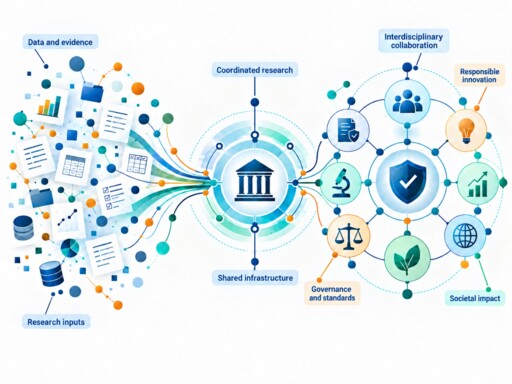
Over its multi-year mission, the EMPOWER program has generated measurable economic, social, and policy impacts — helping reshape how data governance and responsible AI research is conceived and conducted across Europe. Image generated by AI
As AI continues to drive far-reaching change worldwide, Ireland’s national initiative on data governance, ethics, and responsible AI—the EMPOWER program on data governance—has completed its multi-year mission. Led by four leading research centers—Lero (center for software research), ADAPT (center for digital content technology), Insight (center for data analytics), and FutureNeuro (center for translational brain science)—under Research Ireland in collaboration with industry, the public sector, and policymakers, the nationally coordinated program has produced 29 collaborative research outputs and generated measurable economic, social, policy, and public service impacts, as well as contributions to international cooperation, health and well-being, professional services, and human resources. More significantly, it has helped reshape how coordinated research on data governance and responsible AI is conceived and conducted in Ireland and across Europe.
National strategic imperative
In 2020, the European Commission released its White Paper on Artificial Intelligence, marking a major step in the development of Europe’s AI strategy. A series of regulatory frameworks followed, including the Data Governance Act, the Data Act, and the AI Act, aimed at ensuring that data is used responsibly and shared only with parties that have a legitimate need for access. Putting these principles into practice, however, has proved difficult. New approaches to data governance are needed at both the national and global levels—approaches that clearly define access rights, standards, and operating practices while using intelligent technologies to automate processes.
EMPOWER was launched in 2021 in response to these challenges. Conceived from the outset as “Ireland’s first national hybrid research program,” it set a funding target of more than 10 million euros and brought together academia, industry, and the public sector to develop more effective and efficient approaches to data governance and contribute to a thriving global data ecosystem.
“EMPOWER was not conceived as a traditional research project,” said Markus Helfert, director of EMPOWER and professor and director of the Innovation Value Institute at Maynooth University in Ireland, in an interview with CSST.
From the outset, the project was rooted in real-world challenges, with stakeholders jointly defining problems and developing solutions. When EMPOWER launched, remote collaboration had become commonplace, the regulatory landscape was changing rapidly, and public scrutiny of data use and AI was intensifying. In such an uncertain environment, the program needed a governance model that could maintain a clear strategic direction while remaining flexible enough to adapt to change.
Community, co-creation, and collaboration in practice
According to Helfert, EMPOWER had already built a strong community of stakeholders from industry and the public sector before the program formally launched. This community helped shape the research agenda and provided critical feedback on emerging challenges and proposed solutions.
The defining strength of EMPOWER, Helfert said, was its genuinely interdisciplinary research structure, organized around five co-created pillars: data markets, regulatory sandboxes, privacy-preserving technology, governance and standards, and people-centric design and data ethics.
These pillars were not developed by academic institutions in isolation, but jointly shaped with non-academic partners from industry, the public sector, standards-setting organizations, and policymaking bodies. “This ensured that the program addressed real-world challenges while maintaining academic rigor, and that each area contributed to a coherent national agenda on data governance and responsible AI,” Helfert said.
Supporting this interdisciplinary structure was a leadership model that combined coordinated, distributed governance with high-level expertise across participating institutions—a combination that proved crucial to the program’s success. EMPOWER brought together internationally recognized experts from several Research Ireland centers, ensuring depth of expertise and credibility across its thematic areas. Rather than adopting a centralized command-and-control model, the program operated through a federated leadership structure. Each research center retained academic autonomy while working within a shared governance framework that clearly defined roles, responsibilities, and escalation pathways.
In Helfert’s view, this balance between independence and alignment enabled decisive decision-making without weakening collaboration, while preserving both accountability and flexibility—conditions essential to complex, cross-sectoral, interdisciplinary research at the national level.
Innovation in governance of cross-institutional collaboration
Coordinating eight organizations and four world-class research centers—each with its own organizational culture, incentive structure, and disciplinary norms—represented EMPOWER’s primary management challenge.
“The scale and diversity of this collaboration required more than formal governance structures—it demanded active integration,” Helfert said. EMPOWER addressed this complexity by establishing boundary-spanning roles, including a dedicated program manager, executive officer, and Community of Practice leads and co-leads, supported by active leadership, steering committees, and advisory boards. These coordinating roles helped bridge academia, industry, and policy, reducing fragmentation and maintaining strategic momentum.
Alongside institutional coordination, another central management challenge was balancing predefined objectives with the inherently exploratory nature of interdisciplinary research. Like most funded programs, EMPOWER began with agreed milestones and deliverables, as well as clear commitments to industry partners, Research Ireland, and national policy objectives. Yet data governance research unfolds in a highly dynamic environment: Regulatory interpretations evolve, societal expectations shift, and technological capabilities—particularly in AI—often advance faster than policy instruments can keep pace.
A defining leadership challenge, therefore, was knowing when to stay the course and when to pivot, Helfert said. The program’s early work on regulatory compliance readiness illustrates the point. As engagement with industry and public-sector partners deepened, a central difficulty became clear: The challenge lay not in understanding regulations themselves, but in making governance operational—embedding regulatory principles into data pipelines, AI systems, organizational processes, and everyday decision-making.
“Recognizing this gap required a strategic shift toward practical tools, standards, and implementation frameworks,” Helfert explained. Rather than treating such adjustments as departures from the plan, EMPOWER framed them as responses to real-world complexity. This approach was essential to maintaining trust with funders and stakeholders.
Taken together, these experiences highlight a central lesson from the EMPOWER case: Effective research management is less about enforcing rigid stability than about creating mechanisms that support informed adaptation, transparent communication, and mutual trust.
Multidimensional evaluation system
“This multidimensional assessment approach was particularly important in data governance research, where some of the most impactful work—such as drafting standards or designing governance models—does not always translate into immediate scholarly outputs,” Helfert said. To complement traditional academic metrics, EMPOWER incorporated broader performance indicators, including financial measures such as co-funding opportunities and engagement with competitive EU funding schemes.
To mitigate free-riding, EMPOWER relied less on incentives than on structural transparency. Responsibilities and expected contributions were clearly defined, while regular progress reports made each team’s work visible and allowed problems to be identified and addressed early. The program also took differences in researchers’ career stages into account.
“Expectations for early-career researchers, postdoctoral fellows, and senior academics were calibrated accordingly, and mentoring and supervision were explicitly acknowledged as substantive contributions,” Helfert said.
Enduring legacies: Institutional and cultural reform
Asked what EMPOWER’s most important legacy was beyond publications and patents, Helfert was clear: “Its most significant legacy lies in the institutional and cultural change it has enabled.”
Beyond its formal outputs, EMPOWER has demonstrated how to cultivate and sustain an international network spanning academia, industry, the public sector, and policy stakeholders. This community-based model has strengthened trust, promoted shared learning, and embedded responsible data governance practices more deeply within participating organizations, helping the program’s impact endure well beyond the funding period.
“Perhaps most importantly, EMPOWER fostered a fundamental shift in mindset. Rather than asking only whether systems were compliant and whether data could be shared, partners increasingly assessed whether data and practices were trustworthy, explainable, and socially acceptable. This transition—from compliance as a minimum requirement to governance as an enabler of innovation—reflects a profound cultural change,” Helfert said.
Helfert added that this shift also reflected a broader recognition: Responsible AI and data governance are not fundamentally technical challenges, but challenges of organizational transformation. They involve skills development, process redesign, leadership capacity, and the responsible integration of technology into complex institutional settings. While AI technology continues to advance at an unprecedented pace, sustainable adoption requires research models that remain closely aligned with the realities of industry and the public sector, support continuous improvement, and treat uncertainty as an inherent condition rather than an exception.
In this respect, EMPOWER demonstrates that interdisciplinary research integrating technological, organizational, regulatory, and ethical perspectives is not merely desirable, but necessary. This model of collaborative, cross-sectoral inquiry is what makes responsible innovation at scale possible, Helfert concluded.
Editor:Yu Hui
Copyright©2026 CSSN All Rights Reserved