


Revisiting site of Fei Xiaotong’s ‘Jiangcun investigation’ 90 years later
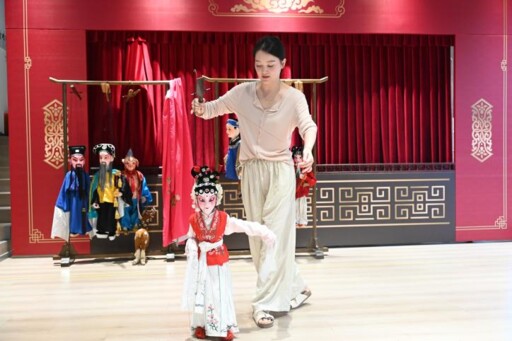
Shi Jinfang, head of the Jiangcun Drama Club, performs with puppets. Photo: Wu Nan/CSST
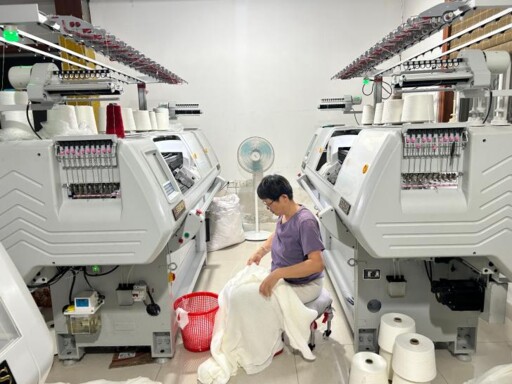
Aunt Zhou at work in her family sweater-knitting workshop. Photo: Wu Nan/CSST
From July 3 to August 25, 1936, 26-year-old Fei Xiaotong conducted more than 50 days of fieldwork in Kaixiangong Village, Qidu Town, Wujiang District, Suzhou City, Jiangsu Province. Drawing on this research, he later wrote Peasant Life in China (known in Chinese as Jiangcun Jingji), establishing this Jiangnan village on the shores of Taihu Lake as a spiritual landmark of Chinese sociology.
Ninety years later, Zhou Xiaohong, director of the Institute of Contemporary China Studies at Nanjing University, invited 30 sociologists, over 10 experts from journals and publishing houses, and film and television artists, along with a group of doctoral and undergraduate students, to form the “Jiangcun Investigation” 90th Anniversary Revisit Team. Following the same schedule as Fei 90 years earlier—from July 3 to August 25—the team returned to Jiangcun to carry out a series of activities including oral-history collection, video documentation, academic defenses, and field seminars.
From the early morning vegetable market to the late-night farmhouses, from the village committee office to the cultural hall, and from the workshops of township enterprises to the factories of nearby Fortune Global 500 companies, the life stories of over 160 interviewees were carefully documented, as an academic dialogue spanning 90 years gradually unfolded in Jiangnan.
People-centered method
Zhou gave the revisit a clear methodological and substantive focus: “people-centered method, Chinese modernization as the goal.” In his view, “people-centered method” means adopting the perspective of ordinary people to understand how they view themselves, their lives, and sociology—identifying problems and understanding society through their narratives and practices, and treating their experience as an important source of knowledge. “Chinese modernization as the goal” means starting from the realities of everyday life to understand how China’s modernization is actually experienced, interpreted, and jointly shaped by ordinary people.
“This is not a slogan meant to adorn fieldwork, but a question concerning how knowledge is produced, who has the right to interpret society, and what kind of reality scholarship ultimately confronts.” Dong Fangjie, an assistant with the revisit team, wrote in New Jiangcun Bulletin that Chinese people themselves should have a voice in interpreting Chinese society. Ordinary people, he explained, should not simply serve as objects of study whose experiences are collected and turned into research material. They should also participate in the production of knowledge—as evaluators and even narrators.
Chen Jiajian, deputy dean of the School of Social and Behavioral Sciences at Nanjing University, interviewed self-employed individuals, villagers, the head of the village committee, and cultural tourism operators, among others. One villager had worked as a bricklayer, an accountant at a township-run enterprise, and an operator of a woolen sweater business, before becoming a corporate safety officer. Through these interviews, the team learned that township enterprises at the time were managed by the township government, which also assigned accountants to them. The salary of a factory manager was roughly twice that of an ordinary worker, while an accountant’s salary could reach 85% of the manager’s. These details provide a clearer picture of how township enterprises operated and were managed during that period, including their internal systems of income distribution. The villager also described the network linking production, sales, and finance in the woolen sweater industry, as well as the business model of unified annual settlement. His account offers a valuable case for understanding the trajectory of local economic development following reform and opening up.
Lu Yuan, assistant to the director of the Institute of Contemporary China Studies at Nanjing University, interviewed an elderly resident of Kaixiangong Village. During the interview, the villager spoke frankly about the village’s growing fame: internet-famous cafés were opening one after another, yet residents were more concerned with having a public venue for weddings and funerals. Lu explained that fame is what outsiders see, but the real needs of ordinary people are what truly define the village. The most important aspect of a people-centered method, he said, is to respect and recognize villagers as the true owners of the village.
Involving people in knowledge production
This idea of “involving the people in knowledge production” took concrete form on the afternoon of August 16, when a special doctoral dissertation defense was held in Jiangcun.
That day, a poster announcing the defense was displayed outside the Jiangcun Cultural Hall. Three doctoral students supervised by Zhou traveled to Jiangcun to defend their dissertations, which focused on rural teachers, “barefoot” doctors, and model laborers. The defense committee was chaired by Qiu Zeqi, a professor from the Department of Sociology at Peking University. Its members included Ye Jingzhong, a professor from the College of Humanities and Development Studies at China Agricultural University, Deng Yanhua, a professor from the School of Sociology and Anthropology at Xiamen University, Meng Yanqing, a professor from the School of Sociology at China University of Political Science and Law, and Chen Jiajian.
Unlike the closed-door defenses typically held on university campuses, the wooden doors of the hall were open to everyone. Rural teachers, doctors, retired village officials, and ordinary villagers who had heard the news arrived one after another, joined by a number of visitors to Jiangcun, and sat on straw mats along the steps to watch the defense from beginning to end.
Zhou saw the revisit as a spiritual journey to rediscover the roots of Chinese sociology. The academic tradition Fei Xiaotong established in Jiangcun—seeking truth from facts and working to improve people’s livelihoods—came to form the spiritual foundation for generations of sociologists. Bringing 30 sociologists from across China together in Jiangcun offered them a chance to revisit the discipline’s original aspirations and build a stronger sense of shared purpose within the sociological community.
To carry this tradition forward, the team developed a diverse range of projects and activities. These included New Jiangcun Chronicles, a photography collection modeled on The Chronicle of Jiang Village by Fei’s student Zhang Zudao, and “Summer in Jiangcun,” a documentary short film capturing everyday life during the revisit. The team also produced “From the Soil: A Shared Lesson from 30 Chinese Sociologists,” which introduces young people to basic sociological ideas in accessible language. Other initiatives included an academic workshop centered on “the contemporary issues of Chinese sociology,” a Jiangcun classroom for rural sociology, and New Jiangcun Bulletin.
Seeking answers in the field
Carrying this intellectual tradition forward must remain grounded in field research. In the 90 years since Fei’s investigation, Jiangcun has ceased to resemble the Jiangnan village he described, then grappling with the decline of the silk industry. Ways of life have changed just as dramatically, but one fundamental question has endured. As Dong wrote in the New Jiangcun Bulletin, much of the Jiangcun world Fei so meticulously depicted has passed into local memory. Yet the theme he identified—how tradition and modernity meet, conflict, adapt to each other, and reshape one another—continues to unfold on a scale far beyond what he could have foreseen.
“The changes here have long exceeded what Mr. Fei could have imagined,” Zhou told CSST. Among the leading enterprises he visited in and around Jiangcun was a company that had grown from a township school-run factory on the verge of bankruptcy into a Fortune Global 500 enterprise. Its industrial chain has expanded far beyond its original silk-reeling, printing, and dyeing operations to encompass petroleum, chemical fibers, optical cables, optoelectronics, photovoltaics, and shipbuilding, with business operations now extending across the globe.
Zhou recounted the story of the “Sunday engineer”—an engineer from the Shanghai Telecommunications Bureau who, beginning in 1985, traveled to the countryside every weekend to help township enterprises solve technical problems. He eventually settled with his family in Wujiang, where he has worked for 41 years. Now 76, he still serves as director of the company’s research institute, providing a vivid footnote to the enterprise’s entrepreneurial history.
Some forms of rural industry, however, have remained largely unchanged for 90 years. In one workshop of just over 80 square meters in Kaixiangong Village, eight sweater-knitting machines stood neatly arranged. The workshop’s operator, Aunt Zhou, told CSST that all orders come through referrals from acquaintances and payment is often settled only once a year, with trust within rural society remaining an important foundation of the business. Chen said that when Mr. Fei studied China’s rural economic and social formations here, he argued that industry and agriculture should form a complementary relationship to support the sound development of rural society. Ninety years later, the area still offers a living example of industry and agriculture embedded in and sustaining one another.
Lyu Dewen, a professor from the School of Sociology at Wuhan University, compared Jiangcun with rural areas in central and western China, noting that its villagers “leave the land but not the village”—even if they no longer farm, they still make their homes there. Three-generation households are common, and the village retains a stable and cohesive social order. Young people are willing to return home for work, while migrants continue to move in. Rather than becoming hollowed out, Jiangcun has maintained a steady inflow and return of residents. In his view, this path of in-situ urbanization offers another possibility for the modernization of rural China.
Editor:Yu Hui
Copyright©2026 CSSN All Rights Reserved