


How is qualitative data redefining social science research?
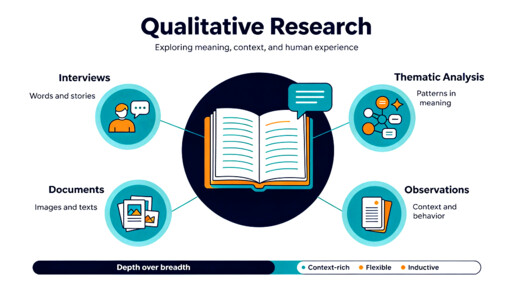
The core value of qualitative data lies in interpreting the meanings of social phenomena and explaining their causes. Image generated by AI
Qualitative research data has long faced questions about scientific validity, unclear evaluation criteria, and inconsistent analytical frameworks. These difficulties stem from its unstructured, context-dependent, and subjective nature, which contrasts with the apparent clarity and standardization of quantitative data. Advances in qualitative research methods through iterative refinement, together with the growing use of digital technologies, are now bringing significant changes to the international academic community’s understanding of qualitative data.
Broadening the scope of qualitative data
Qualitative data forms the foundation of qualitative research. Unlike quantitative data, which focuses on numerical statistics and hypothesis testing, its core value lies in interpreting the meanings of social phenomena and explaining their causes, responding to central questions in humanities and social science research such as “how does it happen” and “why does it persist.” Roehl Sybing, a postdoctoral research fellow in Education, Health & Behavior at the University of North Dakota in the United States, told CSST that qualitative data has traditionally been understood to encompass interview transcripts, focus group discussions, policy documents, and case materials. Contemporary qualitative research, however, draws on a broader framework combining explicit texts with implicit contextual information, expanding both the range of source materials and the perspectives available for analysis.
Sybing explained that qualitative data can be divided into two broad categories: explicit and implicit. Explicit data includes familiar research materials such as interview transcripts, written field notes, public documents, case archives, and participants’ own accounts. Implicit data, by contrast, encompasses less obvious details that emerge during fieldwork, including hesitations, pauses, changes in tone, and attempts to avoid particular topics during interviews. It also includes features of the research setting, such as spatial arrangements, décor, notable absences, and the overall atmosphere, as well as informal interactions and indirect ways of addressing sensitive issues.
However, such details do not automatically constitute meaningful evidence. Sybing noted, for instance, that a pause in an interview cannot in itself be treated as a research finding, nor can an absence at a field site be assumed to carry a particular meaning. These observations become useful data only when they are systematically documented, compared across different settings, and repeatedly examined. Researchers must also remain alert to interpretive bias arising from their own assumptions and subjective perspectives.
Sezai Doruk Soyata, a sociologist of religion and a lecturer in the Department of Sociology at Koç University in Istanbul, Turkey, argues that qualitative data differs from quantitative data in four key respects. First, it is context-dependent, generated through interactions in specific fieldwork settings, and textual excerpts can lose much of their interpretive value when removed from their original context. Second, it is open-ended and emergent. Rather than being confined to predefined hypotheses, qualitative inquiry can evolve dynamically through fieldwork, making it particularly suitable for exploring complex social phenomena that are not yet well understood. Third, it is diverse and unstructured, encompassing texts, behaviors, spatial settings, atmospheres, and other forms of evidence, without a single standardized format. Fourth, it captures subjective experiences, reflecting participants’ own understandings and emotional responses while also being shaped, to some extent, by researchers’ observational perspectives and analytical approaches.
Soyata emphasizes that qualitative data addresses a significant limitation of quantitative research—its tendency to prioritize outcomes over process and statistics over meaning. Quantitative data can precisely describe the scale, distribution, and trends of a social phenomenon, but it cannot fully explain the cultural logic, lived experiences, or deeper motivations behind it. By capturing the texture of everyday situations, qualitative data offers a fuller picture of social life and reveals underlying problems that may remain obscured in numerical findings.
Mainstream analytical approaches and ongoing debates
Over time, researchers in the humanities and social sciences have developed a well-established range of qualitative data collection methods, including interviews, focus groups, observation, open-ended surveys, document analysis, case studies, and ethnographic fieldwork. These methods complement one another and are suited to different research settings.
According to Sarah Jenner, a lecturer in Child and Adolescent Health at the University of Southampton in the United Kingdom, interviews are well suited to exploring individual experiences in depth and addressing sensitive topics, while focus groups examine group interactions and the construction of shared meanings. Observation can capture natural behavior and help address biases in self-reported data, while open-ended surveys facilitate the collection of qualitative data on a larger scale. Document analysis draws on existing materials for historical and policy research, and case studies enable an in-depth, holistic examination of a particular subject. Ethnographic fieldwork, meanwhile, involves prolonged immersion in the field to develop a deeper understanding of community cultures.
Katharine Gelber, deputy executive dean and associate dean (Academic) in the Faculty of Humanities, Arts and Social Sciences at the University of Queensland in Australia, told CSST that the dominant approaches to qualitative data analysis include thematic analysis, grounded theory coding, discourse analysis, and in-depth case studies. These approaches share an inductive logic, she noted, with concepts drawn from raw data and theories developed from those concepts rather than tested against the data. At the same time, the widespread use of dedicated qualitative analysis software such as NVivo and ATLAS.ti has made it possible to organize, code, and categorize unstructured data systematically, improving both the efficiency and rigor of qualitative analysis.
Despite the increasing maturity of research methods, Gelber said, challenges and unresolved issues remain at four stages of working with qualitative data: collection, quality control, analysis, and evaluation.
At the collection stage, many studies continue to rely heavily on explicit textual data while overlooking the implicit, contextual material generated through fieldwork, potentially resulting in fragmented datasets and a one-sided analytical perspective, she explained.
On quality control, Gelber said, qualitative research still lacks a single, universally accepted set of evaluation standards. Unlike quantitative research, which can use reliability and validity tests and significance testing to assess data quality, qualitative research relies heavily on researchers’ professional expertise to make such judgments. Researchers’ prior assumptions, subjective interpretations, and positional biases can influence how data is selected and recorded, potentially compromising its objectivity.
At the analysis stage, shallow and formulaic interpretations remain a persistent problem, Gelber noted. Some researchers limit their analysis to basic coding of explicit textual data without examining it in relation to its context and setting, making it difficult to uncover deeper meanings. She also pointed to shortcomings in qualitative data preservation, which undermine traceability and replicability and hinder secondary analysis and cross-study comparisons.
At the evaluation stage, the perception that qualitative research lacks scientific rigor remains widespread in academia. Existing evaluation frameworks tend to emphasize standardization, quantifiability, and replicability, overlooking the contextual value and interpretive strengths of qualitative data. The lack of evaluation criteria suited to qualitative research hinders full recognition of the scholarly value of high-quality qualitative studies, constraining the balanced development of different research approaches, Gelber said.
Toward a more standardized approach
To address these challenges, the international academic community has pursued two complementary avenues of innovation: standardizing traditional methods and applying digital technologies to support research. Together, these efforts are moving qualitative research from fragmented, experience-based practices toward greater methodological rigor.
To refine traditional methods, researchers have established comprehensive quality control systems that help address core problems such as non-standardized data, interpretive bias, and insufficient rigor, Sybing explained. At the data collection stage, triangulation, member checking, and field memos maintained throughout the research process have become key quality control methods. Researchers collect explicit textual data alongside implicit contextual material, systematically documenting the characteristics of field settings, details of interpersonal interactions, and changes in behavior as they occur. Cross-checking multiple data sources, using participant feedback to identify and correct errors, and maintaining a traceable record throughout the research process all help prevent data from becoming one-sided or distorted.
Meanwhile, Sybing said, the academic community continues to refine research ethics standards, establishing clear principles for informed consent, privacy protection through anonymization, data confidentiality, and the prevention of harm. These standards help guide the collection and use of data involving sensitive topics and implicit contextual information, while balancing research innovation with ethical responsibilities.
Turning to digital technology, Gelber argued that artificial intelligence and specialized qualitative research software are reshaping the way qualitative data is processed. Tools such as NVivo and ATLAS.ti enable the automated transcription, classification, and coding of large volumes of unstructured text, addressing problems associated with manual analysis, including inefficiency, errors, and fragmented workflows. AI technologies such as text mining, semantic analysis, and sentiment analysis can help identify implicit meanings and emotional tendencies in textual material, enabling more fine-grained interpretation and broadening the perspectives available through traditional manual methods.
Big-data technologies are also broadening the scope of qualitative data, Gelber added, with social media discourse and online interactions becoming important new sources of material for qualitative research.
However, Gelber stressed that artificial intelligence should be regarded as a supporting tool rather than a replacement for researchers. While AI can undertake routine tasks such as transcription and coding, it cannot independently interpret situational context, determine the research value of implicit data, or carry out in-depth scholarly interpretation. Interpreting implicit data, developing the reasoning that guides research, and substantiating conclusions still depend on researchers’ fieldwork experience and professional judgment. These capacities remain at the core of qualitative research and cannot be replaced by AI, she said.
Editor:Yu Hui
Copyright©2026 CSSN All Rights Reserved