


From 2020 New Year greeting card to a Washington welcome
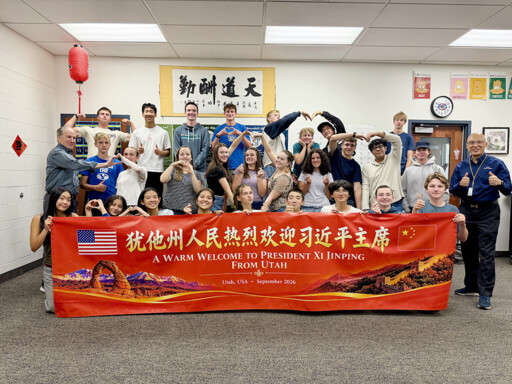
Group photo of the Utah teachers, students, and parents delegation in Washington, D.C. to welcome President Xi Jinping during his visit to the United States. Photo: PROVIDED TO CSST
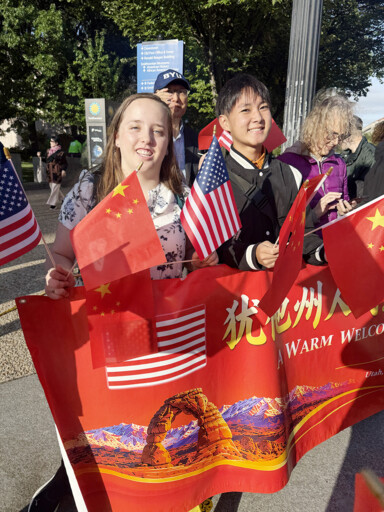
Utah students in the welcoming delegation in Washington, D.C. Photo: PROVIDED TO CSST
On the afternoon of Sept. 23, a group of young people from Utah stood out among the crowds to welcome Chinese President Xi Jinping as he arrived in Washington, D.C., for a state visit to the United States.
Their connection with China began six years earlier, when they were fourth graders learning to write in Chinese. They sent New Year greeting cards to President Xi Jinping and received a warm reply. Now in high school, they had traveled to Washington to express their friendship toward the Chinese people.
Leading the group was Peter Chan, a professor from Brigham Young University (BYU). CSST spoke with Chan as well as Teon Sonomura, a student from Utah accompanying the delegation, and Stacy Lyon, former director of the Chinese Immersion Program in the entire state of Utah.
The students’ journey from a classroom greeting to a Washington welcome illustrates the lasting ties that exchanges between Chinese and American youth can build. As Chan aptly put it, “That is the power of exchange: A subject becomes a relationship.” Through these exchanges, such relationships have taken root and continued to grow across generations of young people.
A bond forged by a greeting card in 2020
CSST: During the Spring Festival six years ago, students at Cascade Elementary sent President Xi New Year’s cards and received a personal reply. As a BYU scholar who works closely with the school, what did this exchange mean to you at the time?
Chan: I thought it was remarkable because it showed what language education could become. Established in 1967, Cascade Elementary is a public school in Utah and was among the first in the state to introduce a Chinese Immersion Program. Today, more than half of its students are enrolled in the program.
It is important to remember the role of Zheng Yamin, the students’ fourth-grade Chinese teacher. She organized the students to write the Chinese New Year greetings. A teacher created a simple educational experience for children learning another language, but that classroom activity ultimately crossed the Pacific.
These were fourth graders. They were not diplomats or political leaders. They were children using the Chinese they had learned to reach out and say “Happy New Year.” Yet their greetings received a personal response from China’s president.
President Xi’s encouragement to become young ambassadors of friendship gave their language learning a larger purpose. Chinese was no longer simply another school subject. It became a way to understand another civilization and communicate with another people.
For me, the story also captured something distinctive about Utah. Utah has made an unusually long-term commitment to Chinese-language education and exchange with China. The Cascade story made that commitment visible.
And it reminds us that teachers sometimes plant seeds without ever knowing how far they will grow.
CSST: Sonomura, in 2020, you sent President Xi a Chinese New Year card. In his reply, President Xi encouraged you to be “young ambassadors of friendship between the Chinese and American peoples.” What does that mean to you, and how have you tried to put it into practice over the years?
Sonomura: I believe that in this time and age, with the world filled with false or negative information, as we have the privilege to learn Chinese, I believe and now feel that I have a role to play in this world as a bridge between the two nations to better gain an understanding of each other.
I’ve tried to fulfill this by continually learning Chinese through my school program, keeping in contact with friends I made during my China trip, taking chances and participating in almost anything related to China, and every so often changing my phone settings to Chinese to better polish my Chinese comprehension!
See the real China
CSST: Having invested so much energy in youth exchange, is there a moment that stands out as unforgettable?
Chan: There are many. This Washington experience has now become one of them, because I could see a seed planted six years earlier still growing.
But another experience illustrates particularly well why exchange matters. One college student we brought to China had studied Chinese from a young age but became discouraged after failing the AP Chinese exam. He initially refused to go to China with his family, but they eventually persuaded him.
In China, something changed. For the first time, Chinese was not an exam subject. It was a living language connected to real people.
He began using Chinese to communicate, and he loved the experience so much that he decided to resume studying the language and hoped to return and spend a year studying in China.
We have seen the same transformation among Chinese students coming to America. Before coming, English may have been simply another school subject they had to endure. Then they arrive, make American friends, live with an American family, and suddenly English becomes the language they use to communicate with people they love.
Lyon: Attending the welcoming activities for the arrival of President Xi, it was meaningful to see the students have the opportunity to be able to express to a larger audience how learning Chinese has impacted their lives. In those moments they were able to bring together all of their hard work and effort over the years, and I hope they could sense how significant the power of that understanding is, and the impact it can have on them personally and in the world to come.
From Utah to Washington
CSST: What first gave you the idea to bring the students from Utah to Washington?
Chan: When I learned that President Xi would visit Washington but would not be able to come to Utah, I immediately thought of the students.
Eventually, six students participated in our Washington activities—two Orem High sophomores from the original Cascade group, three Lone Peak High School students, and one BYU student.
What moved me most was their sincerity. They were not playing a diplomatic role. They genuinely love the Chinese language, and through years of study and their own experiences in China, they have developed real affection for the Chinese people.
I was equally moved by the sacrifices of the parents, educators, and friends who came. They paid their own expenses. They came because they believed that friendship between peoples matters.
Prospects for youth exchanges
CSST: What similarities and differences do you see among American and Chinese youth?
Chan: The similarities are much greater than many adults imagine. Young people in both countries care about family, friendships, education, careers, technology, music, food, relationships, and their futures.
The differences are also important. They have grown up with different histories, educational systems, media environments, political structures, and assumptions about society. Those differences should make us more curious, not more suspicious.
The purpose of exchange is not to erase differences. It is to know one another well enough that differences can be discussed with knowledge and respect rather than stereotypes.
CSST: President Xi announced that China will welcome 100,000 young Americans for study and travel over the next five years. How did you feel when you heard the announcement?
Sonomura: I was very thrilled when I heard that, as I noticed the two countries’ relations were slowly getting better!
I believe inspiring the young generation and teaching them about the true essence of each country is the best way to build a strong foundation for relations between America and China!
With that in mind, I would love to go to China once more, knowing there is so much more to see in such a wonderful country!
CSST: What do you hope for the future of US–China youth exchange?
Chan: I hope it becomes larger, deeper, and more reciprocal. I hope President Xi will someday accept the students’ invitation to visit Utah. We have much to show him—not simply our magnificent scenery, but our schools, families, universities, Chinese immersion classrooms, and the people who have spent decades building relationships with China.
We do not have to pretend that the United States and China are the same. We are not. We have different histories, systems, interests, and sometimes serious disagreements.
But difference does not require hostility.
If young Americans can speak Chinese, if young Chinese can know Americans personally, and if both can learn to see one another as human beings before seeing one another as competitors, then there is reason for hope.
We love America. We love the Chinese people. And we hope the next generation will inherit not only the differences between our countries, but also the friendships that generations before them have worked so hard to build.
Lyon: In a 12-year language immersion program, not all students are able to go the whole distance for many reasons. It says a lot about these students (and their parents) that they’ve maintained their dedication and commitment for so many years. To really develop language and cultural proficiency, students need to have authentic cultural experiences and authentic language audiences.
Hearing them share their excitement about visiting China and their own hopes for the future, I think it’s clear that they are motivated to continue building their understanding of Chinese language and culture through friendship with the Chinese people. I hope that they are able to see the power of people-to-people exchanges and connection, and that even just one person’s efforts can make a big difference in the world!
Editor:Yu Hui
Copyright©2026 CSSN All Rights Reserved