


The 16th World Socialism Forum held in Beijing
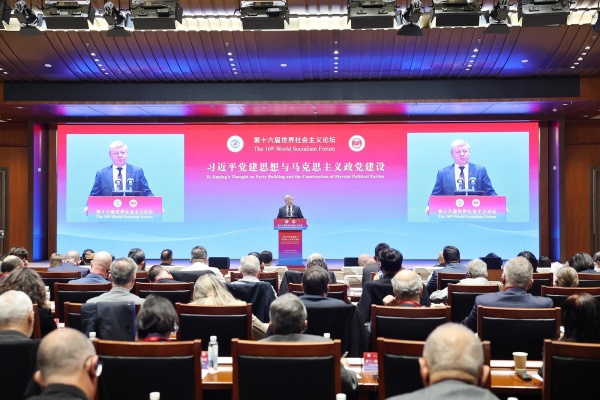
A speaker delivers remarks at the 16th World Socialism Forum in Beijing. Photo: Zhu Gaolei/CSST
The 16th World Socialism Forum was convened in Beijing on Nov. 3 under the theme “Xi Jinping’s Thought on Party Building and the Construction of Marxist Political Parties.” Gao Xiang, president of the Chinese Academy of Social Sciences (CASS) and secretary of its Leading Party Members’ Group, addressed the opening ceremony. Jin Minqing, a member of CASS’s Leading Party Members’ Group and director general of the Institute of Contemporary China Studies at CASS, chaired the ceremony.
Gao emphasized that political parties play an important role in governing modern states and advancing societies. How parties build their institutions has implications for how effectively they govern, how global governance evolves, and how human civilization develops. As the CPC marks its 105th anniversary, Gao said, the CPC Central Committee has articulated Xi Jinping Thought on Party Building. He described it as a scientific theory that took shape through efforts to strengthen the Party and the country in the new era. It brings together advances in the theory, practice, and institutions of Party building in the new era, and forms an important part of Xi Jinping Thought on Socialism with Chinese Characteristics for a New Era.
Under this guidance, Gao said, the CPC has consistently let its ideals and convictions guide its work, drawn on its understanding of historical trends to anticipate risks and challenges, and applied scientific methods to overcome obstacles to development. He noted that the Party has developed a distinctive approach to its own governance that helped foster stability, order, and prosperity in China. Gao credited this approach with helping China achieve rapid economic growth and long-term social stability. He said it has also opened a Chinese path to modernization, helped lift people out of poverty, and fostered ecological prosperity. Taken together, he argued, these achievements offer a Chinese approach to developing a new form of political civilization.
Participants included notable figures such as Zhou Li, former vice minister of the International Department of the CPC Central Committee; Li Wentang, vice president of the Party School of the CPC Central Committee (National Academy of Governance); Huang Yibing, vice president of the Institute of Party History and Literature of the Central Committee of the Communist Party of China; Dmitry Novikov, deputy chairman of the Central Committee of the Communist Party of the Russian Federation and first deputy chairman of the State Duma Committee on International Affairs; Marga Ferré, president of the left-wing think tank “transform! Europe”; He Guangcai, Party secretary of Peking University; and Li Shenming, former vice president of CASS and director of its World Socialism Research Center. They all delivered thematic speeches during the opening ceremony.
The forum brought together over 80 Communist party leaders, Marxist scholars, social activists, and diplomats from 40 countries, along with Chinese experts and scholars in related fields. Participants discussed how the CPC’s 105-year history has influenced world affairs and what original contributions Xi Jinping Thought on Party Building has made to Marxist theories on party building. They also considered how Chinese approaches might address governance challenges facing political parties around the world and what lessons could be drawn from the experiences of Marxist parties.
Chinese and international participants said the CPC has built on the basic principles of Marxist theory on party building through successive periods of revolution, socialist construction, and reform, as well as through its work in the new era. Participants stressed that Xi Jinping Thought on Party Building upholds fundamental Marxist principles and deepens understanding of how Marxist parties develop. They highlighted its emphasis on upholding and strengthening the Party’s overall leadership and advancing full and rigorous Party self-governance. In their view, these ideas show how Marxist party theory has evolved in contemporary China and offer the global socialist movement new ways to think about the links between party building, national development, and public well-being. They said the ideas offered lessons for world socialism and the development of political civilization.
The two-day forum was hosted by CASS and organized by the World Socialism Research Center, the Academy of Marxism, the Research Center for Xi Jinping Thought on Socialism with Chinese Characteristics for a New Era, and the Research Center for Xi Jinping Thought on Party Building, all under CASS.
Editor:Yu Hui
Copyright©2026 CSSN All Rights Reserved