


Protests reflect France’s governance dilemmas

Grievances over education became intertwined with broader public discontent over the rising cost of living, job insecurity, and declining purchasing power. Photo: VCG
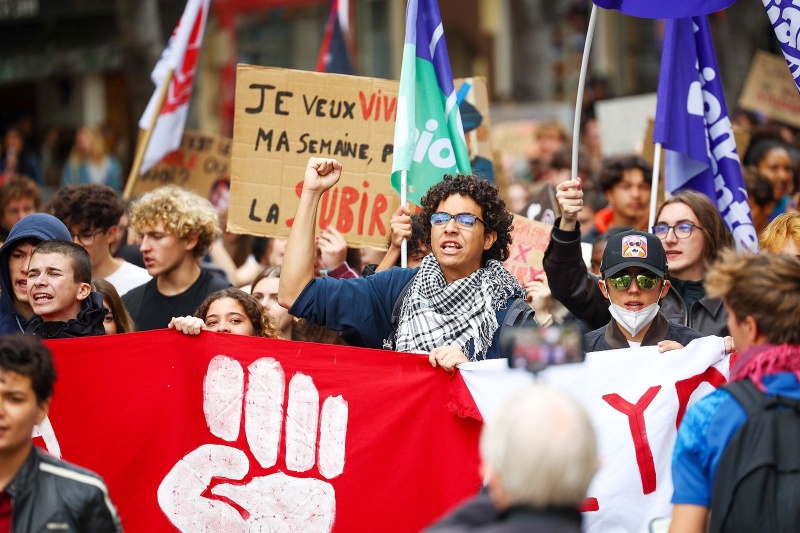
Thousands of high school students marched through Marseille on Nov. 11 to protest overcrowded classrooms, the failure to replace absent teachers, dilapidated school facilities, and cuts to the national education budget. Photo: VCG
Since Oct. 17, large-scale protests and demonstrations have broken out across France, with violent riots erupting in a number of cities. In Limoges, the town hall —over 140 years old—was severely damaged in an arson attack. Beyond France, protests and demonstrations, some involving violence, have also broken out in parts of Belgium, Italy, Portugal, Spain, and other countries.
Overlapping crises fuel protests
Tensions had been building for weeks before the Oct. 17 demonstrations. According to French media reports, the immediate trigger was a strike by high school students in the southern suburbs of Paris in mid-September. The striking students cited dilapidated school buildings, overcrowded classrooms, persistent teacher shortages, and poorly planned course schedules, demanding greater government investment in education and measures to ensure educational equity.
The student strikes soon spread from Paris across France, drawing participation from university students. As news of the strikes circulated widely on social media, other social groups also began joining the movement.
Isabelle Sommier, a professor of political sociology in the Department of Political Science at the University of Paris I, told CSST that the current situation reflects the combined effects of social, fiscal, political, and institutional crises. Against these broader pressures, police misconduct that injures or kills young people can trigger riots in affected neighborhoods, she explained.
Demonstrations themselves have also tended to turn violent since the “Nuit debout” (Up All Night) protests in 2016. The events on Oct. 17 brought together two forms of unrest—“neighborhood riots” and riots arising from demonstrations—with violence breaking out earlier and lasting longer than the clashes usually seen toward the end of protests. Sommier attributed this pattern to a widespread feeling that public demands were being ignored, along with deepening social inequality and inadequate public services that have left people with a sense of social decline.
Young people are also anxious about the climate crisis and fear that far-right parties may come to power. These concerns add to social tensions that have been further aggravated by heavy-handed policing over the past decade, Sommier added.
Aurélien Dubuisson, an associate researcher at the Centre for History of Sciences Po in Paris, argued that these protests reveal a deep-seated structural crisis within France’s education system, rather than isolated failings in particular areas. The unrest has been further fueled by surging inflation, rising fuel prices, and public anger over heavy-handed police treatment of high school students.
As the protests spread, the students’ initial grievances over education became intertwined with broader public discontent over the rising cost of living, job insecurity, and declining purchasing power, further intensifying the unrest, Dubuisson said.
Sluggish economy strains social welfare system
Zhang Jinling, a research fellow and director of the Department of European Social and Cultural Studies at the Institute of European Studies under the Chinese Academy of Social Sciences, explained that France’s persistently weak economy and low fiscal revenue have put considerable pressure on public spending in recent years, forcing the government to adopt austerity measures.
France’s public debt-to-GDP ratio exceeds 110%, nearly twice the indicative ceiling set by the European Union. This debt burden complicates the country’s longstanding efforts to balance economic growth with maintaining its existing social welfare system. Yet weak economic performance, shrinking fiscal revenue, and skyrocketing public debt have left the government with little apparent choice but to cut public spending—not only on education, but also on healthcare and other public services—and reduce social benefits.
Successive French governments have pursued reforms to labor laws, immigration rules, and pension schemes, seeking to adapt the social welfare system to economic conditions over the medium to long term. Such changes inevitably affect the interests of particular groups, especially the most vulnerable, and have therefore struggled to gain broad public support. Zhang noted that these reforms have repeatedly provoked a backlash and protests, exposing another central governance dilemma facing France—the difficulty of building the broad social and political consensus needed to carry policies forward.
The economic costs of educational inequality
Jean-Philippe Bouilloud, a professor in the Management Department at ESCP Business School (Paris Campus), explained that these youth-led protests do not reflect a generational conflict, as some media accounts suggest. The students’ grievances are longstanding and widely shared by parents and the broader public. Many parents and teachers therefore marched alongside students in the early demonstrations, voicing their shared concern and frustration over deteriorating conditions in high schools.
Their calls for improved teaching and learning conditions, Bouilloud said, reflect a broad consensus: France’s education system has deteriorated and operates less efficiently than those of neighboring countries. Findings from the Programme for International Student Assessment (PISA), the global assessment program run by the Organisation for Economic Co-operation and Development (OECD), have borne out this assessment year after year. Over the past 25 years, France has fallen from 12th to 29th in the overall rankings, with declining performance in reading, mathematics, and science.
Claude Diebolt, a leading scholar of quantitative economic history and research director at the French National Centre for Scientific Research (CNRS), and his co-authors found that France has some of the most severe educational inequality in Europe, with the highest level among OECD member states—nearly twice that of Canada. Expressed in terms of educational attainment, the gap between France’s wealthiest and poorest groups is equivalent to three years of schooling.
Educational inequality carries tangible economic costs. Research indicates that had France adopted policies from 1970 onward to narrow the gap between its most and least advantaged socioeconomic groups, its GDP could have been €295 billion higher by 2020. This would be equivalent to an increase of 0.5 percentage points in the annual economic growth rate. Although seemingly modest, an increase of this size would nearly double France’s projected growth rate for 2024, underscoring the substantial economic cost of educational inequality.
Shared pressures fuel protests across Europe
Dubuisson observed that these demonstrations have spread across national borders in Europe, finding resonance in shared material conditions as well as symbolic solidarity. Austerity measures and budget constraints across the continent have had similar effects, eroding public services and leaving young people more vulnerable. The protests also reflect global crises, with anxiety over climate change emerging as a common concern that reaches beyond traditional institutional frameworks and brings a generation together around shared fears for the future.
Bouilloud added that the increasingly prevalent phenomenon of “eco-anxiety” affects large numbers of young Europeans. Data released by France’s Agency for the Environment and Energy Management (ADEME) shows that 16.6 million people in France experienced environment-related psychological distress in 2025, particularly among young people and those aged 25-34. Europe’s recent exceptionally hot summer may have heightened these anxieties.
In public discourse, Bouilloud continued, global warming is largely attributed to the capitalist production system established after World War II. Concerns over education and the environment thus converge, compounded by the difficulty young people face in finding work. Those aged 15 to 24 bear the brunt of unemployment, with a rate of 19.8%, compared with the national average of 7.7%. Advances in artificial intelligence have further complicated the employment outlook, giving rise to a new and deeper form of “digital anxiety.”
Faced with a higher education system that fails to deliver on its promises and a deteriorating environment, young people find the world of work increasingly out of reach. Their doubts about future employment prospects are therefore likely to persist, Bouilloud concluded.
Editor:Yu Hui
Copyright©2026 CSSN All Rights Reserved