


China’s development under 15th FYP globally relevant
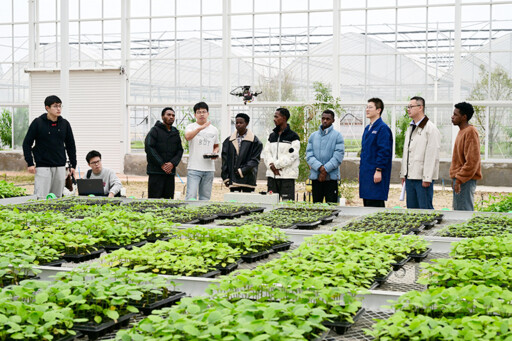
African students learn about drone-based crop growth model data collection at a vegetable seedling smart factory exhibition center in Jinhua, Zhejiang Province, on Oct. 31, 2025. Photo: IC PHOTO
Since the release of the Recommendations of the CPC Central Committee for Formulating the 15th Five-Year Plan for National Economic and Social Development, the development trajectory of Chinese modernization during the 15th Five-Year Plan period (FYP, 2026–30) has drawn wide attention from international academia. Recently, CSST invited experts and scholars from several countries to examine key dimensions of China’s development during the 15th FYP period, with a focus on technological innovation, ecological and environmental protection, people’s livelihood, and high-standard opening up. They also shared forward-looking assessments of the prospects for win-win cooperation between China and countries in the Global South.
Extensive global implications
The achievements of the 15th FYP period will directly determine whether China can meet several key objectives set for 2035: markedly stronger economic strength, scientific and technological capability, national defense capacity, composite national strength, and international influence; per capita GDP comparable to that of a mid-level developed country; a better and happier life for the people; and the basic realization of socialist modernization. This comprehensive transformation is critical not only for China, but also for global development more broadly.
On green transformation, B. R. Deepak, a professor from the Center of Chinese and Southeast Asian Studies at Jawaharlal Nehru University in India, noted China’s expanded deployment of renewable energy—wind, solar, and hydro—alongside carbon-reduction policies in industry, transportation, and urban infrastructure.
“The promotion of electric vehicles and energy-efficient technologies supports the ‘dual carbon’ goals of peaking emissions before 2030 and achieving carbon neutrality before 2060. Globally, these measures reduce carbon emissions, drive down renewable energy costs, and shape environmental cooperation frameworks,” Deepak said.
For example, China has already installed more than 1,300 gigawatts of renewable energy capacity, accounting for about half of total installed power capacity. The country also leads globally in solar photovoltaic and wind energy production, accounting for nearly one-third of global renewable investment.
In Deepak’s view, these advances point to China’s determination to play a larger role in climate governance, framing its environmental agenda as extending beyond domestic priorities to the provision of global public goods and the promotion of sustainable development.
Katarina Zakic, a senior research fellow and head of the Regional Center for the Belt and Road Initiative at the Institute of International Politics and Economics in Serbia, expects the next phase of progress to be more comprehensive, spanning both economic and social dimensions of life—higher salaries, better health and social benefits, and increased investment in education, the arts, and culture.
“By improving the lives of Chinese citizens, China is indirectly improving the lives of other nations. With improvements within one of the biggest economies in the world, other nations are reaping the benefits as well. With that being said, it is important that China keeps the good momentum going, because its continued development contributes to broader development,” Zakic remarked.
“Digital governance too is an area where China’s example offers lessons,” Deepak added. “From smart villages to public service delivery, China’s use of technology to solve local problems is inspiring joint projects across the Global South. The AI capacity building initiative launched in 2024 is bringing training, research, and technology transfer to countries that otherwise risk being left behind in the digital revolution.”
Injecting momentum into Global South
At this new historical juncture, countries around the world face dual tests of development and governance. The high-standard opening up championed by China will serve not only as a stabilizer for its own development during the 15th FYP period, but also as an important driver of renewed growth across the Global South and the wider world economy.
The Recommendations emphasizes the need to “expand opening up at the institutional level, safeguard the multilateral trading system, and promote broader international economic flows.” Deepak commented that by deepening institutional reforms and upholding the multilateral trading system, China aims to make its market more accessible, transparent, and innovation-driven.
“This approach—anchored in reciprocity and inclusiveness—offers developing nations expanded access to trade, technology, and investment flows, strengthening South-South cooperation,” he said.
Data from the General Administration of Customs and the Ministry of Commerce show that in 2023, China–Africa trade reached $282.1 billion. With Latin America, China’s trade exceeded $515.0 billion, and with ASEAN countries it approached $1 trillion ($911.7 billion). South Asia has also benefited from increased connectivity, with trade volumes nearing $200 billion.
Amid intensifying global technological competition, China has been deepening engagement with countries in the Global South in ways that support technology transfer and the integration of local companies, thereby preventing the reemergence of technological dependence or structural inequality, observed Mariana Escalante, a professor from the Faculty of Political and Social Sciences at the National Autonomous University of Mexico.
Escalante underscored that China has already achieved—or is close to achieving—global leadership in several priority sectors, including electric vehicles, solar panels, batteries, high-speed rail, and robotics. “One need only to look at the increase in the presence of Chinese high-tech products in our countries: Five years ago, there were virtually no sales of Chinese cars in Mexico, and today they account for around 9% of total new car sales.”
Deepak summarized that, in essence, China’s high-standard opening up represents not only an internal reform agenda but also a framework for collective progress that can strengthen interdependence, stability, and shared prosperity across the Global South and beyond. “At a global level, China’s pursuit of open, sustainable, and rules-based economic engagement contributes to growth resilience by diversifying supply chains and stimulating cross-border innovation. These initiatives reflect the vision of a community with a shared future for humanity, where development is inclusive and benefits are widely shared,” he concluded.
Editor:Yu Hui
Copyright©2023 CSSN All Rights Reserved