


No. 1 central document for 2026 stresses agricultural modernization, rural revitalization
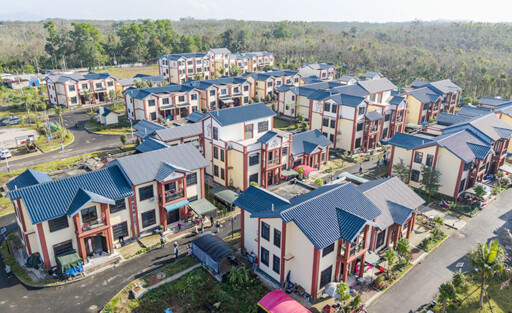
Miantou New Village, Huishan Town, Qionghai City, Hainan Province, Feb. 11. Led by the government, the entire Miantou Village completed its relocation two years ago, greatly improving the villagers’ living conditions. Photo: IC PHOTO
On Feb. 3, 2026, the CPC Central Committee and the State Council unveiled the “No. 1 central document” for 2026, outlining plans to advance agricultural and rural modernization and to promote all-around rural revitalization. The release marks the 14th consecutive No. 1 central document issued since the 18th CPC National Congress to guide work related to agriculture, rural areas, and farmers. In recent interviews with CSST, several scholars noted that this year’s document combines policy continuity with innovation, systematically mapping out strategic pathways toward agricultural and rural modernization. It signals that China’s work on agriculture, rural areas, and farmers has entered a new phase characterized by greater systematization, institutionalization, and precision.
Building multi-dimensional foundation for food security
Food security remains a fundamental national priority. While setting the goal of stabilizing grain output at around 1.4 trillion jin (700 million metric tons), the 2026 No. 1 central document emphasizes a coordinated approach that simultaneously addresses production and capacity, production and ecology, as well as increased production and increased income.
Huang Zuhui, a chief expert from the China Academy for Rural Development at Zhejiang University, explained that “production and capacity” underscores that grain output must rest on enhanced comprehensive production capacity. “Production and ecology” signifies the integration of grain production with green, low-carbon, and ecological development. “Increased production and increased income” emphasizes that higher grain yields should translate into rising incomes for farmers. The synergy between arable land protection, agricultural sci-tech innovation, and the development of new quality productive forces in agriculture, he added, provides a solid farmland base and technological support for safeguarding food security.
Fan Xiangcheng, director of the Rural Development Institute at the Shandong Academy of Social Sciences, noted that achieving the goal of ensuring production and capacity, ecological sustainability, and increased farmers’ incomes in tandem requires a more systematic and comprehensive set of supporting measures. In addition to reinforcing the traditional foundation of arable land protection and quality improvement, the document places “enhancing the efficiency of agricultural sci-tech innovation” and “developing new quality productive forces in agriculture according to local conditions” at the center of structural upgrading. Together with efforts to build a diversified food supply system, these measures aim to strengthen full-chain support for food security.
Establishing institutionalized framework for regular, targeted assistance
For the first time, the 2026 No. 1 central document calls for the “implementation of regularized and targeted assistance measures,” explicitly incorporating them into the broader rural revitalization strategy for coordination. This marks a strategic adjustment in assistance efforts toward preventing large-scale relapse into poverty and advancing common prosperity through institutionalized, long-term governance mechanisms closely aligned with rural revitalization.
Understanding this transition requires attention to its historical and policy context. Kong Xiangzhi, a professor from the School of Agricultural Economics and Rural Development at Renmin University of China, reviewed the trajectory: Following the successful conclusion of the poverty eradication campaign, the CPC Central Committee established a five-year transition period to continue supporting formerly impoverished areas and populations. As this period concludes in 2026, assistance efforts are entering a new stage of regular and targeted support, with emphasis on enhancing the industrial competitiveness of formerly impoverished regions and building integrated agricultural industrial and value chains.
With the five-year transition period following poverty eradication now concluded, Cao Bin, an associate research fellow from the Rural Development Institute at the Chinese Academy of Social Sciences, added that the provision of “regular” assistance entails establishing mechanisms for continuous monitoring and dynamic response. “Targeted” measures, Cao noted, must concentrate on low-income groups and underdeveloped regions, applying differentiated measures such as industrial development, employment support, and social security to achieve precise empowerment.
Systematically expanding channels for sustained increase in farmers’ incomes
The 2026 No. 1 central document stresses the “promotion of stable income growth for farmers” and introduces a coordinated policy package spanning production, employment, industrial development, consumption, and other areas. Achieving this objective calls for a multi-pronged approach.
Huang noted that, in terms of “safeguarding and incentivizing farmers’ engagement in grain production,” the document highlights coordinated policy tools—such as pricing mechanisms, subsidies, and insurance—to strengthen income guarantees for grain growers. To cultivate county-level industries that benefit rural residents, it proposes measures including expanding the reach of e-commerce platforms to rural areas to empower farmers and guiding new types of agricultural business entities to drive income growth.
The document’s emphasis on expanding rural consumption through multiple measures stands out as another key highlight. Liao Zujun, vice president of the Sichuan Academy of Social Sciences, explained that the expansion of rural consumption will create a closed loop of “employment–income–consumption.” This approach not only helps advance common prosperity among farmers but also injects new vitality into the rural economy. Cao further noted that the document lays out a full-chain, multi-dimensional framework for boosting farmers’ incomes. First, it seeks to stabilize operational income through price supports, subsidies, and industrial chain extension. Second, it expands wage income by promoting local employment through county-level industries and strengthening skills training for migrant workers. Third, it activates property income by deepening rural land system reforms and exploring market-oriented resource allocation schemes, enabling farmers to share more fully in value-added gains.
Editor:Yu Hui
Copyright©2023 CSSN All Rights Reserved