


Government work report sparks discussion in academia
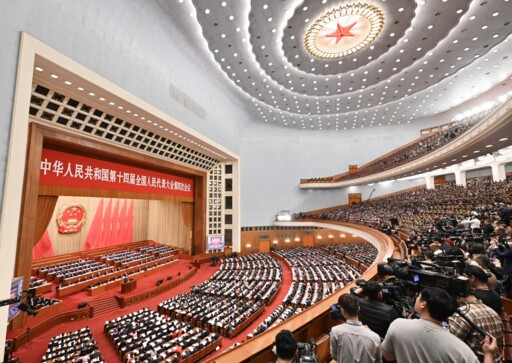
The 14th National People’s Congress opens its fourth session at the Great Hall of the People in Beijing on March 5, 2026. Photo: Duan Danjie/CSST
On March 5, the fourth session of the 14th National People’s Congress (NPC) opened at the Great Hall of the People in Beijing, with Xi Jinping, general secretary of the CPC Central Committee, and other state leaders seated at the rostrum. On behalf of the State Council, Premier Li Qiang delivered the government work report, which reviewed the major achievements made in 2025 and throughout the 14th Five-Year Plan period (FYP, 2021–25), outlined the main objectives and major tasks for the 15th Five-Year Plan period (2026–30), and set out plans for economic and social development as well as government work in 2026.
NPC deputies and members of the National Committee of the Chinese People’s Political Consultative Conference (CPPCC) from the philosophy and social sciences community listened attentively to the report, while universities and research institutions across China promptly organized study sessions through the internet, television, and other channels. In interviews with CSST, scholars expressed their commitment to, under the leadership of the CPC Central Committee with Comrade Xi Jinping at its core, fully implement the requirements set out in the government work report. They pledged to produce high-quality academic outputs and think tank recommendations in their respective research fields, providing robust intellectual support and strong spiritual impetus for a successful start to the 15th FYP period.
Chinese modernization advances with new strides
The year 2025 was an extraordinary one. During the year, the fourth plenary session of the 20th CPC Central Committee was successfully convened, a solemn ceremony commemorating the 80th anniversary of the Chinese People’s War of Resistance Against Japanese Aggression and the World Anti-Fascist War was held, the main economic and social development targets and tasks for the year were fulfilled, the 14th FYP concluded successfully, and Chinese modernization made solid new strides.
The government work report introduced 20 main indicators detailed in a draft outline of the 15th FYP for national economic and social development. It also elaborated on major strategic tasks across different sectors during the 15th FYP period, highlighting four priorities: promoting high-quality development, strengthening domestic economic circulation, advancing common prosperity for all, and balancing development with security.
To ensure the implementation of the objectives and tasks for the 15th FYP, the draft outline proposes 109 major projects across six areas, selected with consideration for strategic significance, driving capacity, and policy continuity. Hong Xianghua, a professor at the Party School of the CPC Central Committee (National Academy of Governance), noted that uncertainties may increase during the 15th FYP period. Nevertheless, Hong emphasized that China’s economic fundamentals remain stable, with immense potential and strong resilience. The country also enjoys institutional advantages under socialism with Chinese characteristics, a vast domestic market, a comprehensive industrial system, and abundant talent resources. By fully leveraging these strengths, he said, the blueprint for the 15th FYP will certainly be realized.
Fang Lan, an NPC deputy and a professor at Shaanxi Normal University, highlighted that the 15th FYP period requires a cumulative 17% reduction in carbon dioxide emissions per unit of GDP. She noted that the state is increasing investment while placing strong emphasis on food and energy production—areas that have long been central to her research. Fang suggested translating these policy priorities into concrete research initiatives, making full use of the strengths of university think tanks and academic disciplines to deliver high-quality research that supports the country’s future development.
Gan Chunhui, executive vice president of the Shanghai Academy of Social Sciences, predicted that in the coming year and throughout the 15th FYP period, China’s development will exhibit three key characteristics: the coordinated evolution of sustained economic resilience and innovation-driven growth, a dynamic balance between the systematic advancement of reform and opening up and the coordination of security and development, and a virtuous cycle in which green transformation and improvements in people’s livelihoods reinforce one another.
Greater focus on improving people’s wellbeing
Listening to the report on-site, Zheng Gongcheng, an NPC deputy and a professor at Renmin University of China, said he was particularly struck by the emphasis on combining sustained economic growth with an organic integration of “investment in physical assets” and “investment in human capital.” He noted that the signals for strengthening and improving the social security system are especially clear.
“It can be expected that, as we enter the 15th FYP period, China’s coordinated economic and social development will reach a new realm. This realm will undoubtedly advance toward continuously meeting the people’s needs for a better life and steadfastly promoting common prosperity for all,” Zheng stated confidently.
On March 5, Shen Danyang, head of the government work report drafting team and director of the State Council Research Office, announced at a State Council Information Office press briefing that China’s economic growth target for the year is set within a range of 4.5%–5%. Yu Miaojie, an NPC deputy and president of Liaoning University, described the use of a target range as a pragmatic approach. High-quality development, he noted, should not be understood simply in terms of economic growth but must also encompass improvements in people’s livelihoods and other dimensions of development.
Among the 10 key tasks identified in this year’s government work agenda, two concern coordinated urban-rural and regional development: making solid progress in all-round rural revitalization and advancing new urbanization alongside coordinated regional development. As a scholar long dedicated to issues concerning agriculture, rural areas, and farmers, Wei Houkai, an NPC deputy and a Member of the Chinese Academy of Social Sciences (CASS), explained that promoting coordinated urban-rural and regional development represents a crucial step toward advancing common prosperity. The report proposes pragmatic measures such as improving the effectiveness of policies designed to strengthen agriculture, benefit farmers, and enrich rural areas, as well as building a regional economic landscape that leverages comparative advantages to foster high-quality development. These arrangements, Wei said, align precisely with the strategic needs of national development and resonate with the aspirations of the people.
Upon hearing the report’s call to advance people-centered new urbanization—particularly the directive to grant urban residency to rural migrant populations in a scientific and orderly manner—Du Haifeng, a CPPCC member and a professor from the School of Public Policy and Administration at Xi’an Jiaotong University, said the report has further strengthened his research group’s determination to continue working deeply in this field, and, through more systematic and in-depth research, better serve major national strategies. At the same time, new measures proposed in the report—such as easing eligibility requirements for rural migrant students to register for the senior high school entrance examination in their places of residence according to local conditions—also raise new research questions and open new avenues for related studies.
Cheng Jianping, a CPPCC member and Party secretary of Beijing Normal University, remarked that the higher education sector will fully implement the requirements set out in the government work report and proactively contribute to the broader effort of building a strong education system. In alignment with the development goals and tasks of the 15th FYP period, the university will systematically advance reforms and innovation in teacher education, continuously supplying high-quality and specialized teaching talent to support the development of a strong national education system.
The significant emphasis on artificial intelligence (AI) in the government work report also presents major governance issues that need urgent attention from scholars in philosophy and the social sciences. Liu Ning, a CPPCC member and a research fellow from the Institute of Literature at CASS, believes that the application of AI in primary and secondary education should not be expanded without limits or conditions. The promotion of technology must be paced appropriately and implemented prudently.
Xu Ling, a CPPCC member and vice president of Guangdong Polytechnic Normal University, noted that AI is not only transforming modes of production and everyday life but will also profoundly reshape the workforce’s skill structure. She recommended establishing a public platform to enhance AI literacy and support workforce reskilling, providing systematic digital skills training for a wide range of industrial workers. Such efforts would enable more workers to adapt to employment demands under new technological conditions, promoting coordinated development between the workforce and industrial upgrading.
Serving overall national development
The government work report calls for further developing philosophy and the social sciences. Accordingly, scholars across the field have expressed their commitment to aligning their research more closely with the great practice of Chinese modernization. By deepening fundamental theoretical research and strengthening applied policy studies, they aim to better fulfill the role of philosophy and the social sciences as the nation’s “think tank” and “brain trust” during the 15th FYP period.
Ma Yide, an NPC deputy and dean of the School of Intellectual Property at the University of Chinese Academy of Sciences, discussed the need for in-depth research on how institutional innovation can translate policy dividends into tangible development momentum. As a new type of production factor, data raises a range of frontier issues in national and global governance, including defining property rights, establishing circulation rules, and protecting the rights associated with AI-generated content. The regulatory system suited to the digital economy urgently requires improvement. Related research, Ma suggested, should actively provide theoretical support for building an independent Chinese intellectual property and data governance framework suited to the digital era.
Yu also noted that greater emphasis should be placed during the 15th FYP period on constructing an independent Chinese knowledge system for economics. This effort requires a deeper exploration of the socialist attributes of China’s market economy—from a focus on economic growth to equal attention to structural optimization and equitable distribution; from simply “making the pie bigger” to ensuring the pie both grows and is shared fairly; and from prioritizing investment in physical assets alone to combining investment in both physical and human capital. Ultimately, he argued, such efforts will realize the value principle of putting the people first.
The government work report also stressed the importance of adjusting academic disciplines and majors, launching a new round of the “double first-class” initiative to cultivate world-class universities and disciplines by the mid-21st century, establishing national interdisciplinary research centers, and strengthening the independent cultivation of top-tier innovative talent. Regarding these measures, Wang Canlong, a CPPCC member and a research fellow from the Institute of Linguistics at CASS, remarked that “this is an issue that requires consideration for the further flourishing and development of philosophy and social sciences.” With the rapid advancement of AI, big data, and information technology, he added, philosophy and the social sciences should deepen collaboration with the natural sciences through greater integration and innovation, thereby better serving Chinese modernization and the broader cause of national rejuvenation.
Across the interviews, scholars generally agreed that advancing philosophy and the social sciences requires researchers to remain both problem-oriented and practice-driven. By closely integrating theoretical innovation with practical exploration, research outcomes should genuinely serve and benefit the people, achieving unity between policy responsiveness, governance precision, and scholarly depth.
Lu Hang, Zha Jianguo, Li Yongjie, Zhao Xuzhou, and Chen Lian contributed to this story.
Editor:Yu Hui
Copyright©2023 CSSN All Rights Reserved