


Theoretical research to continue bolstering Chinese modernization during 15th FYP
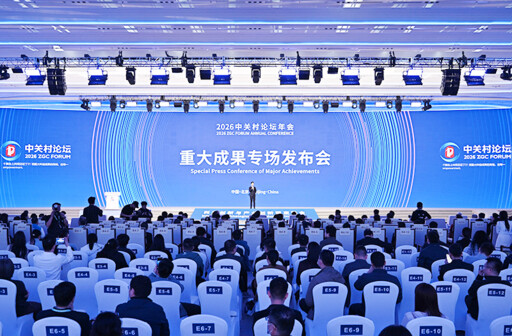
From Mar. 25 to 29, the 2026 Zhongguancun (ZGC) Forum Annual Conference, themed “Integrate Technological and Industrial Innovation,” was held in Beijing. During the conference, 21 major scientific and technological achievements were announced. Photo: IC PHOTO
With the release and implementation of the outline of the 15th Five-Year Plan (FYP, 2026–30), China has entered a critical period for consolidating the foundations and building comprehensive momentum toward the basic realization of socialist modernization. This new phase creates significant opportunities for research in philosophy and the social sciences, while also placing greater demands on theorists to address a series of major questions related to advancing Chinese modernization. To explore these issues, CSST interviewed several leading scholars in the field, who reviewed progress over the past five years and discussed key priorities and the role of the social sciences during the 15th FYP period.
Scaling new heights in research
Lin Jianhua, Party secretary of the National Academy of Chinese Modernization (NACM) at the Chinese Academy of Social Sciences (CASS), noted that deepening theoretical research on Chinese modernization is closely intertwined with the ongoing practice and process of comprehensively advancing Chinese modernization. Over the past five years, the academic community has produced a steady stream of original theoretical outcomes, providing a strong intellectual foundation and theoretical support for promoting economic restructuring, addressing social development challenges, and fostering a new form of human civilization.
Zhang Guanzi, director of the NACM, highlighted the urgent need to construct a theoretical framework and practical pathway for modernization aligned with China’s national conditions as the country enters a new stage of development. Since its establishment, the NACM has systematically examined the historical context, comparative pathways, practical experiences, and policy recommendations of Chinese modernization. To date, it has produced a series of representative works, including the Chinese Modernization Development Report and the World Modernization Development Report, further establishing the NACM as a key driver of research on Chinese modernization.
China is gradually establishing a multi-level, strategically oriented research framework for Chinese modernization, remarked Tian Pengying, director of the Institute of Chinese Modernization at Northeastern University. Supported by high-caliber research platforms and grounded in China’s specific realities, this framework is laying a solid academic foundation for the practice of Chinese modernization. At the same time, it addresses the challenges facing humanity amid global transformations, contributing scholarly insights to promote a shared path toward modernization for all nations.
Grounded in practice
Scholars said that during the 15th FYP period they will more keenly capture the practical experiences of Chinese modernization, distilling replicable and scalable Chinese solutions from vibrant primary-level practices through in-depth investigation. Wang Yonggui, a professor from the School of Marxism at Nanjing Normal University, suggested that theoretical studies of regions such as the Beijing–Tianjin–Hebei area, Jiangsu, and Zhejiang could systematically extract the evolutionary characteristics of successful provincial-level modernization efforts in the new era. Such research, he noted, would also prospectively explore differentiated modernization models to reveal the dialectical relationship between top-level national design and local practical exploration in the process of Chinese modernization.
Wang Heng, vice dean of the School of Marxism Studies at Renmin University of China (RUC), observed that original theoretical achievements in Chinese modernization research have not only laid a strong foundation for enhancing national strength comprehensively and advancing national rejuvenation, but have also enriched innovation in global modernization theory.
Reviewing the historical trajectory of the Communist Party of China in leading the people to explore modernization has also become a key focus for scholars. Wang Weiguo, executive dean of the School of Marxism at the University of Chinese Academy of Social Sciences, explained that the academic community has examined the Chinese paradigm of modernization through the historical continuity of revolution, construction, and reform, thereby revealing the intrinsic connection between the institutional advantages of socialism with Chinese characteristics and the path of modernization.
In recent years, scholars have placed greater emphasis on explaining the connotations of Chinese modernization to the world through international academic conferences, journals, and other platforms, promoting the integration of Chinese modernization theory into global academic discourse. Wang Wen, dean of the Chongyang Institute for Financial Studies at RUC, noted that Chinese modernization has effectively broken the monopoly of the notion that “modernization equals Westernization.” By prioritizing people-centered development principles over capital-centered approaches and advocating for peaceful development instead of expansion and plunder, Chinese modernization offers developing countries a new option for maintaining independence while achieving rapid growth. He added that practices such as the Belt and Road Initiative and building a community with a shared future for humanity are helping shift global modernization paradigms from singularity toward diversity and coexistence.
New theoretical growth points
During the 15th FYP period, China’s development environment is expected to undergo profound and complex changes, prompting scholars to more consciously shoulder the mission of deepening theoretical research and contribute to Chinese modernization. Lin suggested that research during this period should focus on China’s historical position and major objectives in economic and social development, as well as strategic tasks and measures across various fields.
Yan Wenbo, a professor from the School of Marxism at Jiangxi Normal University, identified three key areas for future research. First, he emphasized the need to intensify practical research in critical domains, entailing interdisciplinary dialogue on core issues such as new quality productive forces, common prosperity, and national governance. Second, he called for deeper theoretical research on cultural forms to promote cultural expressions with Chinese characteristics and contemporary relevance. Third, he proposed expanding perspectives in civilizational comparison to highlight the universal significance of Chinese modernization in cross-civilizational dialogue.
Editor:Yu Hui
Copyright©2023 CSSN All Rights Reserved