


Emerging disciplines inject vitality into independent knowledge system
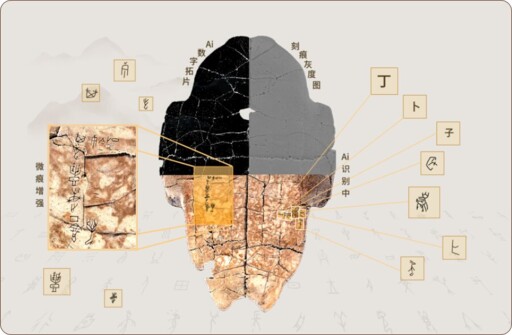
FILE PHOTO: An AI-powered tool for recognizing oracle bone inscriptions, jointly developed by Anyang Normal University in Henan Province, Tencent, and other institutions
On May 17, 2016, General Secretary of the CPC Central Committee Xi Jinping delivered an important speech at the Seminar on Philosophy and Social Sciences, setting forth the ambitious goal of developing philosophy and social sciences with Chinese characteristics. Scholars recently interviewed by CSST said that over the past decade, guided by the spirit of the “May 17” address, China’s philosophy and social sciences community has not only deepened research in foundational theory and traditional disciplines, but also accelerated the development of emerging and interdisciplinary fields with Chinese characteristics, injecting new vitality into the construction of an independent knowledge system for these fields.
Responding to national needs, contemporary changes
Shen Zhuanghai, an expert representative who attended the 2016 seminar and now serves as executive deputy Party secretary of Wuhan University as well as a professor in its School of Marxism, told CSST that over the past decade, China’s discipline system in philosophy and the social sciences has been steadily refined, with emerging and interdisciplinary fields gaining momentum, the quality of talent cultivation continually improving, and landmark achievements emerging regularly. Data released by the Ministry of Education shows that as of June 2025, degree-granting institutions had independently established 5,219 second-level disciplines and 1,017 interdisciplinary fields across 459 universities. In Shen’s view, this reflects the acute insight among higher education institutions and research organizations into shifting knowledge production models, as well as their proactive alignment with the needs of national development strategies.
According to Zhi Zhenfeng, head of the department on Xi Jinping Thought on the Rule of Law at the Institute of Law under the Chinese Academy of Social Sciences, “from first-level disciplines such as studies of the history of the CPC and Party building, national security studies, and area and country studies, to second-level disciplines like intra-Party regulation studies, cyber and information law, computational politics, and gerontology, these emerging and interdisciplinary fields conform closely to the nation’s major strategic needs and the core demands of the times, forming extensive, well-positioned, and strongly supportive growth points for disciplines.”
Zhang Xiaomeng, Party secretary of the Discipline Inspection and Supervision School at Renmin University of China, said the newly established first-level discipline of discipline inspection and supervision studies is grounded in the historical practice of deepening reform of the discipline inspection and supervision system in the new era. It focuses on promoting the construction of an independent knowledge system through signature concepts and original theories. The publication of the “China Series” textbooks, Zhao added, reflects the development of this independent knowledge system into a systematic teaching framework.
Chen Xuguang, a professor from the School of Arts at Peking University, has long been dedicated to emerging fields such as film industry aesthetics, imaginative consumption theory, and cross-media research. In his view, to leverage the role of emerging and interdisciplinary disciplines as new quality productive forces, it is necessary to anchor them in national strategic needs, make forward-looking plans around major themes such as Chinese modernization, digital governance, and mutual learning among civilizations, and break down disciplinary barriers to promote deeper integration. This would allow traditional disciplines, through their intersection with digital technology and social development, to develop original theories that interpret Chinese practice and respond to the questions of the times.
Zhao Yongsheng, director of the French Economic Studies Center at the University of International Business and Economics, is among the earliest Chinese scholars to enter the field of area and country studies. Over the course of his career, he has witnessed its rapid rise into one of the most dynamic emerging disciplines within the system of philosophy and social sciences with Chinese characteristics. In his account, the field has undertaken bold reforms in certain specialties facing research bottlenecks, enabling them to better adaptcontemporary progress in both practical application and methodology.
Technology drives new academic growth points
In recent years, Zhao Yupei, deputy dean of the College of Media and International Culture at Zhejiang University, has frequently collaborated with computational science experts on how algorithmic recommendation can shape new forms of international communication, and with sociologists on the social psychology behind massive public opinion trends. She believes emerging interdisciplinary fields can break down the boundaries separating traditional disciplines, bringing new technologies and multidisciplinary perspectives into philosophy and social science research. This integration, Zhao believes, helps build a knowledge system that is both more distinctively Chinese and better equipped to address real-world issues.
Oracle bone inscriptions are the oldest mature writing system yet discovered in China, but oracle bone studies as a discipline has a history of little more than a century. Driven by strong national support and a broader wave of technological advancement, the field has undergone a paradigm shift. Zhao Xiaolong, an assistant research fellow from the Institute of Ancient History at the Chinese Academy of Social Sciences, emphasized that in recent years, the integration of oracle bone studies with modern science and technology has accelerated significantly. A range of non-destructive techniques has been developed and applied in oracle bone analysis, while emerging technologies such as artificial intelligence are also gradually being incorporated, pushing the field in a more intelligent direction.
Hui Zhibin, director of the Center for Internet Studies at the Shanghai Academy of Social Sciences, leads a pioneering team in the emerging field of “digital economics.” He noted that the rise of digital economics is aimed precisely at addressing new problems that traditional economics struggles to explain, including platform monopolies, data pricing, and algorithmic governance, thereby building an economic paradigm better suited to a digital civilization.
Wang Jin, deputy dean of the College of Foreign Studies at Jinan University, believes that digital and intelligent technologies are empowering the development of emerging disciplines along three dimensions: research methods, knowledge creation, and disciplinary growth. Large language models and big-data analytics have enabled a deeper integration of qualitative and quantitative approaches, improving both research efficiency and objectivity. The construction of multilingual intelligent agents and databases provides factual support for solving practical problems, while the emergence of such interdisciplinary directions as “digital humanities” and “computational social science” is bringing together diverse talent and generating fresh momentum for collaborative innovation.
Editor:Yu Hui
Copyright©2023 CSSN All Rights Reserved