


New cultural trio set to enter new stage of high-quality development
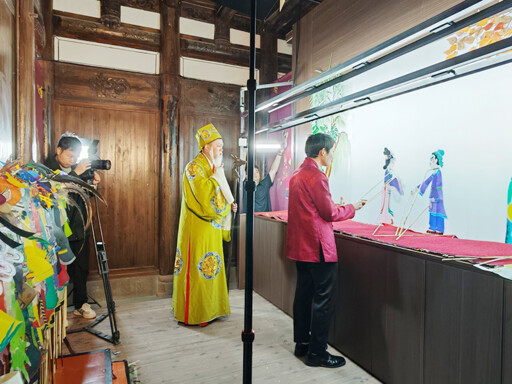
On Mar. 28, 2026, a newly adapted micro-short drama The Story of Dong Yong, using Chinese intangible cultural heritage shadow puppetry as its material medium, officially began filming in Xiaogan City, Hubei Province. Photo: IC PHOTO
With Chinese online literature now reaching more than 350 million overseas users, micro-dramas surpassing 100 billion yuan (approximately $14.66 billion) in total output value, and online games winning international awards, the “new cultural trio”—online literature, web dramas, and video games—has become a new engine of growth for China’s cultural industry and a leading force in bringing Chinese culture to the world. In recent interviews with CSST, several scholars noted that the trio’s strategic positioning, development goals, and governance logic are undergoing a systematic qualitative shift, pointing toward a new stage of high-quality development.
From ‘junior player’ to ‘leading force’
The 2025 China Online Literature Development Research Report, released on April 13, 2026, shows that China’s online literature reading market reached 50.21 billion yuan, up 16.6% year-on-year. The number of authors grew to 32.694 million, an increase of 1.496 million over 2024, while the number of works reached 45.837 million, an increase of 4.186 million from 2024. In 2025, revenue from Chinese online literature’s overseas market reached 5.64 billion yuan, up 11.2% year-on-year, with nearly 200 million active overseas users across more than 200 countries and regions.
The China Online Audiovisual Development Research Report (2026), released on April 15, shows that the market scale of China’s online audiovisual industry reached 1.287661 trillion yuan in 2025. As of December 2025, China had 1.099 billion online audiovisual users.
According to the 2025 China Game Industry Annual Report, released in December 2025, China’s game market generated actual sales revenue of 350.789 billion yuan in 2025, with a total of 683 million users. Self-developed games generated 291.095 billion yuan in domestic sales revenue, while overseas market revenue reached $20.455 billion, demonstrating strong international competitiveness.
For Xiang Yong, director of the Institute for Cultural Industries at Peking University (PKU), the new cultural trio precisely aligns with contemporary audiences’ fragmented, immersive, and highly interactive consumption habits, and has become a significant force in stimulating cultural consumption and promoting employment.
Xu Jinlong, head of the cultural resources institute of the National Research Center of Cultural Industries at Central China Normal University, attributed the systematic development of this industrial ecosystem to the combined efforts of multiple actors, including government, enterprises, and individuals. These efforts, he said, have enabled the trio’s cultural formats to flourish across multiple fronts and develop synergistically.
Even more notable is the leap in content quality. Ten online literary works, including Joy of Life and Douluo Continent, have entered the collections of the British Library. Web dramas such as The Longest Day in Chang’an and An Ancient Love Song interpret historical narratives through Chinese aesthetics. The game Black Myth: Wukong won Best Action Game and Players’ Voice at The Game Awards 2024.
Zhou Kai, director of the creative industry research center at Nanjing University, sees the core competitiveness of the new cultural trio in its precise alignment with the aesthetic expectations of Generation Z worldwide, leveraging lightweight narratives and immersive experiences to transcend language and cultural barriers.
Peng Jian, director of the culture and tourism research base at Communication University of China, observed that the new cultural trio has adopted globally popular genre narratives, weaving a distinct Chinese flavor into familiar formulas such as cultivation progression and revenge plots, thereby turning Eastern aesthetics and the spirit of martial arts into differentiated selling points.
The 14th Five-Year Plan (FYP, 2021–25) period marked a strategic leap in Chinese culture’s “going global.” Xu argued that the new cultural trio has advanced the international reach of Chinese culture through the trifold logic of technological empowerment, content innovation, and global dissemination.
In Xiang’s view, the trio’s success in cross-cultural communication stems from a dual pathway: Precise cultural translation mitigates the “cultural discount,” while deep localization strengthens communication effectiveness by tailoring content themes and distribution channels to the cultural preferences of different regional markets.
Elevated positioning in 15th FYP
The outline of the 15th FYP calls for efforts to “develop new cultural business models such as digital animation, immersive performances, online broadcasting, short videos, and micro-dramas, guide and regulate the healthy development of online literature, online games, and online audiovisual content, and promote the export of high-quality online literature, online games, film and animation, and fine exhibitions.”
Zhou stated that the 15th FYP elevates the positioning of the new cultural trio from “components of the cultural industry” to “strategic pillars for enhancing the global influence of Chinese civilization.” The development path is shifting from scale expansion to quality-led growth, while the overall strategy is transitioning from isolated breakthroughs toward ecosystem coordination.
According to Xiang, the 15th FYP no longer pursues scale expansion alone, but instead emphasizes the integration of cultural and industrial value, as well as the synergy between development speed and quality. This, he said, is an important marker of the new cultural trio’s entry into a new stage of high-quality development.
Zhang Yiwu, a professor from the Department of Chinese Language and Literature at PKU, emphasized that cultural development is an important component of Chinese modernization. The new cultural trio, he said, carries the responsibility of activating society-wide cultural innovation and creativity, fostering mutual empowerment among culture, the economy, and technology, and enhancing the country’s cultural soft power.
Editor:Yu Hui
Copyright©2023 CSSN All Rights Reserved