


A decade of academic paradigm innovation bears fruit
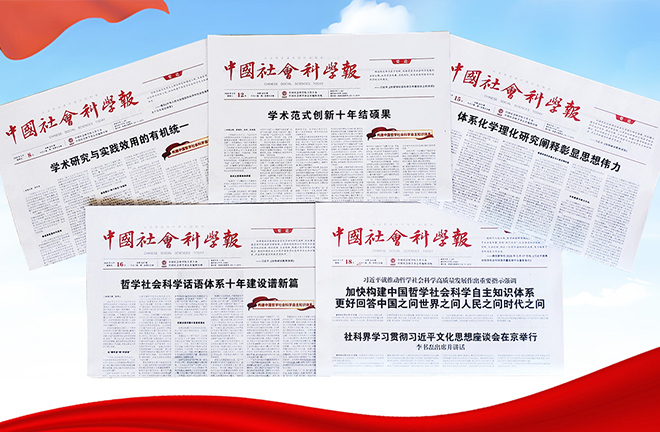
In the context of the 10th anniversary of General Secretary Xi Jinping’s “May 17” speech, CSST recently launched a special column titled “Building an Independent Knowledge System of Chinese Philosophy and Social Sciences,” in which it interviewed scholars from various disciplines within philosophy and the social sciences to showcase the achievements the fields has made over the past decade. Photo: Wang Youran/CSST
Ten years ago, on May 17, General Secretary of the CPC Central Committee Xi Jinping emphasized at the Seminar on Philosophy and Social Sciences that “the life of a theory lies in innovation.” At the time, China was already the world’s second-largest economy, yet the gap between its academic discourse power and its status as a major country left many scholars uneasy. The practice of applying “Western theory” to “Chinese experience” seemed to have settled into a kind of inertia.
A decade later, when CSST journalists visited universities and research institutions, the word they heard most often was no longer “anxiety,” but “consciousness,” a shift that reflects the profound transformation in academic paradigms now steadily advancing across China’s philosophy and social sciences community.
Progress brought by paradigm shift
“If one phrase could summarize the most fundamental change over the past decade, it would be the full awakening of academic self-awareness,” Wu Xiangdong, dean of the School of Philosophy at Beijing Normal University, told CSST.
This awakening is reflected first in a shift toward “problem awareness.” For many years, Chinese sociologists commonly applied Western theoretical frameworks to “fit” Chinese experience. Now, things are changing.
Mi Li, a professor from the School of Public Administration at Central South University, pointed to poverty alleviation as an example. The largest poverty reduction endeavor in human history is almost impossible to explain through Western welfare state theory: China’s poverty alleviation campaign was neither simple economic compensation nor pure administrative mobilization, but a systematic project featuring “targeted measures, tailored policies, and Party secretaries at five levels leading the effort.”
“When you find Western theories inadequate, you must roll up your sleeves to refine concepts and construct frameworks yourself,” Mi remarked.
This “do-it-yourself” effort has crystallized into a series of distinctively Chinese concepts: the Social Operation School, relational sociology, the social governance community, and integrated urban–rural development.
Gu Pengfei, dean of the Faculty of Liberal Arts at Northwest University, summarized the essence of this paradigm innovation with four “Chineses”: identifying “Chinese problems” on the basis of the “Chinese context,” developing “Chinese approaches,” and revealing “Chinese values.”
In Wu’s view, paradigm innovation is not a breakthrough along a single dimension, but a systematic linkage among four elements: a shift toward problem awareness, the reshaping of methodological principles, innovation in conceptual systems, and a transformation in value orientation. “It is not patchwork repair, but a collective, deep academic revolution,” Wu asserted.
Among the paradigm innovations unfolding across various disciplines, the exploration of Chinese classical studies has been especially striking, directly addressing a fundamental question: When we speak of “classical studies,” must the model necessarily be ancient Greece and Rome?
In 2024, “Chinese Classical Studies,” a program proposed by Renmin University of China (RUC), was officially included in the Ministry of Education’s catalog of undergraduate programs, giving China a discipline of “Classical Studies” defined on its own terms.
“Western classics focuses on ancient Greece and Rome, and due to the rupture in cultural inheritance, it lays particular stress on the historical-linguistic examination of parallel texts,” explained Yang Qingzhong, dean of the School of Chinese Classics at RUC. “China, however, is different. Our written language has developed in an unbroken lineage, and the transmission and study of texts span ancient and modern times. If we simply copy the Western model of classical studies, it would actually fracture our own tradition.”
What path, then, is Chinese classical studies taking? Yang summarized it as “grounded in xiaoxue (philology), informed by Sinology, rising to daxue (classics), and culminating in the ‘Second Integration’ [integrating the basic tenets of Marxism into China’s fine traditional culture].” In simpler terms, it takes original texts, classics, and classical scholarship as its core objects of study, emphasizing both the rigorous work of textual exegesis and a comprehensive grasp of Chinese civilization. Ultimately, this approach aligns with the contemporary imperative of integrating the basic tenets of Marxism with China’s fine traditional culture.
This model is already taking shape in talent cultivation at RUC, which has enrolled two cohorts of undergraduates in its Chinese Classical Studies program. Unlike the traditional model of separate training in literature, history, and philosophy, students in the program first strengthen their grounding in philology after enrollment, engage comprehensively and without bias with classics, and then gradually connect their training with the disciplinary paradigms of literature, history, and philosophy. “Students trained this way are not ‘prejudiced’ by disciplinary perspectives from the very beginning,” Yang said.
If the transformation in classical studies is more an intellectual revolution within the study, the paradigm innovation in sociology is a fieldwork revolution moving “from paper to the field.” Mi outlined three core paths of innovation in sociology over the past decade: problem-oriented interdisciplinary integration, data- and intelligence-driven methodological upgrading, and theoretical construction grounded in Chinese practice.
“In the past, many researchers would first look for Western theories, then seek Chinese data to verify them,” Mi observed. “Now it’s the reverse—first immerse oneself in reality, identify problems, and then consider what methods and theories to use to explain them. If the explanation doesn’t fit, we refine our own concepts.” In this way, Chinese sociology has moved from theory application toward theory production.
National longitudinal surveys such as the Chinese Social Survey (CSS) and the Chinese General Social Survey (CGSS) have continued to deepen, accumulating tracking data spanning more than a decade, and in some cases nearly two decades. New methods such as big data, social computing, and digital ethnography are spreading rapidly, while digital sociology and computational sociology have become frontier fields.
The orientation toward solving real problems has also driven changes in the academic evaluation system. Mi noted that in sociology, the results of long-term fieldwork, policy advisory reports, and database construction are gradually being incorporated into evaluation frameworks.
Diverse evaluation system needed
The systemic innovation of academic paradigms is not only reshaping how knowledge is produced in philosophy and social sciences. It is also exerting a profound influence on academic evaluation systems, talent cultivation models, and forms of academic organization.
Qiu Junping, director of the China Association of Science and Education Evaluation at Hangzhou Dianzi University, believes that academic paradigm innovation is pushing academic governance away from outcome measurement and toward a knowledge creation orientation. The inertia of traditional evaluation systems, which have relied excessively on the quantity of papers, journal rankings, and project levels, is being broken. The new paradigm places greater emphasis on original contributions, problem-solving capacity, and social impact, shifting the focus of academic evaluation from static verification of existing achievements to a comprehensive assessment of the process of knowledge innovation and its actual contributions.
Mi added that in talent cultivation, academic paradigm innovation is propelling universities to shift from knowledge transmission to problem solving and innovation generation, with greater attention to fostering students’ sense of national commitment, awareness of local issues, and capacity for interdisciplinary integration. In academic organization, the shift is moving from single-discipline, individualized research toward interdisciplinary collaboration, platform-based organization, and networked cooperation. Integrated “industry-university-research-application” innovation consortia formed around major practical issues are continuing to emerge.
The rapid development of emerging technologies has opened new opportunities for academic paradigm innovation. Qiu emphasized that technologies such as artificial intelligence and big data are moving philosophy and social sciences research from small-sample explanation toward large-scale verification, and from empirical induction toward computation-driven approaches. Methods such as massive text mining, social network analysis, and intelligent simulation are significantly expanding the objects, methods, and boundaries of research.
“AI + Humanities” is not merely a superficial overlay of technology, but a deep transformation in the paradigm of knowledge production. It is pushing the humanities beyond traditional textual interpretation toward an integrated path of interpretation, computation, and verification, giving rise to emerging fields such as computational humanities and digital social sciences. Mi pointed out that “AI + Humanities” will revolutionize research methods, but the core values of the humanities and social sciences—value-based care, meaning interpretation, critical reflection, and theoretical insight—remain central.
Change is never without challenges. When asked about the greatest obstacles currently facing paradigm innovation, several interviewed scholars mentioned the same term: the evaluation system. Qiu stated frankly, “The orientation toward quantity and short-term goals has not yet been fundamentally reversed. Interdisciplinary research faces institutional barriers in resource allocation, outcome recognition, and career development.” He suggested establishing a diverse evaluation system centered on original contributions, academic impact, and social value, while exploring the organic integration of representative work evaluation, long-cycle evaluation, and peer review.
Another issue underscored by several scholars is that within the current academic review mechanism, senior scholars still dominate, and their acceptance of new paradigms and methods varies. “For the younger generation pursuing academic paradigm innovation, there are indeed certain unknown risks,” Gu acknowledged, and to address this challenge, he proposed improving the mechanism for recognizing representative achievements, updating expert databases in a timely manner, and establishing an expert exit mechanism that supports academic innovation.
Optimism about future
Across the interviews, scholars conveyed high expectations for the next decade while maintaining a sober perspective. Wu highlighted the importance of transforming experience-based summaries and practical reflection on major strategic issues into categories and foundational theories with universal explanatory power.
This, however, does not imply self-isolation. “We must engage more openly in global academic dialogue and contribute Chinese intellectual resources to the contemporary development of global academia,” Wu appealed.
Mi summarized her vision for the future in two phrases: “localize problems and globalize theories.” Chinese scholars, she said, should have the courage to distill ideas from China’s vivid experiences that can address universal human concerns.
Gu expressed the hope for an academic ecosystem that encourages even more innovation and allows for greater tolerance of failure: “Paradigm innovation is inherently exploratory. We cannot expect every path to succeed. We must allow space for young scholars to experiment and make mistakes.”
Qiu stressed the need to further deepen academic evaluation reform, break down disciplinary barriers, foster stable interdisciplinary research platforms, and reduce reliance on single metrics.
From “interpreting China through the West” to “interpreting China through China,” from “purely theoretical articles” to “field-based studies,” and from “paper-driven” to “problem-driven,” China’s philosophy and social sciences community is undergoing a paradigm revolution, shifting from knowledge importation to knowledge production. This revolution is far from complete, but the direction is clear, and a consensus has taken shape.
Editor:Yu Hui
Copyright©2023 CSSN All Rights Reserved