


Xi’s directive inspires philosophy, social sciences community
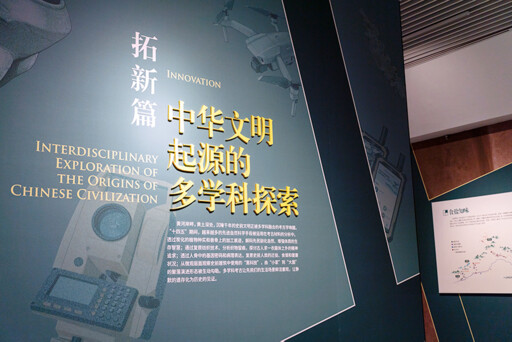
Archaeological work in the new era has been anchored by major initiatives such as the project to trace the origins of Chinese civilization and “Archaeology in China.” The image shows a section of the exhibition “Archaeological Achievements in Tracing the Origins of Chinese Civilization in Shaanxi, Shanxi, and Henan during 2021-2025,” held at the Shaanxi History Museum from February 15 to May 14, 2026. Photo: IC PHOTO
On May 17, General Secretary of the CPC Central Committee Xi Jinping issued an important directive on promoting the high-quality development of philosophy and social sciences, in which he called for speeding up the building of a Chinese knowledge system in philosophy and social sciences, better responding to the questions posed by China, by the world, by the people and by the times, striving for new progress in the high-quality development of philosophy and social sciences, and therefore contributing wisdom and strength to advancing Chinese modernization. The instruction has resonated strongly across China’s academic community. In recent interviews with CSST, scholars from across the field said they would bring stronger resolve and a more pragmatic spirit to advancing philosophy and social sciences in the new era.
Accelerated construction of independent knowledge system
The Chinese Academy of Social Sciences (CASS) promptly communicated Xi’s important instruction on promoting the high-quality development of philosophy and social sciences across the institution and organized study sessions on its key points. Coming on the 10th anniversary of the Seminar on Philosophy and Social Sciences, the renewed directive not only affirms the achievements made by the philosophy and social sciences community since the 18th CPC National Congress, but also sets higher expectations for opening new ground in the field’s high-quality development. As such, it reflects the top leadership’s strong emphasis on, deep concern for, and earnest expectations of philosophy and social sciences.
Since the 18th CPC National Congress, Chinese philosophy and social sciences have entered an unprecedented “golden age of development.” A historic shift has been unfolding—from following and imitation to independent articulation, from theoretical reflection to scholarship rooted in reality, and from disciplinary separation to interdisciplinary integration—rooted in the dynamic practice of Chinese modernization.
Tang Wanghu, vice chairman of the Chongqing Federation of Social Sciences, noted that China’s social science community has drawn on disciplinary perspectives and multidisciplinary methods to analyze a wide range of classic cases. By taking major practical problems as the point of departure for theoretical innovation, scholars have injected vivid Chinese elements and sustained momentum into the construction of an independent knowledge system.
For Zhao Hui, president of the Liaoning Academy of Social Sciences, the construction of an independent knowledge system for Chinese philosophy and social sciences has entered a new stage in which autonomy has become the defining marker, while the endogenous momentum of academic innovation is forming at an accelerated pace.
A review of Chinese academic journals over the past decade reveals a striking change. An increasing number of homegrown, original concepts with distinct Chinese features have begun to supplement Western concepts and theoretical frameworks. Concepts bearing a strong Chinese imprint—such as new quality productive forces, the “Two Integrations” (integrating the basic tenets of Marxism with China’s specific realities and fine traditional culture), whole-process people’s democracy, and the “Two Mountains” theory (lucid waters and lush mountains are invaluable assets)—have entered China’s mainstream academic discourse.
Gan Chunhui, president of the Shanghai Academy of Social Sciences, emphasized that the concept of new quality productive forces breaks out of the traditional theoretical framework of productive forces, forming an original core category that accords with the logic of Chinese modernization. In a similar vein, the analytical framework of an efficient market and a well-functioning government moves beyond the entrenched binary between government and market, offering Chinese insights into the global challenge of balancing state intervention and market dynamics.
Huang Chaochun, Party secretary of the Guizhou Academy of Social Sciences, said the “Two Mountains” theory has corrected the misconception that development and ecology stand in opposition. In practice, it has helped move beyond the old dilemma of “polluting first, treating later.” It is not merely an innovation in development philosophy, he noted, but also a theoretical contribution China has made to global ecological governance.
Chen Yanbo, vice president of Guizhou University, observed that the “Two Integrations” addresses the relations between China and the West, as well as the interplay between ancient and modern civilizations that have preoccupied China’s intellectual community since 1840. At a deeper level, he said, the theory answers foundational questions about the cultural roots of Chinese theory and the autonomous basis of Chinese scholarship.
Adapting Marxist philosophy to the Chinese context and the needs of the times, Chen added, is no longer an abstract proposition. It now engages directly with the underlying logic of contemporary China’s development, bringing theoretical inquiry into the depths of practice. Fine traditional Chinese philosophy, meanwhile, is no longer confined to dusty archives. It is being revitalized, transformed, and reinterpreted as a modern intellectual resource. Emerging interdisciplinary fields—including ethics of technology, ecological philosophy, and civilizational dialogue—are also flourishing, responding to the searching questions raised by technological revolution and social transformation.
Hou Zhenfa, Party secretary of Zhongnan University of Economics and Law, noted that the systematic study and interpretation of Xi Jinping Thought on the Rule of Law, together with research on the legal safeguards for whole-process people’s democracy, are reshaping the core categories of socialist rule of law theory with Chinese characteristics.
Sun Qingwei, president of Northwest University, said archaeological work in the new era has been anchored by major initiatives such as the project to trace the origins of Chinese civilization and “Archaeology in China.” Around pivotal issues such as “what makes China” and the prominent features of Chinese civilization, archaeologists have carried out in-depth research, providing solid empirical support for tracing the origins of Chinese civilization and fostering national identity.
Humanistic economics has emerged as an important category and iconic concept in the development of socialist economic theory with Chinese characteristics, aiming to move beyond the traditional economic assumption of the “rational economic man.” Li Yang, vice president of the Jiangsu Provincial Academy of Social Sciences, told CSST that the academy plans to establish cross-departmental specialized teams and liberal arts laboratories. Through collaboration with local authorities, it will set up policy observation and research sites in order to identify “real problems” through “in-depth investigation.”
Responding to the ‘Four Questions’
The questions posed by China, the world, the people, and the times form the examination paper of the era that philosophy and social sciences must answer. They are also the touchstone by which academic quality is tested. To answer them well, researchers cannot remain in the ivory tower; they must enter the main battlefield of economic and social development.
Liu Weimin, secretary of the Party members’ group and vice chairman of the Shandong Federation of Social Sciences, said researchers must take the initiative to bridge theory and practice. This requires long-term tracking surveys at the primary level, as well as the transformation of academic achievements into actionable policy recommendations and governance capacity that can support high-quality development.
Chen Yunping, secretary of the Party members’ group at the Jiangxi Academy of Social Sciences, identified future-oriented industries such as quantum technology, biomanufacturing, and brain-computer interfaces as strategic fields for answering the “Four Questions.” In his view, China should work to develop a theory of Chinese-style future-oriented industrial development—one that originates in China and contributes to the world—so that Chinese academia can help shape the discourse amid global industrial transformation.
Yao Yuchun, deputy Party secretary of Jilin University, offered a concise formulation: The question posed by China centers on constructing an independent knowledge system grounded in national conditions; the question posed by the world centers on contributing Chinese insights to global challenges; the question posed by the people centers on upholding the people-first principle; and the question posed by the times centers on discerning new trends and taking the initiative in setting the agenda.
Gao Dongxin, secretary of the Party members’ group and president of the Xi’an Academy of Social Sciences, noted that Xi’an is working to build a disciplinary knowledge system with Chinese characteristics and local features, including “ancient capital studies,” “Xi’an studies,” “Silk Road studies,” and “Qinling studies.” The aim is to connect academic research more closely with the city’s cultural heritage and with national strategies.
Zhao Hui stressed that autonomy should not mean rejecting foreign academic achievements. Rather, such achievements should be analyzed, distinguished, criticized, and selectively absorbed, so that emphasis on autonomy does not lead to the neglect of humanity’s shared intellectual resources. Chinese scholars, he suggested, should conduct forward-looking research on strategic issues such as the ecological environment, ethics of technology, demographic shifts, and changes in global governance. By working with experts and scholars around the world on shared problems, Chinese scholarship can contribute to the search for global solutions.
Going forward
Precision in topic selection is the first step toward answering major questions effectively. Qiu Xin, Party secretary of Fudan University, explained the university has distilled 31 key directions for the humanities and social sciences during the 15th Five-Year Plan period (FYP, 2026–30). These priorities bring research on the Party’s innovative theories into step with the construction of an independent knowledge system, place equal emphasis on major theoretical issues and major real-world problems, align the continuation of cultural lineages with digital and intelligent empowerment, and combine rootedness in China with a global perspective. In this way, Qiu said, Fudan aims to help the humanities and social sciences send out “new branches” and bear new fruit from their “old roots.”
An Shi, Party secretary of Central South University, suggested that philosophers and social scientists focus on major national strategies, the needs of the people, and the challenges of the times. From these priorities, they should distill questions with theoretical depth and practical value, identify the point where national needs and individual strengths converge, and root their scholarship in China and among the people.
Xu Jianqun, Party secretary of the Gansu Academy of Social Sciences, argued that social science research should firmly reject the arbitrariness of choosing topics “off the top of one’s head” or simply chasing trends. Academic research, he added, should be more precisely targeted and produce more enduring effects.
He Yalan, president of the Beijing Academy of Social Sciences, proposed that the philosophy and social sciences community should consciously align its research topics with the major theoretical and practical issues in the Chinese modernization drive, focusing on key areas such as high-quality development, megacity governance, cultural inheritance and development, the cultivation of new quality productive forces, and the improvement of livelihood guarantees.
According to Li Yihang, secretary of the Party members’ group and vice chairman of the Guangdong Federation of Social Sciences, Guangdong’s social science community will promote organized scientific research. Under the leadership of distinguished scholars, it will launch a county development investigation team titled “Writing Papers on the Land of Southern Guangdong,” guiding experts and scholars by example to step out of their studies and into the field. It will also lead the drafting of five-year plans for area and country studies in the province, with the aim of building a southern hub for the discipline.
Hou Jufeng, secretary of the Party members’ group of the Xinjiang Uygur Autonomous Region Federation of Social Science Associations, said that during the 15th FYP period, Xinjiang’s social science community will explore new materials, identify new problems, propose new viewpoints, and construct new concepts from the autonomous region’s practice of reform, development, and stability. Through these efforts, it aims to produce a group of landmark achievements characterized by depth of thought, theoretical rigor, and practical warmth.
History shows that eras of great social transformation are correspondingly eras of substantive development for philosophy and social sciences. Contemporary China is undergoing the most extensive and profound social change in its history, while carrying out grand and distinctive practical innovations. This has created powerful momentum and broad space for theoretical creation and academic prosperity. The scholars interviewed agreed that, standing at the new starting point of the 15th FYP, Chinese philosophy and social sciences shoulder the mission of writing a splendid chapter worthy of the era and the people, contributing intellectual strength and academic support to the comprehensive advancement of Chinese modernization.
Duan Danjie, Ban Xiaoyue, Liu Yue, Chen Yajing, Lu Hang, Ming Haiying, Chen Lian, Zha Jianguo, Zhu Yi, Zhao Xuzhou, Zhang Qingli, Wu Nan, Wang Guanglu, Li Yongjie, Zhang Peijun, and Jia Baosheng contributed to this story.
Editor:Yu Hui
Copyright©2023 CSSN All Rights Reserved