


Illuminating the path of human progress with classical wisdom
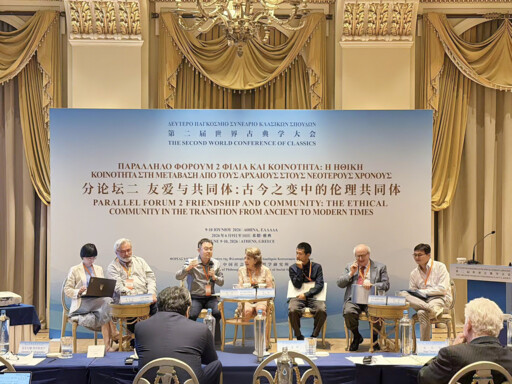
Parallel Forum 2 “Friendship and Community: The Ethical Community in the Transition from Ancient to Modern Times” of the Second World Conference of Classics in Athens, Greece, on June 9, 2026. Photo: Liu Yuwei/CSST
On June 9–10, the Second World Conference of Classics, co-hosted by the Chinese Academy of Social Sciences (CASS), China’s Ministry of Education, the Ministry of Culture and Tourism, Greece’s Ministry of Culture, and the Academy of Athens, was held in Athens, Greece. This marked the second world-class gathering on classical studies co-hosted by China and Greece, following the successful inaugural World Conference of Classics held in Beijing in November 2024.
Themed “Dialogue between Ancient and Modern: Contemporary Inspirations from Classical Wisdom,” the conference featured four parallel forums: “Virtue and Paideia: A Modern Interpretation of Classical Education,” “Friendship and Community: The Ethical Community in the Transition from Ancient to Modern Times,” “Peace and Order: Civilizational Solutions to the Shifting Global Landscape,” and “Technology and Civilization: Humanism in the Age of Digital Intelligence.” More than 200 participants attended, including officials from relevant Chinese and Greek departments, scholars and experts in classical studies and related fields from around the world, diplomatic envoys in Greece, and media representatives.
Participants observed that human civilizations have never developed in isolation, but have grown and flourished through exchange and mutual learning. Amid mounting global uncertainty, humanity is once again looking to classical civilizations for insight and guidance in addressing contemporary challenges. The study of classics has long transcended the confines of any single region, language, or tradition, and is no longer limited to the works of individual thinkers or canonical texts. Instead, it now embraces a broader vision, engaging with all classical civilizations that have produced enduring canonical writings and nurtured virtue and spiritual character. Reflecting this expanded understanding of the field, the conference placed particular emphasis on interdisciplinary dialogue and multi-civilizational exchange. Rather than focusing solely on Eastern and Western traditions, it turned its attention to a wider range of civilizational origins—including ancient Egypt, Mesopotamia, and pre-Columbian Latin America—in an effort to present a fuller picture of humanity’s classical heritage.
Enduring relevance of classics
Mainstream international scholarship generally regards classical studies as a multidisciplinary field encompassing history, archaeology, epigraphy, paleography, religious studies, linguistics, art history, and other domains. Rich in life wisdom, cosmological reflection, and statecraft, the classics have long served as a powerful catalyst for shaping human thought.
In an interview with CSST, Chen Siyi, a tenured associate professor from the Department of Philosophy at Peking University, described classical thought as an “eternal legacy and inexhaustible treasure trove.” In Chinese, the term “gudian” (ancient canons) consists of two core elements: “ancient” and “canonical.” Classical civilization represents the first crystallization of human excellence preserved by history—the primordial expression of each civilization’s lived experience and civilizational ideals. As such, it remains irreplaceable and perennially relevant, serving as the original source of inspiration and the cultural foundation for subsequent innovation and creativity.
Throughout human history, Chen said, every period of groundbreaking intellectual creativity, whether in the East or the West, has been inseparable from a cultural subject’s return to the classics. By drawing upon these ancient resources, adjusting them, and reinventing them, civilizations are able to adapt the wisdom of antiquity to the needs of a new age.
“Although classics is a discipline that studies civilizations of the past, I am not in doubt about its relevance to modern life and the impact it could have in contemporary times,” Hasskei Mohammed Majeed, a professor of philosophy and classics at the University of Ghana, told CSST. “First, the world did not come into existence just yesterday. Human life, experience, and potential have been shaped by a long history which is only visible to those who care to look. There are many cultures today (such as Chinese, Greek, and African [Egyptian]) whose worldviews trace back to ancient wisdom, implying that they are already benefitting from the distant past.”
Valery Petroff, chief research fellow and director of the Centre for Ancient and Mediaeval Philosophy and Science at the Institute of Philosophy under the Russian Academy of Sciences, remarked that the classical tradition has profoundly enriched modern culture. The study of classics, he said, is a vocation that speaks to the very core of human existence; the classics have never grown old, but remain our constant guide. Transcending eras and borders, classical works constitute a shared cultural heritage for all humanity.
According to Hisham El-Leithy, secretary-general of the Supreme Council of Antiquities of Egypt, Chinese, ancient Egyptian, and ancient Greek civilizations stand together as pillars of human history, sharing a deep resonance in their pursuit of order, virtue, and meaning. The canonical texts of antiquity teach us that while empires rise and fall, the truths of human nature, justice, and beauty endure.
Zhang Zhiqiang, director of the Institute of Philosophy at CASS, cited the concept of “friendship” as a prime example. “Friendship is a central theme in classical studies,” he noted, “particularly holding foundational significance for classical dialogue between China and the West.”
While this notion of “friendship” originates primarily from the ancient Greek philosophical tradition, corresponding expressions can also be found within Chinese civilization, including the notions of “ren’ai” (benevolence), “renyi” (humaneness and righteousness), and “dexing” (virtue), Zhang continued. These concepts reflect similar value commitments across different dimensions. Indeed, both Chinese and Western classical traditions share an intrinsic concern for and orientation toward the idea of “community.”
Jenny Strauss Clay, former president of the Society for Classical Studies, a professor of classics emerita at the University of Virginia, and a member of the American Academy of Arts and Sciences, examined the Odyssey and Herodotus’ Histories, highlighting how the Western classical tradition is permeated by inquiry into universal human nature.
Theodoros Papangelis, a member of the Section of Letters and Fine Arts at the Academy of Athens, compared ancient Greek and Roman love poetry with its Chinese counterparts. Western lyric poetry, he observed, tends to emphasize the expression of individual emotion, while Chinese poetry often situates love within broader historical and natural landscapes. Though their modes of expression differ, both traditions converge in their celebration of the beauty of human nature.
Roger T. Ames, a humanities chair professor at Peking University and professor emeritus of philosophy at the University of Hawai’i in the United States, emphasized the need for a force capable of uniting humanity in today’s severely fragmented world. Drawing on the Confucian tradition, he argued that human beings are embedded in family relations from the moment of birth. The family serves as the natural bond of socialization and precedes the individual both logically and temporally. Exploring the role of familial affection in constructing a “minimal morality,” Ames stressed, is a pressing philosophical task.
In an interview with CSST, Gregory Nagy, a member of the American Academy of Arts and Sciences and a professor of comparative literature from the Department of Classics at Harvard University, translated one of Aristotle’s most celebrated formulations concerning the polis as the political carrier of human existence in his own words: “A human [ánthrōpos] is by nature an-organism-of-the-pólis [politikòn z?ion].” In Nagy’s view, the passage—more commonly translated as “Man is a political animal”—means that human beings realize happiness and virtue as their highest potential within a civilized society.
“In his celebrated works, we see a broadening of the very idea of civilization into a model of humanism that is considered by some scholars to be universal,” Nagy added.
Constructing ‘East-West integrated classical studies’
He Fangying, a research fellow from the Institute of Foreign Literature at CASS, stated that following the inaugural World Conference of Classics—and guided by the spirit of President Xi Jinping’s congratulatory letter to that conference—the Chinese classics community is now committed to building a form of classical studies that integrates Eastern and Western traditions. This approach advocates expanding the object of classical studies to include all ancient canonical texts that have played a foundational role in shaping intellectual systems, modes of thought, and spiritual character throughout human history, extending the field to encompass all outstanding civilizational traditions.
She described this “East-West integrated classical studies” as a holistic structure with three dimensions: research oriented toward China’s own civilizational tradition; research on the ancient canons of human civilization as a whole; and the sustained deepening of research into Western classics, represented by the Greco-Roman tradition. Together, He explained, these three dimensions redefine the connotations and extensions of new classical studies, moving the field from the study of a single civilization toward a more open and pluralistic paradigm.
Liu Zuokui, director of the Institute of World History at CASS, observed that contemporary understanding of classical studies “has fundamentally leaped from being closed to open, from singular to pluralistic, and from Eurocentric to one based on civilizational equality.” While the inaugural World Conference of Classics focused on expanding the connotations and extensions of classical studies, Liu noted, the second conference sought to advance from “expanding” to “activating” the field. The core question, he argued, is how classical studies can provide value judgments, intellectual resources, and civilizational solutions for the contemporary world amid global transformations, technological revolutions, and the reshaping of inter-civilizational relations.
In the view of Li Changchun, an associate professor from the Department of Philosophy at Sun Yat-sen University, while discussions on the differences between Chinese and Western civilizations have dominated academia for decades, civilizational self-awareness must be premised on abandoning a “defensive mindset.” In relations between China and the West, he advocates viewing each other as equals. In the interplay between ancient and modern civilizations, Li suggests breaking down barriers between Chinese and Western learning in order to uncover classical wisdom that belongs to all humanity. This implies placing greater emphasis on the commonalities between Chinese and Western classical traditions.
In fact, when examining the reflections of ancient sages such as Confucius, Mencius, Zhuangzi, Socrates, and Plato on questions such as the nature of virtue, whether virtue can be taught, how individuals should live, and what constitutes a good social order, their commonalities far outweigh their differences. “Comparative mutual learning among different classical cultures is essentially a process of understanding the other amidst differences and reflecting on the self through the mirror of the other,” Chen explained metaphorically. In his view, deep engagement with the canonical texts of different civilizations reveals differences, but also points to consensus beneath those differences. One of the missions of classical studies is to foster a pluralistic, comparative view of civilizations rooted in mutual understanding—not one in which one side defeats or replaces the other, but one in which different traditions complement one another and help build a more inclusive human culture.
Having participated in both the inaugural and Second World Conference of Classics, Ames told CSST: “Civilizational dialogues are different from political and economic issues, and geopolitical discourse, which comfort people’s hearts. They enable us to get past and explore communication between cultures by comparing values, fragmenting histories, cultural achievements, and the mutual influences that make us one and many at the same time.”
At the closing ceremony, Liu read out the joint initiative titled “Illuminating the Path of Human Progress with Classical Wisdom.” Li Xinwei, director of the Chinese School of Classical Studies at Athens, announced the launch of the Global Visiting Scholars Program, a new initiative open to teaching and research staff from universities, research institutions, and cultural heritage organizations worldwide that aims to encourage diverse studies of ancient civilizations. The program will promote regularized collaborative research on world classical civilizations, transforming the academic exchanges held during the World Conference of Classics into long-term, sustainable international cooperation.
Editor:Yu Hui
Copyright©2023 CSSN All Rights Reserved