


Building just, equitable global AI governance system
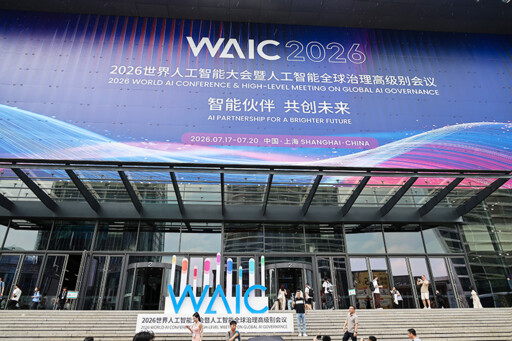
The 2026 World Artificial Intelligence Conference and High-Level Meeting on Global AI Governance was held in Shanghai, China, from July 17 to 20. Photo: IC PHOTO
From July 17 to 20, the 2026 World Artificial Intelligence Conference & High-Level Meeting on Global AI Governance was held in Shanghai. Chinese President Xi Jinping attended the opening ceremony and delivered a keynote address calling for joint efforts to build a just and equitable system for global AI governance. Heads of state, leaders of international organizations, prominent experts from China and abroad, and industry leaders gathered at the event, while over a thousand innovative technology companies showcased their latest products. The signing of an agreement establishing the World Artificial Intelligence Cooperation Organization (WAICO), together with the launch of a series of capacity-building initiatives, reflected the international community’s shared commitment to advancing AI for good and ensuring that its benefits reach all humanity.
Unleashing impetus for development through collaborative innovation
A wide range of applications integrating general-purpose foundation models with specific industries took center stage at the conference. Exhibitors demonstrated a clear shift away from competition over parameter counts toward delivering tangible value in real-world settings. Their displays underscored a growing consensus: AI’s true value lies in its deep integration with the real economy and its capacity to address the common challenges facing humanity.
“AI governance is far more than a matter of technological competition; it is a civilizational proposition bearing on the future trajectory of humanity,” said Shen Yang, a professor at Tsinghua University’s College of AI. In his view, the future of global AI development should not be determined by who erects the greatest number of technological barriers, but by who creates the most collaborative value and builds connections among the greatest number of civilizations.
Ji Weidong, a professor at Shanghai Jiao Tong University (SJTU) and co-chair of the UNU Global AI Network Board, noted that practical measures—including cultivating digital talent, building platforms for cooperation on AI applications, and expanding green computing—could translate the principle of equitable global governance into institutional arrangements that are actionable, replicable, and scalable. Such initiatives would also open up vast new markets for AI applications.
Fortifying secure, controllable defensive line
While the rapid advancement of AI has generated enormous benefits, it has also introduced security challenges including algorithmic discrimination, privacy breaches, and the malicious use of AI-generated images, audio, and video.
“The faster technology evolves, the more we must uphold the principle of beneficial AI; the deeper innovation advances, the firmer the security bottom line we must safeguard,” remarked Jin Li, president of Fudan University and an academician of the Chinese Academy of Sciences (CAS). Countries are now accelerating efforts to legislate and regulate AI, but fragmented and one-sided security narratives risk misaligned governance and may even create friction among different regulatory systems. Jin urged the international community to work through multilateral frameworks, including the United Nations, to develop comprehensive systems of law, monitoring, early warning, and emergency response, ensuring that AI remains under effective human control.
Ding Kuiling, president of SJTU and a CAS academician, called for a proactive response to both the opportunities and challenges created by emerging technologies. He stressed the importance of upholding the philosophy of “people-centric, beneficial AI” while strengthening education in technological ethics and building capacity for risk prevention and control.
Wang Xiao, executive director of the Institute of Embodied Intelligence at Anhui University, emphasized the need to advance legal regulation, policy guidance, application standards, and ethical constraints in a coordinated manner. At the same time, he cautioned against one-size-fits-all regulation that could stifle innovation.
Yu Feng, an associate professor from the Department of Philosophy at East China Normal University, observed that China’s active promotion of open-source AI models offers countries of the Global South inclusive opportunities to lower barriers to technological access, strengthen their digital sovereignty, and build local innovation capacity. However, he added, broadly accepted ethical standards must also be developed within multilateral frameworks.
Bridging digital divide through inclusive, shared progress
Uneven global AI development and inequalities in rulemaking power remain pressing challenges. Lang Ping, director of the Security Studies Division at the Institute of World Economics and Politics under the Chinese Academy of Social Sciences, argued that technological monopolies and blockades not only harm shared global interests but may ultimately backfire on those who impose them. The solution, she said, lies in fostering an equitable and inclusive global AI ecosystem in which every country enjoys an equal right to participate and benefit.
Wen Hong, director of the Research Center of Social Governance at South China University of Technology, proposed tiered global AI governance as a pragmatic and viable approach. Under this framework, universal rules could be established for security baselines, ethical principles, and accountability, while technical standards and data governance systems could remain compatible and mutually recognized. In specific applications, meanwhile, countries’ different stages of development and institutional systems should be fully respected.
Ma Yugang, president of East China Normal University and a CAS academician, underscored the need to accelerate the deep integration of AI into education and help narrow the global gap in AI literacy.
Yang Qingfeng, a professor at Fudan University’s Institute of Technology Ethics for Human Future, outlined three broad proposals China has put forward for global AI development and governance. First, in managing security risks, development and safety should receive equal attention, with sound progress supported by stronger laws, institutions, and ethical codes. Second, in seizing new opportunities, global collaboration should be orchestrated to guide development through human wisdom and international consensus. Third, at the ethical level, extensive international cooperation should help bridge the digital divide and prevent the emergence of new forms of historical inequities.
Given AI’s global ramifications, its governance demands multilateral collaboration and collective efforts. During the conference, representatives from 29 countries signed the agreement establishing WAICO, becoming the organization’s founding members. The agreement marks the creation of a new multilateral platform for global AI governance, laying a solid institutional foundation for structured international collaboration on technical standards, policy alignment, and capacity building.
Gan Chunhui, president of the Shanghai Academy of Social Sciences, suggested that Chinese scholars in philosophy and the social sciences should draw on governance practices from different countries to distill experiences and empirically validated theories with replicable value. He also called for deeper cross-border academic exchange, greater compatibility among governance philosophies rooted in different civilizations, and the gradual formation of a global consensus on AI for good.
Yuan Huajie, Duan Danjie, and Wang Guanglu contributed to this story.
Editor:Yu Hui
Copyright©2026 CSSN All Rights Reserved